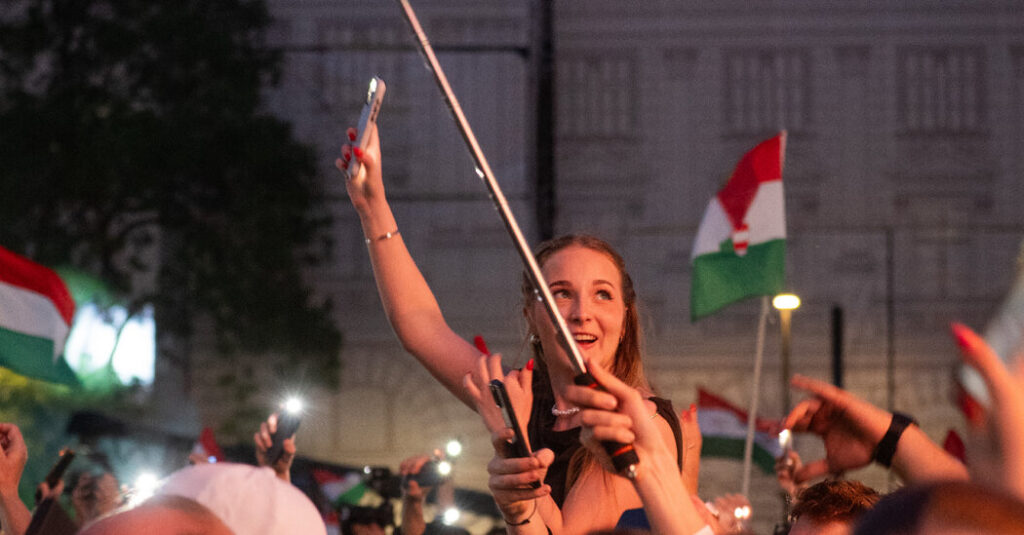
Starting early in the morning on the second Saturday of May, first hundreds and then thousands of people gathered in the square in front of Hungary’s majestic Parliament building to celebrate the start of a new political era. This was the square where tens of thousands gathered in 1956 and 1989 to demand an end to the Soviet occupation and in 2006 to protest a discredited government. It was the square on which Prime Minister Viktor Orban’s regime imposed a major redesign more than a decade ago — with traffic rerouted away, a large reflecting pool and raised beds installed, narrow pathways laid down — apparently to ensure that no such mass gathering could take place again. Today it was the square where Peter Magyar, a former Orban loyalist, would be sworn in, promising a rebirth of democracy and liberty after 16 years of autocratic control.
Squeezing into the available spaces and gradually filling up nearby cafes and streets, the crowd absorbed people of all ages: young people who didn’t remember a time before Orban and who had voted in unprecedented numbers; aging intellectuals who didn’t think they’d ever celebrate their country again; multigenerational families who had arrived by bus after seeing Magyar in their hometowns and villages. During his campaign, Magyar had traveled to an estimated 700 locations, turning many of them into “Tisza islands” — outposts of support for his party. By the end, Magyar was holding five or more rallies a day.
It had looked like an impossible quest. Orban and his cronies dominated the media, persecuted and smeared opposition politicians and changed election laws to benefit his party, Fidesz. Orban had seemed to achieve what the Hungarian sociologist and political theorist Balint Magyar (no relation) calls “autocratic breakthrough” — the point after which it’s impossible to unseat an autocrat using elections. Illiberal politicians from other countries made pilgrimages to Hungary to learn from Orban; CPAC, the gathering for American national conservatives, started staging an annual convention there; and Vice President JD Vance visited Budapest in advance of the election, in a show of support for Orban. And yet Hungarians handed Tisza not just a victory but a constitutional majority, enough power to reverse Orban’s changes to Hungarian laws and institutions. The triumph was stunning — unique in our era of democratic backsliding — and it holds clear lessons for the United States.
One obvious lesson of Peter Magyar’s success lies in the scale, reach and relentlessness of his organizing network. “They had 2,000 Tisza islands with between 30,000 and 50,000 volunteers,” Balint Magyar told me, in evident awe. “Just in their call centers, they had 3,000 to 4,000 people in the last week of the campaign.” We talked two days before the swearing-in ceremony, at his office in the spectacular but largely empty building of Central European University. In 2018, Orban’s government forced most of the university’s operations into exile amid an antisemitic scare campaign focused on the Hungarian American philanthropist George Soros, the C.E.U.’s founder and principal funder. Some of Orban’s many other scare campaigns targeted migrants, “the Brussels elites” and L.G.B.T.Q. people. During the latest election campaign, billboards and A.I.-generated social media posts warned Hungarians they were in danger of being overtaken by Ukraine and only Orban could protect them. It should have seemed absurd — it was absurd — but outlandish xenophobic and antisemitic propaganda had served Orban well for years. It didn’t work against Peter Magyar — probably because so many Hungarians got to see him in person, many of them repeatedly. This is another lesson of his success: Old-fashioned in-person politics can be a powerful antidote to media fearmongering.
In his inaugural speech to Parliament, broadcast on giant screens set up around the square, Peter Magyar said that voters had handed him a mandate “not just to change the government, but to change the system. To start over.”
Magyar enumerated the ways in which Orban had damaged Hungary: a stalled economy in which a third of the population lives in poverty, inadequate health care, low-quality schools, child welfare institutions plagued by abuse, an atmosphere of hatred and fear. Orban’s regime had “stolen from the common good of the Hungarian nation — from the pockets of the Hungarian people, and from the tables of Hungarian children and the elderly,” Magyar said, “an estimated 20 trillion Hungarian forints,” or some $65 billion, over the last decade and a half.
Previous opposition politicians had described Orban’s regime as “corrupt,” a relatively mild term suggesting some aberration from the government’s intended function. Peter Magyar made no such accommodation. Borrowing a term coined by Balint Magyar, he has called it a mafia state — a fundamentally criminal enterprise. Third lesson: Don’t mince words.
Instead of shrinking away from direct confrontation, he fortified himself against it. By getting elected to the European Parliament, in 2024, he secured immunity from prosecution in Hungary. When rumors circulated of an intimate video that would be used to blackmail him, he went on the offensive, accusing Orban of using “Russian-style kompromat” (no video was released). Knowing that he would probably be blocked from registering a new political party, he took over one that had become dormant. Even more important, instead of trying to build coalitions among other parties, he focused on conscripting as many actual people as possible, from across the political spectrum, ultimately building a giant organization capable of taking down Orban’s political monopoly.
One could say — and some have — that Magyar won at least in part because he was a former insider of Orban’s Fidesz party. But my interlocutors in Hungary emphasized that Magyar’s credibility lay in the fact that he was not a member of the old opposition, whose policies had led to the discontent that made Orban’s rise possible and whose timidity had helped perpetuate Orban’s power. That’s a lesson, too: The person best positioned to break the power of Donald Trump would not be an anti-Trump Republican but an outsider to the Democratic establishment, someone who can credibly claim that Trump didn’t happen on his watch — a Graham Platner rather than a Thomas Massie.
For all his tireless work over the last two years, Magyar did not create his political machine from scratch. Like Zohran Mamdani, Magyar excelled at converting potential supporters into campaign volunteers. An existing news distribution service provided an initial skeleton of the organizing network. A panoply of grass-roots protest movements joined, too. On the day of Magyar’s inauguration, a parallel, smaller commemoration organized by the city of Budapest celebrated those organizations. One by one, people took the microphone to give a short speech about their cause and their part in the electoral victory: teachers who had organized against a unified state-dictated curriculum; a young man who spoke up against abuses in the child care system; a high school student persecuted for reciting an anti-Orban poem; organizers of Budapest’s L.G.B.T.Q. Pride celebration. The speakers stayed onstage, gradually forming a crowd of the kind — the many kinds — of ordinary Hungarians who had ended the Orban era.
That’s a fifth lesson: Grass-roots organizations that have little or no connection to electoral politics — in the United States, that might be the networks formed by the No Kings rallies, ICE-resistance groups and so on — can matter as much as or more than those already focused on winning votes.
Another lesson lies in the issues that motivated Magyar’s voters. Hungary’s economy is a mess, but post-election polling by Median, an organization that had predicted election results with uncanny accuracy, shows that voters saw corruption as the most important issue by far. Asked why they thought Orban had lost, 49 percent cited corruption, and only 18 percent thought it was the “worsening economic situation, rising cost of living.” The next three reasons cited were “lies” (15 percent); “fearmongering, war rhetoric” (11 percent); and “people got fed up” (10 percent). In other words, Hungarians seemed to see the damage that Orbanism had done to the nation as more important than any harm they felt they had suffered as individuals. They were united by a sense of moral outrage — “value choices,” as one person close to the incoming government described it to me.
Polls have consistently shown that even Fidesz voters generally want Hungary to stay in the European Union. Some surely just want the ease of travel and residency, but others probably have in mind the loftier ideals of the E.U., such as the rule of law, human rights and the essential purpose of the E.U., which is peace.
Hungary is one of the poorer countries in the union, and in the early years of his regime, Orban was able to use E.U. membership to secure funding, and thereby power, even as he railed against the Brussels bureaucracy. But in 2022, the European Union started withholding funding, citing corruption. And in 2024, after Hungary ignored a European Court of Justice ruling that compelled it to process asylum applications, the court ordered Hungary to pay 200 million euros and imposed a daily fine of 1 million euros. (When Orban refused to pay, Brussels deducted the money from E.U. funds earmarked for Hungary.) These actions didn’t just hurt the Hungarian economy — they also allowed Magyar to draw a causal connection between Orban’s policies and the well-being of ordinary voters. One of his major campaign promises was to unlock E.U. funding.
Hungary joined the European Union in 2004. The E.U. flag — 12 gold stars on a blue background — adorned the facade of the Hungarian Parliament building alongside the nation’s red, white and green standard. But Orban’s politics, like the politics of most autocrats, was the politics of grievance. Under his regime, the E.U. flag was removed and replaced with the flag of the Szekelys, a Hungarian minority that found itself living in Romania when World War I’s victors redrew the region’s borders. Orban’s symbolic gesture helped fan resentment against the E.U. and what he claimed were a new generation of attacks on Hungarian sovereignty.
Peter Magyar scheduled his inauguration for Europe Day — the 76th anniversary of the declaration that created the road map for a united continent. Before he was sworn in, the European flag was raised again. But the Szekely flag remained, signaling that Magyar seeks to represent all Hungarian citizens, including those who supported Orban. In some U.S. coverage, Magyar has been labeled centrist or right-of-center. What his politics actually are — and this is another lesson of his victory — is pluralist.
Peter Magyar’s rise began in February 2024, when he gave an interview to the independent media outlet Partizan. He blasted Orban for corruption and failure to represent Hungarians, but most explosively, for a different issue altogether: covering up the sexual abuse of children in state care. A case involving more than four dozen defendants had made its way through the courts, but Orban apparently instructed his justice department to pardon several of them. Two women who had signed off on them at the time — President Katalin Novak and Justice Minister Judit Varga, who was then Magyar’s wife — ended up resigning. Magyar accused Orban’s regime of hiding “behind women’s skirts.” Remarkably, in nearby Poland, the only other European country to have unseated an autocratic government, a child sexual abuse scandal and a cover-up also appear to have played a significant role. Perhaps this is because such stories can shed a particularly harsh light on networks of power, and the abuses of power. This, too, is a lesson that can prove useful in the United States. Perhaps it already has.
Now, speaking in Parliament, the new Hungarian prime minister offered an extensive and detailed apology to the victims of abuse and those who sought justice on their behalf. And he announced that to reckon with the crimes of the Orban regime, he was submitting legislation to create the National Asset Recovery and Protection Office, which he promised would “be one of the pillars of the 2026 regime change.” Everyone I interviewed in Hungary insisted that regime change would not be complete until a full accounting of the abuses of the Orban regime had occurred and those guilty of crimes were punished — though no one, including the people whose job it will be to ensure that justice is served, seemed to have a clear idea of how this process could be organized. It’s evident, however, that its goal will be not only to satisfy the desire for retribution but also to separate those who became rich through their connections to the Orban regime from the millions of ordinary voters who enabled it — an essential step toward healing a society that has been ruled by politics of hatred, anger and suspicion. There’s a lesson in that, too.
Like many other autocrats and aspiring autocrats — Vladimir Putin, Benjamin Netanyahu, Donald Trump — Orban had been apparently desperate to maintain power because if he lost his office, he could face criminal charges. For this reason, even as Peter Magyar surged in the polls, and even on Election Day, as early returns pointed to Tisza’s overwhelming victory, many Hungarians assumed Orban would find a way to cling to power. Would he refuse to acknowledge election results? Would he declare martial law? But even after he authorized lump-sum payments of six months’ salary to members of the uniformed services, military personnel were said to overwhelmingly favor regime change. Orban must have known he could not count on them.
He stepped down from Parliament after the election, and on inauguration day he wasn’t in the building. Neither were several of the most prominent members of Fidesz, the party he still leads, which won roughly a fourth of the seats in the legislature. President Tamas Sulyok, an Orban loyalist, was there, however. Before Magyar took his oath of office, Sulyok delivered an anodyne speech about the importance of rule of law and constitutional order.
Magyar refused to play along. “It is ironic to hear him speak of the rule of law now, after two years of silence,” he said. “Mr. President, you remained silent when the failed prime minister called half the country” — those who opposed him — “‘insects to be exterminated.’ You expressed no concern when the secret services were sent after the largest opposition party. You failed to speak up when billions in public funds were used to spread war hatred among Hungarians, including among our children. After so much cowardice and turning a blind eye, how could you represent the unity of this nation? You cannot. It is time to leave with your head held high while you still have the chance.”
Hungarians think of themselves as a polite and reserved people. They arrive on time. They observe decorum. They refrain from confrontation. On election night, however, they had shocked themselves by dancing in the streets, chanting “It’s over!” And now their new prime minister was shocking them again. Inside Parliament there was silence, but the thousands of people watching the speech on the outdoor screens broke out in screams and applause. And when the camera cut to Sulyok, his face frozen in an uncomfortable half-smile, the crowd let out a round of boos that could probably be heard on the other side of the Danube.
Earlier that morning, Magyar and Agnes Forsthoffer, the new speaker of Parliament, had laid wreaths at the statue of Attila Jozsef, an early-20th-century poet whose poem “By the Danube” is a hymn to Hungarian diversity. It ends with this stanza, understood as a call for settling differences:
The battle which our ancestors once fought Through recollection is resolved in peace, And settling at long last the price of thought, This is our task, and none too short its lease.
Most of Jozsef’s poetry is considered so complex as to be untranslatable. And so, when the new political leaders laid flowers at his statue to the accompaniment of a Mozart clarinet concerto, they were projecting a new-old attitude toward high culture.
Here is another lesson of Magyar’s victory: His politics are aspirational and inspirational, a tone that is an antidote to the cynicism and vulgarity of autocracy. It is the opposite of, say, the approach taken by California’s governor, Gavin Newsom, who trolls Trump by trying to outperform him in the debasement of political language and political life. Speaking in the Parliament building, which Magyar called “the most beautiful building in the world” — and it may well be — he was proclaiming a new era of beauty and love. Forsthoffer had used the word “love” four times in her own brief speech.
As Magyar wrapped up his speech to Parliament, he announced that he had invited an ensemble of Roma children to perform. The person I was standing with — Zsofia Ban, one of Hungary’s most celebrated authors, and a person so unaccustomed to participating in exuberant displays of optimism that she told me it felt like cross-dressing — teared up. Nothing like this had ever happened in Parliament before. The Roma people constitute about 8 percent of the Hungarian population, making them one of Hungary’s largest minority groups — and, arguably, the poorest and most often discriminated against. Magyar had spoken extensively about the plight of Roma children, which he seemed to learn about on the campaign trail.
A dozen and a half preteen boys wearing white shirts and black bow ties played tamburas and sang a song considered an anthem of Hungarian Roma people, followed by a Hungarian folk song. Several newly elected members of Parliament wept openly. But members elected from the far-right Our Homeland party had left the chamber in protest. The deputy leader of this faction, Dora Duro, had once held a news conference to physically rip up one of Ban’s children’s books, which she labeled “homosexual propaganda.” It had been very good for book sales, but I know what it’s like to be denounced by people in your own country. I asked Ban how she felt knowing that Duro was still a member of Parliament. “They have lost,” she responded.
When Magyar emerged from the building to address the assembled crowd, he offered his own lesson of his impossible victory. “Against a machine of power,” he said, “we don’t need another machine of power, but real people who — going from mailbox to mailbox, house to house, in the cold, the frost and the rain — are capable of anything for their homeland, their neighbors, their relatives and their community.”
The next task was “to rediscover how to see ourselves as a community once again,” he said. “Therefore, I ask you to turn toward those compatriots who are disappointed today, who are afraid, or who experience this period as a loss. Do not try to defeat them; do not look down on them. Listen to them and talk to them. Tell them that this country belongs to them, too; that they are needed, just as everyone is needed; and that together, we will rebuild Hungary, because there is no left, there is no right — only Hungarians.”
One of the secrets of Peter Magyar’s success, Balint Magyar had told me, lay in reclaiming the symbols of the nation: the flag, the national anthem, the very idea of Hungarian-ness. Now Peter Magyar was watching over an elaborate national performance: the raising of the flag, soldiers goose-stepping, cavalry in ornate uniforms.
And then the pageantry was over, but Magyar was still separated from the crowd by large expanses of empty space, the distance that Orban’s government had so carefully engineered. Magyar started motioning to the crowd: Come closer, come closer — but people were already pressed up against the edge of the reflecting pool. After a few moments, the excitement and the desire to be fully a part of this historic moment became too much to resist. Some men hiked up their pants and ran across the reflecting pool — which, it turned out, was just a couple of inches deep. Almost immediately, hundreds more followed. They ran splashing through the water and onto the other side, filling the space from which they had so long been excluded. “This is your house now!” Magyar exclaimed.
Everyone I interviewed on this trip to Budapest believes in this new era. Academics believe that they will be free to teach again. Young people believe that they will be the first generation in years for whom staying in Hungary is a desirable option. Civil society activists believe that they will be able to stop fighting for their own survival and focus on helping the people they want to help. Marta Pardavi, co-chair of the only organization in Hungary that provides free legal representation for people seeking asylum, was even hopeful — despite the absence of any such promises — that the new government would resume accepting asylum applications.
Experts I talked to outside of Hungary are more skeptical, concerned about the “blood and soil” notes they had heard in Magyar’s speeches, sure that his focus on the plight of the Roma people was just a calculated overture toward Brussels, made in hopes of unlocking E.U. funds. On the other hand, isn’t that what the European government is for — to encourage and enforce humanistic values? It’s too early to say anything about Magyar’s policies, but his cabinet choices seem consistent with the inclusive spirit of his campaign, politically and socially.
Magyar finished speaking, ceding the stage to Ibolya Olah, a pop star who is ethnically Roma and openly lesbian. She performed “Magyarorszag” (“Hungary”), a ballad that she had not performed in many years because, she had said, its patriotic sentiment had lost its meaning.
Ban, a friend of hers and I sat down at a cafe and ordered Aperol spritzes. “To the first day of democracy,” Ban said, and we clinked our glasses. The owner of the cafe, who recognized Ban, brought us cream-filled muffins. Ban danced in her chair along to Queen’s “We Are the Champions.” I asked her how she felt about placing her hopes in a politician who had come from the right wing, had seemingly never said a word in defense of immigrants and had barely spoken up for the rights of L.G.B.T.Q. people. Could he be a wolf in revolutionary clothing?
“Maybe he is,” she said, smiling broadly. “Maybe he is.”
And then we danced our way through the square to the Icona Pop song with the refrain, “I don’t care, I love it.” People of all ages were dancing in a conga line, taking their hands off one another’s shoulders to high-five us. The party in the square continued into the next day.
The Times is committed to publishing a diversity of letters to the editor. We’d like to hear what you think about this or any of our articles. Here are some tips. And here’s our email: [email protected].
Follow the New York Times Opinion section on Facebook, Instagram, TikTok, Bluesky, WhatsApp and Threads.
Máté Bartha is a photographer and filmmaker based in Budapest.
The post This Is the Formula That Defeated Orban. It Would Defeat Trump, Too. appeared first on New York Times.