U.S. officials are closing in on an agreement with Iran that could lead to the reopening of the Strait of Hormuz while the two countries negotiate President Trump’s demands for an end to Iran’s nuclear program, according to three U.S. officials with knowledge of the discussions.
The emerging “memorandum of understanding” still needs approval from President Trump, and Iran has not yet confirmed any commitments.
Should it come together, the development would offer Mr. Trump a way out of a war that has pushed up gas prices and grown deeply unpopular at home. It would also create a structure for Iran to regain access to its own assets provided it complies with U.S. demands. And Iran would eventually have a pathway to get billions of dollars in oil revenue flowing again at a moment when its economy is on the precipice.
Along the way, the agreement would extend the existing “cease-fire,” which has shown signs of cracking in recent days as the United States has conducted what it calls “defensive strikes” on missile and drone bases that threaten American ships and planes, and the Iranians have retaliated.
White House officials provided only a vague outline of what the negotiating teams had agreed to — at least preliminarily. But under the framework, the Iranians would see economic relief phased in as progress is made in the negotiations and a substantive deal is reached.
Mr. Trump and his aides have said a key to any deal would be that Iran disavows any intention of acquiring a nuclear weapon. Iran has made that promise many times before, including in the opening paragraphs of the 2015 agreement it made with Obama administration. The Trump team is also insisting on the Iranians agreeing to dispose of their near-bomb-grade uranium, two of the officials said. Experts say that Iran’s current stockpile of uranium enriched to 60 percent — just below bomb grade — could be turned into the fuel for 11 or 12 bombs fairly quickly.
But the method of how the fuel would be recovered from the rubble of a June 2025 air attack by the United States, and whether it would be shipped out of the country or neutralized, would be deferred to later negotiations. That would leave it inside Iran for months and maybe far longer — along with another 10 or more tons of nuclear fuel enriched to lower levels.
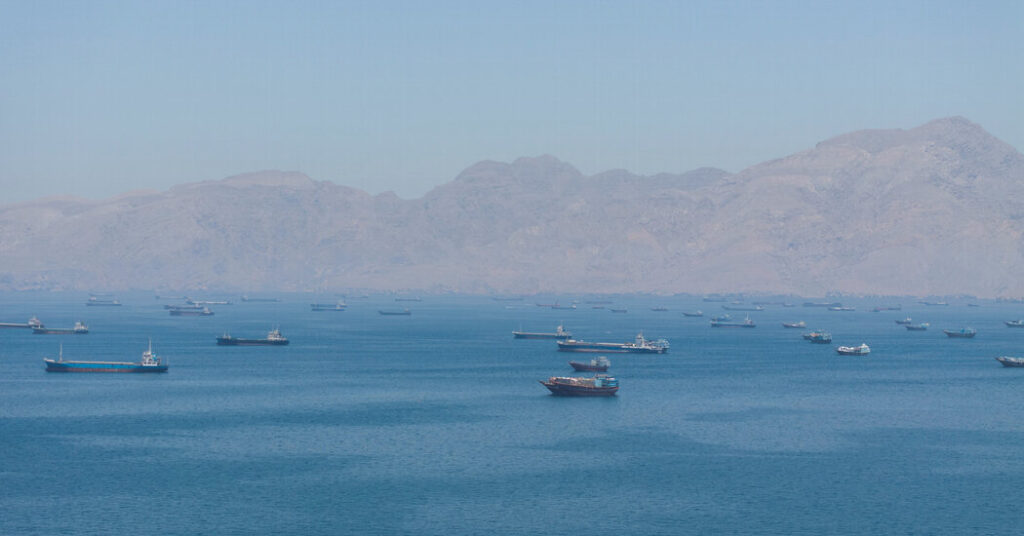
Under the U.S. understanding of the memorandum, the Strait of Hormuz would reopen immediately, one of the officials said, but the U.S. military blockade there would stay in place. The blockade would be reduced in proportion to how much prewar ship traffic is restored by Iran, the official added. The idea is to incentivize Iran to quickly remove mines that it laid throughout the strait and allow U.S. officials to assess whether the waterway is safer to cross.
The three officials were not authorized to speak publicly, and all were granted anonymity to discuss the American view of the current talks.
It is not clear that all the parties are working from the same draft agreement, one diplomat involved in the process said. And leaders on both sides are managing their own domestic audiences and dealing with hard-liners who are working hard to undermine any potential deal.
Communications between the sides have been frustratingly slow, U.S. officials said, because senior Iranian officials are communicating via couriers and the ayatollah is in hiding. One U.S. official conceded that this was understandable given that the Americans and Israelis have interrupted both previous rounds of negotiations with bombing campaign.
If an agreement works out, it could essentially return the United States and Iran to the status quo before Feb. 28, when the United States and Israel, acting in concert, began 38 days of bombing, followed by seven weeks of cease-fire. The two sides had spent several months over the past year debating the future of Iran’s nuclear and missile programs. U.S. officials initially expressed optimism about a deal and then, months later, said that Iranian officials were insincere and simply trying to stave off military actions.
The U.S. views nearly every economic lever it can possibly use against Iran as a way to force the negotiations forward, one of the officials said. But Iran has been a uniquely difficult adversary for the Trump administration — one willing to face immense hardship and commit violence against its own people rather than give in to the United States.
Even if the preliminary framework is agreed upon, experts say it could take a month or more to get traffic moving again through the strait. And the Iranians have insisted before that they will not surrender their newfound powers to regulate and tax the traffic.
Mr. Trump has told advisers he will not sign off on any deal in which the United States can be said to be giving direct cash payments to Iran. One U.S. official described this as a “public relations” challenge, acknowledging that some form of financial relief would be required for Iran. Mr. Trump has attacked President Barack Obama for years over sending “pallets of cash” to Iran to settle a decades-old financial dispute, timed after Mr. Obama’s 2015 nuclear deal.
Given that political reality, Mr. Trump’s team has been developing ideas that would involve other countries, including the Qataris, releasing funds to the Iranians — so that the U.S. could say it did not replenish the coffers of Iran’s regime. But it is not clear whether that political sleight-of-hand would quiet the many critics who are already noting that while Mr. Obama shipped $1.7 billion to Iran, Mr. Trump is looking at potentially unfreezing many times that amount.
Mr. Trump and his team have quietly lobbied the Gulf Arab states to underwrite Iran’s postwar reconstruction, contingent on the Iranians agreeing to acceptable terms. The Gulf countries have discussed a $300 billion investment fund to that end, one that the U.S. would not invest in itself. Many expect China also to move in, tightening its relationship with Iran. Because Beijing has ignored oil export sanctions against Iran, around 90 percent of Iran’s oil exports go to China.
Another measure under discussion would ease Iran’s economic strain by lifting the freeze on some Iranian funds held in Qatar, allowing the money to be spent on medicine and feedstock for Tehran. Qatar would then turn those items over to Iran, according to one of the officials.
For days now, Mr. Trump and his aides have been claiming a preliminary agreement was near. Then the administration received word from mediators on Wednesday night that Iran was comfortable with the latest version of the memorandum of understanding, one of the U.S. officials said.
Mr. Trump’s reaction was that he wanted to take a few days to consider it, the official said.
There is no discussion of Iran’s missile program in the current framework. The United States has said it wants to limit the Iranian program in size and scope. The memorandum of understanding also sidesteps all the central questions surrounding Iran’s nuclear activities, leaving them for later negotiations. Key among them is whether Iran will continue to enrich uranium. Mr. Trump long insisted it could not, though he indicated to reporters on Air Force One as he returned from China earlier this month that he was willing to agree to a 20-year suspension on nuclear enrichment by Iran, rather than a permanent ban.
A critical issue — to be negotiated later — is how to dispose of the near-bomb-grade uranium and the 10 other tons of lower-enriched fuel.
There are four broad technical approaches that could be considered.
One would be to ship the material out of Iran altogether — most logically to China or Russia, which as established nuclear powers and allies of Tehran would be the natural recipients, sparing the U.S. from sending fuel to a non-nuclear state. But that possibility may be complicated by Mr. Trump’s public statements that he isn’t comfortable seeing it go to either country.
That could mean the U.S. would take it, despite Iran’s objections. In the Obama-era deal, Russia was the recipient of 97 percent of Iran’s stockpile.
A second would render the uranium effectively unrecoverable while leaving it inside the country, either through vitrification — fusing it into glass — or by burying it deep underground. Both methods make recovery impractical, and vitrification is the approach the United States uses to dispose of its some of own weapons-grade material.
A third would be recovering the material and converting it into fuel rods, to be burned off in a nuclear reactor. But that could be costly and impractical.
The fourth, known as down-blending, would dilute the material with natural uranium, lowering its purity from 60 percent to between 3 and 5 percent. That option is the most easily reversed. If Iran retained its centrifuges, it could re-enrich the diluted stock.
Whatever the method, all three U.S. officials were emphatic that Iran would receive no economic relief until the disposal of the material is settled.
Maggie Haberman is a White House correspondent for The Times, reporting on President Trump.
The post U.S. and Iran Move Toward Agreement to Reopen the Strait of Hormuz appeared first on New York Times.