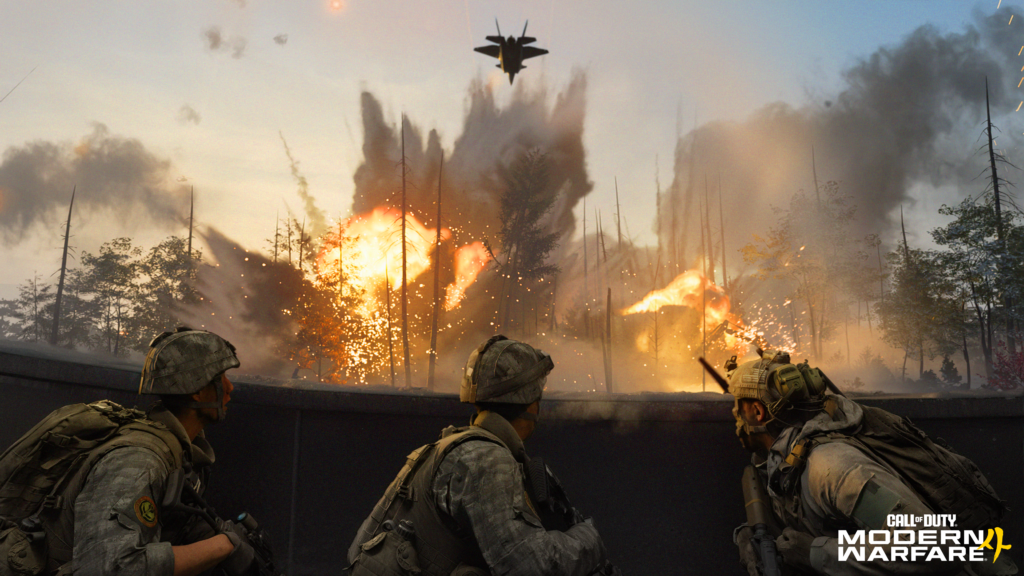
The Call of Duty franchise returns to its boots-on-the-ground roots while exploring the Korean Peninsula, a volatile modern-day flash point for the series’s return to modern warfare.
“Call of Duty: Modern Warfare 4″ will be set against a full-scale invasion of South Korea and is scheduled for release Oct. 23 on all modern gaming platforms including, notably, the Nintendo Switch 2. (The blockbuster franchise has long skipped Nintendo consoles.)
The campaign introduces Private Park, a young Korean soldier thrown into combat for the first time, framed as a classic “zero-to-hero story” against the backdrop of global calamity. The franchise’s most recognizable hero, Capt. John Price, also returns, this time as a rogue agent, picking up the story of the Modern Warfare timeline that began with 2019’s reboot title.
“We were really interested in showing Asia because we haven’t done it before, at least at scale, in Modern Warfare,” said Jack O’Hara, co-head of Infinity Ward, the studio that created the multibillion-dollar series. He said the team decided on the Korean setting almost four years ago. “You’ve got North and South frozen in conflict for many years, but there’s also a large U.S. military presence, and South Korean and U.S. marines are often embedded with each other.”
The last time the series leaned this hard into the anonymous-soldier perspective was the first trilogy of Modern Warfare games beginning in the 2000s, titles that are foundational to the first-person shooter genre today. The games featured shocking, violent moments that O’Hara and co-studio head Mark Grigsby promise will return here.
“We’ve made games that are more about spec ops operators with a CIA handler telling them there’s a guy around the corner,” O’Hara said. “It’s fascinating for us to go back to that perspective of young guys, 18 to 25, and they have no idea what’s going on, receiving an incomplete picture from their orders, and they’re just trying to survive to the next moment.”
O’Hara stressed that the series should feel “ripped from the headlines,” but the game features a fictional North Korean leader, rather than Kim Jong Un or his family.
Infinity Ward said it consulted regional specialists, people who defected from the North and the studio’s own Korean employees. When asked whether the studio is braced for a diplomatic response from Pyongyang (familiar territory for the series), O’Hara was dry about it.
“We’ve had state responses to our games before. We’ll find out what we all think about each other soon enough,” he said.
“Beef” star Young Mazino leads the cast. The game’s trailer opens with Mazino’s character and others patrolling Seoul until combat inevitably breaks out. There are flashes of wide-open battlefields set against the monumental and brutalist architecture of North Korea, resembling the series’s earlier missions in Soviet-era Russia, contrasted with the bright lights and pop aesthetic of Seoul.
Notably, the Call of Duty series has stuck with creating characters and story arcs at a time when many major franchises have abandoned the “campaign” mode. O’Hara said the studio sees single-player modes as load-bearing, not supplementary.
“The campaign forms the DNA of that game,” he said. “There are millions of people that play our campaigns, who enjoy the adventure and the storytelling. Games are a lot stronger when they feel cohesive, when the multiplayer feels like it came from a story.”
“Modern Warfare 4″ arrives at a difficult moment for the series, as players have grown vocal about franchise fatigue. Grigsby, who animated the original Modern Warfare games, left during the studio’s turbulent 2010s and eventually returned, said the team has been listening.
“We hear what the community has said. … We’ve made some adjustments with our systems that I think will satisfy what the community is looking for,” he said.
For millions of players, the multiplayer is the main draw, and Infinity Ward is making its most significant mechanical changes in years. The game will remove “bloom,” the randomized bullet spread visual trick that game developers use to simulate gunfire chaos, while firing guns from the hip. Instead, bullets will exit the gun in the same direction as the visible recoil on screen, rewarding aim over chance.
Movement has been overhauled, with player stances and aim shifting dynamically depending on position, whether against a wall, leaning over a corner or shimmying across ledges in the game’s improved parkour features. Sprint animations will visibly degrade as stamina drains, adding a layer of physical authenticity and visual feedback for the series.
The studio is also introducing Kill Block, a multiplayer map that reconfigures itself between matches using a modular system of interchangeable sections, producing more than 500 possible layouts. It’s inspired by the shifting stadium under construction in Riyadh, Saudi Arabia.
The game will also feature a new version of DMZ, the franchise’s take on the niche “extraction” genre of games that ask players to hunt down gear and exit the game safely or risk all progress. Details of that mode are expected next month.
The post The next Call of Duty imagines a present-day Korean war appeared first on Washington Post.