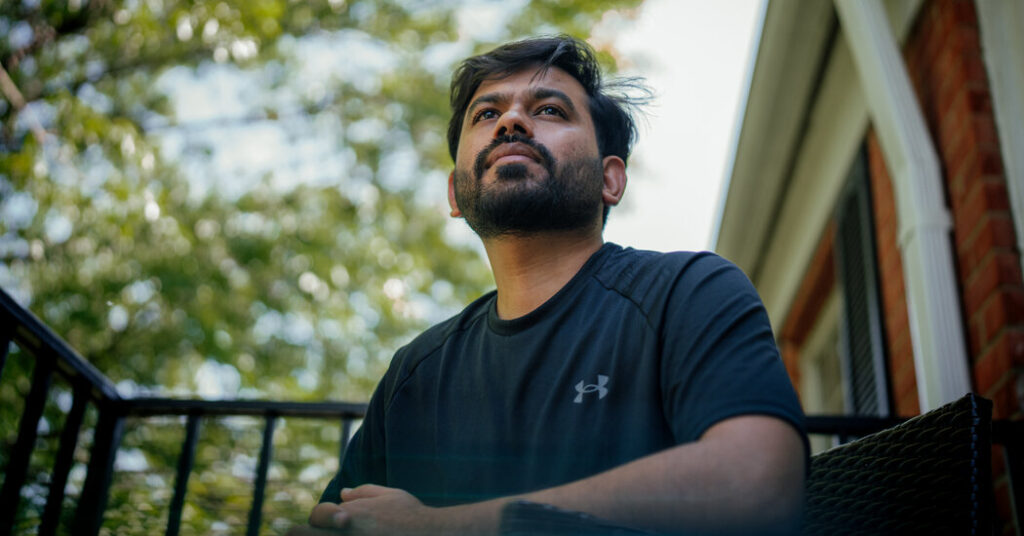
Until a couple of weeks ago, Abhijeet Dipke was one of thousands of Indian students in the United States with a fresh graduate degree in hand, seeking a job. Then, a cockroach changed his life.
It started with a question that Mr. Dipke, a 30-year-old graduate of the public relations program at Boston University, posted on X on May 16: “What if all cockroaches came together?” He was responding to comments a day earlier from India’s chief justice, Surya Kant, who referred to young and unemployed Indians as cockroaches who, failing to secure jobs, end up complaining on social media or becoming activists and criticizing the system.
Encouraged by thousands of replies endorsing his call to action, Mr. Dipke started the “Cockroach Janta Party” — janta means “the public” in Hindi — as a joke, with its own website, built in two hours with help from A.I. and friends. The goal was to create a movement for young people “who keep getting called lazy, chronically online, and — most recently — cockroaches,” the mission statement read. “The rest is satire.”
Tens of millions of young people joined the movement, eager to turn a perceived insult into an emblem of pride. Within days, some of the C.J.P.’s accounts had more social media followers than India’s biggest political parties. But beyond the laughs, the instantaneous embrace of Mr. Dipke’s message tells a bigger story of the bleak mood of many young Indians who are struggling to find jobs, even though the country has been the world’s fastest-growing large economy four years in a row.
C.J.P., which now has more than one million registered members, also seeks to give voice to people who feel overlooked by what they call a corrupt government. “We are here to ask — loudly, repeatedly, in writing — where the money went,” the website reads.
“There is this underlying feeling among them that the current political system just does not care about them, be it the government party or the opposition,” Mr. Dipke, who is currently in the United States, said in an interview.
The rate of unemployment for people aged between 15 and 29 — more than a quarter of India’s population — was roughly 10 percent last year, far higher than the overall unemployment rate of around 3 percent, according to India’s 2025 Periodic Labor Force Survey.
Competition for jobs is fierce in both the private and government sectors. In 2022, 10 million people competed for 35,000 railway jobs, according to the state-owned Indian Railways.
Roopak Yadav, 22, has a bachelor’s degree but is working as a delivery person in Delhi for Swiggy, a popular online platform.
“I am not doing this because I want to, obviously,” Mr. Yadav said.
“Who is getting jobs? No one. We are all going to die as delivery partners.”
For a generation brought up on the story of India’s global promise and hungry for success, the educational system itself can be a letdown.
Just two days before Mr. Kant’s comments, more than two million students who took India’s biggest entrance exam for medical school on May 3 were told those results would be voided, amid allegations of a leak involving exam questions. Those students will have to retake the exam.
Mr. Dipke said disbelief and disappointment at Mr. Kant’s comments drove him to write the X post. In a hearing, the judge had launched into a broadside about “youngsters like cockroaches who don’t get any employment,” some of whom turn to social media and activism and start “attacking everyone.”
Mr. Kant later said it was “totally baseless” to suggest that he criticized the nation’s youth.
Last week, Indian government officials directed X to block the “Cockroach Janta Party” handle, citing a threat to national security, according to Indian media reports. Mr. Dipke created a second handle, “Cockroach is Back,” which remains active. (Under Indian law, social media companies operating in the country must take down content that could pose a risk to national security.)
Mr. Dipke called the move “ridiculous,” but he has appealed to supporters to engage only in peaceful protests. The nascent movement has drawn some comparisons to student revolutions in Bangladesh and Nepal that toppled governments, amid brutal, deadly crackdowns.
He previously volunteered for the Aam Aadmi Party, which campaigns on an anti-corruption platform. That has created ammunition for political rivals, including Prime Minister Narendra Modi’s party, the Bharatiya Janata Party. Mr. Dipke said the C.J.P. would remain independent.
As its first action, the party is circulating a petition calling for the resignation of India’s education minister, Dharmendra Pradhan, under whose watch the recent medical school exam was allegedly mishandled. As of Thursday, the petition had gathered around nearly 800,000 signatures of the targeted one million, according to the C.J.P.’s website.
Mr. Pradhan has said the government is committed to fixing the system.
Mr. Dipke said he plans to keep “cockroach” in the party’s name as a reminder that the insect, which arouses visceral disgust in many people, is also nearly indestructible. “What was thrown at them as an insult, now they are carrying it with pride,” he said of the C.J.P.’s members.
Hari Kumar and Pragati K.B. contributed reporting.
Anupreeta Das covers India and South Asia for The Times. She is based in New Delhi.
The post The Man Turning the Cockroach Into a Gen-Z Movement in India appeared first on New York Times.