One of the last major underreported stories of the Vietnam War — a six-month campaign by U.S. troops that killed thousands of Vietnamese civilians — may now get the attention it deserves, thanks to a superb Dutch documentary that premiered in the Movies That Matter Festival in the Hague in March.
The movie, called “Soldier’s Bones,” explores the military operation Speedy Express, carried out by the U.S. Army’s 9th Infantry Division in South Vietnam’s Mekong Delta from December 1968 to May 1969. Speedy Express was intended to eliminate a Viet Cong stronghold in the Mekong Delta, but of the nearly 11,000 people killed whom the U.S. claimed were Viet Cong, it’s likely that 5,000 to 7,000 were civilians, including thousands of women and children. Whatever the number, the operation was many times bloodier than the 1968 My Lai massacre, which killed nearly 500 villagers and is usually regarded as the most egregious commission of American war crimes in Vietnam.
Even worse, while My Lai was a single action carried out by an Army captain and his company who collectively succumbed to a vengeful bloodlust, Speedy Express was a long-running operation led by a high-ranking officer, Maj. Gen. Julian Ewell, who was decorated and promoted for his performance. Equally distressing, editors of a mainstream news organization, Newsweek, suppressed the story, ostensibly out of fear of offending President Nixon.
Given President Trump’s expressed openness to bombing Iran “back to the Stone Ages” and the shrinking of independent news outlets in the Trump era, the film has a contemporary ring. It has not yet found an American distributor.
Speedy Express focused a massive amount of firepower from infantry, artillery, helicopter gunships, fighter-bombers and even B-52s on three Delta provinces. Kevin Buckley, Newsweek’s Saigon bureau chief who wrote the story in January 1972 only to have it kept out of print, then truncated into insignificance by his New York editors, called the operation a “super My Lai.” The only extensive article about it, headlined “A My Lai a Month,” appeared in the Nation in 2008, nearly four decades later. That article uncovered three letters in the National Archives that had been written to Pentagon officials by a “concerned sergeant” who described how helicopter gunships mowed down Vietnamese farmers in their fields and even forced civilians to walk in front of Army units’ point men in order to trip Viet Cong booby traps before the soldiers did. The Nation reported that the sergeant’s letters reached the desk of Gen. William Westmoreland, then the Army chief of staff, but Westmoreland quashed an investigation.
Speedy Express’ horrors almost certainly would have remained unknown outside military circles if not for Alexander D. Shimkin, a young Newsweek stringer in Saigon who made a habit of intently studying military statistics. In 1971, two years after the operation ended, he came across a musty U.S. military document in the Newsweek office that said Speedy Express killed 10,883 Viet Cong soldiers while recovering only 748 enemy weapons. Because Viet Cong soldiers were usually armed, this huge discrepancy suggested that many of the dead were not soldiers at all.
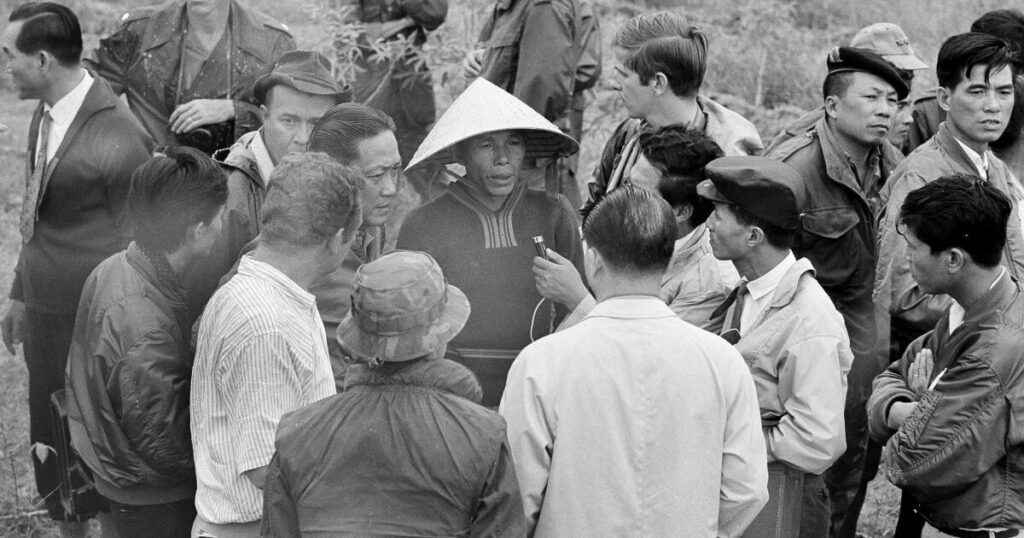
Shimkin and Buckley spent months talking to residents in areas hardest hit by Speedy Express, interviewed U.S. officials and participants in the operation, and studied military documents and hospital records. Buckley’s 4,700-word story found that the U.S. Army had turned the three Delta provinces into a “free-fire zone,” where U.S. soldiers were told they could shoot anything that moved. Vietnamese peasants who ran when Army helicopters hovered over them were presumed to be enemy soldiers and became targets. Children as young as 5 herding buffalo were killed and were added to the count of Viet Cong casualties, sometimes along with the buffalo. “Soldier’s Bones” contains archival footage from Speedy Express showing helicopter gunners shooting indiscriminately into villages. (I knew both Buckley, who died in 2021, and Shimkin, who was killed in Vietnam in 1972, and I appear briefly in the film.)
Among the movie’s revelations is the discovery of a U.S. military study carried out immediately after the operation that was classified until 1981. It shows that Viet Cong troop strength in the Delta declined only slightly as a result of Speedy Express, from 10,475 soldiers before the operation to 9,520 afterward — this despite claims of 11,000 Viet Cong deaths. Nevertheless, Gen. Creighton Abrams, commander of U.S. forces in Vietnam, declared in the 9th Division’s official publication that the division’s performance in Speedy Express “has been magnificent.”
The absence of a large drop in Viet Cong troop strength most likely indicates that recruitment soared as villagers grew angry with the death and destruction that U.S. forces rained upon them.
“I came to Vietnam to wage war on other soldiers, not on their parents, wives or children,” a senior U.S. military advisor quoted in the film said. “The idea that you can terrorize a people out of supporting your enemy never leads to victory — not in Vietnam, not anywhere.”
It’s that same thinking, of course, behind Trump’s devastating air attacks in Iran, intended to topple the Iranian regime, and in Israeli Prime Minister Benjamin Netanyahu’s determination to level Gaza as a way of eliminating Hamas. More than half a century later, the lesson of Speedy Express remains highly relevant, and it still hasn’t been learned.
Jacques Leslie covered the Vietnam War for the Los Angeles Times for two years and is the author of “The Mark: A War Correspondent’s Memoir of Vietnam and Cambodia.”
The post Almost-forgotten atrocity in Vietnam War holds lessons for the Trump era appeared first on Los Angeles Times.