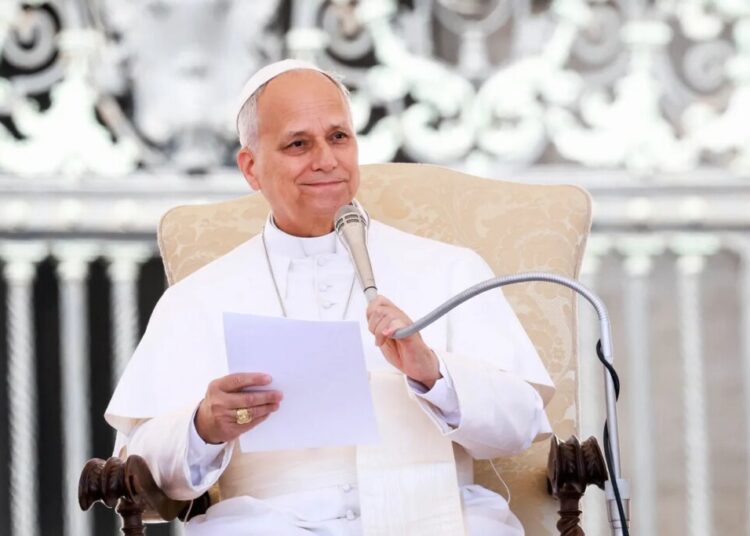
Nobody was surprised that Pope Leo XIV cited well-known saints and previous pontiffs in his first encyclical, or papal letter of spiritual guidance, “Magnifica humanitas,” released Monday.
But the name that immediately jumped out to many readers is one synonymous with high fantasy literature: J.R.R. Tolkien, the Catholic author of The Lord of the Rings.
Leo’s letter is concerned with “safeguarding the human person in the time of artificial intelligence,” a major theme of his first year as leader of the Catholic Church. Drawing from his predecessor, Pope Francis, he warns of “the growing dominance of a technocratic paradigm,” one capable of “reducing creation to an object of exploitation and human beings to mere cogs in a system driven toward ever greater efficiency.” He again compares the rise of AI to the Industrial Revolution that spanned from the mid-18th century to the beginning of the 20th, alluding to the teachings of his namesake, Pope Leo XIII, who in his own 1891 encyclical asserted the importance of workers’ rights and dignity during a time of technological upheaval and burgeoning capitalist empire.
The lengthy text further solidifies Leo’s stance as an AI skeptic. But the Tolkien nod is particularly salient given some backward interpretations of Middle-earth mythology by right-wing billionaires like Peter Thiel and Elon Musk, which have long been ridiculed by other Lord of the Rings fans. One might even think Leo is trolling. (The Vatican did not immediately return a request for comment.)
Clearly, the pope is somewhat concerned about the motives of tech oligarchs racing to develop artificial general intelligence that surpasses human capabilities. Do they really dream of using this tool to cure diseases and solve climate change, or are they building engines of limitless profit and cultural dominance? It’s when he addresses our personal responsibility in challenging such dark forces that Leo borrows an insight from Tolkien’s famous wizard, Gandalf: “It is not our part to master all the tides of the world, but to do what is in us for the succour of those years wherein we are set, uprooting the evil in the fields that we know, so that those who live after may have clean earth to till.”
That lesson is miles away from what Musk and Thiel apparently see in Tolkien’s masterpiece.
Thiel named his data analytics firm Palantir, after the crystal ball used as a spying device by the traitorous wizard Saruman in the saga; he reportedly calls his venture capital firm, the Founders Fund, “the precious,” which is what the twisted and covetous character Gollum calls the One Ring, a magical means of totalitarian power. Almost anyone who encounters Tolkien (or adaptations of his work) can see that he was writing about the corrupting effect of such power—in the novels, the temptation to rule inevitably undoes anyone who succumbs to it—yet Thiel seems to revel in the same possibilities of authoritarian control and omniscience as the villains.
Musk, for his part, has suggested that Tolkien’s epic can be read as an anti-immigration, build-the-wall parable: “When Tolkien wrote about the hobbits, he was referring to the gentlefolk of the English shires, who don’t realize the horrors that take place far away,” he posted on X in October. “They were able to live their lives in peace and tranquility, but only because they were protected by the hard men of Gondor.” He offered this simply inaccurate recollection of Lord of the Rings as a defense of Islamophpbic far-right UK agitator Tommy Robinson.
In fact, Tolkien’s depictions of marauding armies pillaging the land were inspired by the horrors of militarization and industrialization—two phenomena that the English of Tolkien’s generation were more than familiar with. His experience of mechanized horrors in World War I is widely understood as crucial inspiration for Saruman’s campaign of death, which relied upon the destruction of an ancient forest for fuel and the slave labor of brutalized orcs.
If anything, this allegory better suits Pope Leo’s critique of the tech-bro elite as those who would sow division and inequality, bend their resources toward war, ravage the environment, and seize power at any cost. (Neither Thiel nor Musk immediately returned a request for comment on the encyclical.)
Thiel, at least, appears somewhat self-aware on this point, given his preferred Tolkien allusions and Palantir’s collaboration with Immigration and Customs Enforcement. Musk, even if he sees himself as one of the heroes of the story, oversaw the bulldozing of the US Agency for International Development (USAID), leading to hundreds of thousands of preventable deaths around the globe and likely millions more to come. And both continue to support a Trump administration that has leveraged AI for everything from racist propaganda to planning where to drop bombs in Iran—and, of course, have used Lord of the Rings to promote and valorize ICE.
In that context, Leo shouting out Gandalf could be seen as very deliberate.
A quote from this beloved character in a treatise condemning a society that prizes efficiency above all else, and concentrates immense power and wealth in the hands of a few, scans as a direct message to those people—whether intentional or not. But with their reading comprehension, who knows if it can get through.
The post Pope Leo Schooled the Tech Bros on Tolkien appeared first on Wired.