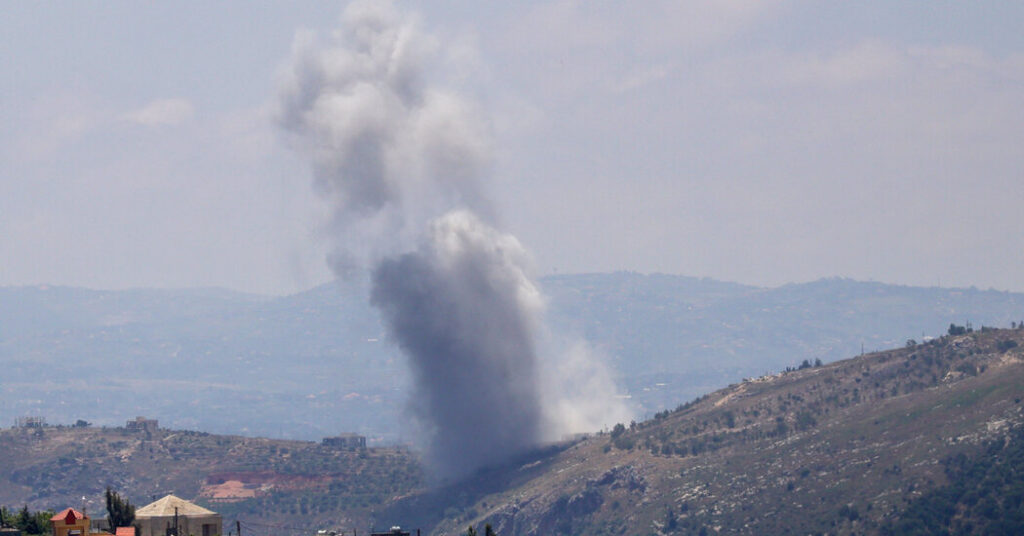
Israel intensified its military campaign against Hezbollah on Tuesday, striking targets across Lebanon after Prime Minister Benjamin Netanyahu said he had ordered the military to “increase the blows” against the Iran-backed militant group.
The Israeli military said it had struck more than 100 Hezbollah sites overnight in southern and eastern Lebanon, including weapons storage facilities and command centers. It also issued an evacuation warning on Tuesday for the entire city of Nabatieh, one of the largest cities in southern Lebanon, signaling that airstrikes there were imminent.
Mashghara, a town in the Bekaa Valley, was among the areas that were hit overnight, killing at least 11 people, including two children, according to Lebanon’s health ministry. The Israeli military did not immediately respond to a request for comment on the strike.
“We are at war with Hezbollah,” Mr. Netanyahu said in a video statement on Monday night, adding that he had ordered the military to “press on the pedal even more.”
The latest round of fighting began in March, shortly after the U.S.-Israeli offensive against Iran, when Hezbollah fired rockets across the border in support of Tehran. A U.S.-brokered cease-fire took effect in April, but tit-for-tat attacks have continued, with each side accusing the other of violating the truce.
Now, the violence in Lebanon appears to be intensifying just as President Trump and Iranian officials signal progress toward a possible deal to end the U.S.-Israeli war with Iran.
The terms of any U.S.-Iran agreement remain murky, but three senior Iranian officials told The New York Times over the weekend that it would also halt fighting on all fronts, including Lebanon. However, Mr. Netanyahu appeared to double down on Sunday, saying he had “reaffirmed Israel’s right to defend itself against threats on every front, including Lebanon” during a weekend phone call with Mr. Trump.
Hezbollah said on Tuesday that it had launched a string of drone and rocket attacks on Israeli troops in southern Lebanon, where Israeli forces have carved out what they call a “forward defense line” extending several miles deep after invading during the war.
Hezbollah has increasingly relied on low-cost, fiber-optic drones, which are difficult to jam, to target Israeli troops. The attacks have exposed an Israeli vulnerability, even after weeks of airstrikes and ground operations aimed at degrading Hezbollah’s capabilities.
As a result, Mr. Netanyahu has faced mounting pressure from Israeli hard-liners to broaden the campaign in Lebanon, including by resuming strikes on Beirut and its southern suburbs. Such a move would further strain the already fragile cease-fire and complicate U.S.-led diplomatic efforts to resolve the conflict.
In recent weeks, Israeli and Lebanese representatives have held rare, direct talks in Washington aimed at brokering a longer-term settlement. A central issue is Hezbollah’s disarmament, which Israel has demanded but Hezbollah has ruled out discussing until Israel ceases its attacks and withdraws from Lebanese territory.
Military officials from both countries are scheduled to meet at the Pentagon on Friday under U.S. supervision, with a separate round of political talks set for next week.
Hezbollah is not a party to the talks and has rejected any direct negotiations with Israel.
Gabby Sobelman contributed reporting.
Euan Ward is a Times reporter covering Lebanon and Syria. He is based in Beirut.
The post Israel Steps Up Strikes in Lebanon as U.S. Pushes for Iran Peace Deal appeared first on New York Times.