THE VIVISECTORS, by Missouri Williams
“If you wanted to write something terrible about somebody,” Agathe, the narrator of Missouri Williams’s new novel, “The Vivisectors,” is told at the start, “then it was best to use the first person, because they’ll never be able to accept that you were capable of betraying them so utterly, and so instead of seeing the obvious they’ll look at just about anything else.”
Her uncle gives her this bit of writing advice at breakfast the day after her mother has attempted suicide. It’s a safe bet, he continues, “because to mix up the author and their narrator was the most cardinal of literary errors.”
Does this advice make sense? Is the author warning us not to make this “most cardinal” error, or giving us permission to do precisely that? More important, why would a man say this to his niece the morning after his sister has tried to drown herself in the bathtub and ended up brain-damaged and in a wheelchair?
Well, Agathe isn’t precious about it. She is so stoic that she does not feel pain, even when, after walking for hours, her socks soak with blood and her toenails crack. Her indifference extends to her “ethics” (“nonexistent”), her “politics” (“neutral”) and her “passion” (“absolute lack”). Her mother’s attempted suicide, she says, “left no impression.” So why not take the post-maternal-incapacitation breakfast to discuss narratology? In any case, the chat concludes as suddenly as it begins. Her uncle’s “watery gray eyes” examine her momentarily “before drifting in the direction of the garden.”
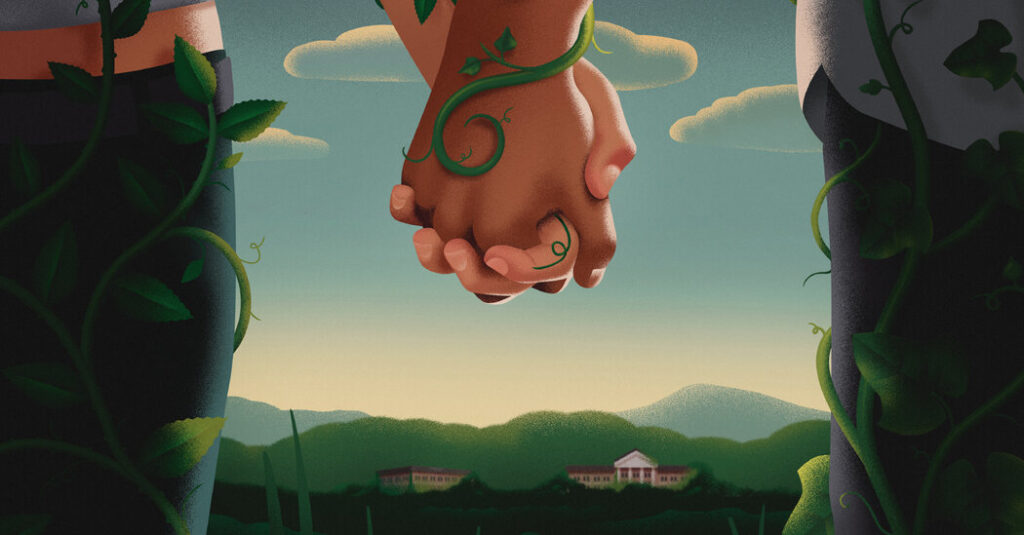
The garden is where we will stay. “The Vivisectors” takes place in an unnamed university city overtaken by uncontrolled vegetative growth. “Nature had won its battle,” despite the efforts of the semi-mystical “gardeners,” a vaguely right-wing alliance of anti-academic men. Walls are damp, windows are covered in ivy, water and animal droppings sluice through houses. The gardeners make little headway on the herbage; instead they spend, say, 13 pages at a time discussing imaginary cities (“the city does not end”) and imaginary gardens (“the garden cannot be summarized”). Several more pages are dedicated to a song about mold.
This is one of those novels in which “there are no places and barely any proper names,” Agathe acknowledges after about 100 pages. (Indeed, we don’t get hers until Page 135.) “Nothing happens in them either.” And yet “people keep buying” them and “people keep writing” them for various asinine reasons: because wiping them of distinctions makes them easier to identify with, because these “depthless” novels are the inevitable product of authors addicted to screens.
“Now I need to give my world more detail,” she decides. “I’ll need to name people and things.”
Alas, little of that promised detail emerges. The only other character who gets both a name and significant time on the page is Adam, a rather on-the-nose extension of the garden metaphor. Adam is an international student at the university who is “so handsome that he was repulsive; so perfect that he made you feel sick.” He is from “a new, aggressive city that was hurling itself into the future and reshaping the power relations of the past.” The people from this desert city, we are told, are mostly blond.
The novel briefly gestures at a naughty little anti-#MeToo theme. Adam has slept with nearly all the female students in his department, who get very jealous. He tells Agathe’s boss — an inept urban planning professor from his city — that women are “the same everywhere”: They “wanted to be rescued or raped.”
But Adam’s controversy ends up having less to do with female oppression than cultural oppression. A male professor, from a city whose people “500 years ago” had been the “slaves” of Adam’s city, gets angry because of something “outrageous” Adam says in class. Adam, in turn, gets angry when the professor tells him to stop “peddling conspiracy theories,” which is apparently a very sensitive point for the “persecuted people” from Adam’s city.
This is all very dramatic: We can tell because, as Agathe’s boss first tells her about the incident, “it had begun to rain, violently.” Agathe’s boss, in short, dispatches her to befriend Adam, vaguely to save him from his despair. The portrayal of seduction that follows is rather painful — “Adam would talk to me, and I would talk back” — but it leads to interest, reflected mainly in the weather. “The greenery was running wild” and “the heat of the summer” spikes when romance blooms, but when it falters, the sky, on cue, becomes gray.
For all the professor’s fretting about a controversy that is “destroying her,” about the outrage from the students and administration, we learn almost nothing of what Adam said, beyond that it was “a question of reading.” There is a limited, but great, lineage of novels of cancellation — “Disgrace,” “The Human Stain,” “This Is Pleasure” — and they are deeply discomfiting ones. Here, there is not even an incident to discomfort us. The novel promises a dangerous critique of contemporary sexual and cultural politics, and a narrator who sympathizes with the collective enemy; instead, it retreats into metaphor and meteorology.
“Like vivisectors,” Agathe’s boss says of academics, “we analyzed a situation until we had proved the presence of evil, and nothing could escape our scalpels.” But rather than analyze with any honesty the way humans tally up presumed evils on an inscrutable social abacus — or even depict it — “The Vivisectors” merely pre-empts all criticism, stepping back to vivisect its own pretense of sophistication. “They were playing a game with no real stakes, no real feeling,” Adam says of his imbroglio. “It was simply another excuse to generate text. And so he generated it. All those emails.” All those novels, indeed.
THE VIVISECTORS | By Missouri Williams | MCD/Farrar, Straus & Giroux | 276 pp. | $28
The post A Campus Novel That Dwells on Controversy but Spares the Details appeared first on New York Times.