Bruce M. Beehler is a naturalist and author whose most recent book is “Flight of the Godwit: Tracking Epic Shorebird Migrations.”
When I was 10, I learned the cost of free-roaming dogs the hard way. It was 1962, and before heading off on our annual beach vacation, my family handed our beloved Scottish terrier, Missy, over to my grandparents’ care. They were lax about confining their own pet dogs, Gail and Sam, and one day, these two led Missy on a ramble. Our little terrier was struck and killed by a car on busy Falls Road in Baltimore. The phone call that brought the news was like a knife in my heart.
Too late for Missy, the city came to enforce restrictions on free-ranging dogs, and with time most everybody accepted these as sensible. Before then, wandering pet dogs mixed with feral populations to form packs that coursed after deer and other wildlife, threatened people and their pets, and even spread rabies. Eventually, those packs became as much a thing of the past as clouds of cigarette smoke in airplane cabins.
But this piece is about cats, which continue to be treated differently. In the 1990s, we allowed our cat, Joey, a chill orange tabby, to roam about our Bethesda neighborhood. Despite being well-fed, Joey would periodically deposit a shrew or songbird on our doorstep. Cats will be cats, in other words — except multiply Joey by tens of millions, and the result is a nationwide scourge.
Felis catus — the common domestic cat — is a mass killer of North America’s native birds and mammals. Researchers have calculated that each year, free-ranging cats kill more than 2 billion birds (e.g., cardinal, catbird, chickadee) and 12 billion small mammals (e.g., chipmunk, meadow vole, deer mouse) in the United States. Endangered island populations like the Hawaiian crow, Key Largo wood rat and Perdido Key beach mouse have been particularly hard-hit.
But if the well-being of small animals doesn’t concern you, consider your own. Free-ranging cats are vectors fordiseases and parasites that afflict humans: rabies, tularemia, salmonella, giardia, pneumonic plague, cat scratch fever (Bartonella), ringworm, roundworm, hookworm and toxoplasmosis.
This last, Toxoplasma gondii, is a single-celled protozoan parasite for which free-roaming cats are the definitive host, and more than 40 million people are infected with it in the U.S. The parasite encysts in muscle and brain tissue. Most human carriers are asymptomatic, but some people get flu-like symptoms. Infants and people with weakened immune systems are most at risk. Even in asymptomatic carriers, the disease can alter brain chemistry, which can lead to potential mental health issues. This is one of those diseases that, for some strange reason, flies under the radar. To avoid it, steer clear of cat feces.
Cats kept indoors are unlikely to contract toxoplasmosis or other diseases. The cats themselves are healthier, too, and live longer; the lifespan of outdoor cats is half that of indoor ones. If you want your beloved Fluffy to have a long and healthy life, keep her indoors.
What to do? For anyone who cares about both cats and wildlife, as I do, free-ranging felines raise tricky policy issues. The answer for house cats is clear: Treat them like dogs. My county mandates that pet cats must be under the control of the owner, so we are free to walk our outdoor-loving cats on a leash if we want but not to open the door wide for them. Still, many cities and towns still allow pet cats to roam.
The more difficult challenge is unowned cats. When the problem of dogs was tackled, free-ranging animals were captured and offered for adoption, and any that weren’t taken would be euthanized. But euthanasia has become less acceptable, and let’s face it: Sixty-million-plus feral cats is a lot of cats.
These cats pose a conundrum. People more concerned about the massive annual loss of native mammals and birds may believe lethal control is the only answer. But results in Australia, which has a near-universal ban on free-ranging cats, indicate that lethal methods can’t eliminate feral cats from the wild except on small islands or within fenced enclosures. Perhaps the best we can expect is for government to use a mixed approach, employing euthanasia as a last resort to reduce cat populations within the parks and preserves under their purview, where the welfare of native wildlife is a priority.
As concerned citizens, our focus should be on owned cats and unowned “colony cats” in populated areas. Every owned cat should be vaccinated, neutered and kept indoors. Unowned cats in urban or suburban “cat colonies” (sometimes maintained by feline support groups) should be captured, vaccinated, neutered and either put up for adoption or relocated to a sanctuary. That last step is key: Currently, many trapped, neutered and vaccinated cats are returned to their colonies to live out their wretched lives, with predictably dire consequences for the birds and small mammals that live nearby.
Even with a more aggressive approach, a return to balance will take years. All the more reason to start now. Cats make wonderful pets, but it is not humane to allow these invasive predators to live harsh, disease-shortened lives at the expense of treasured native wildlife.
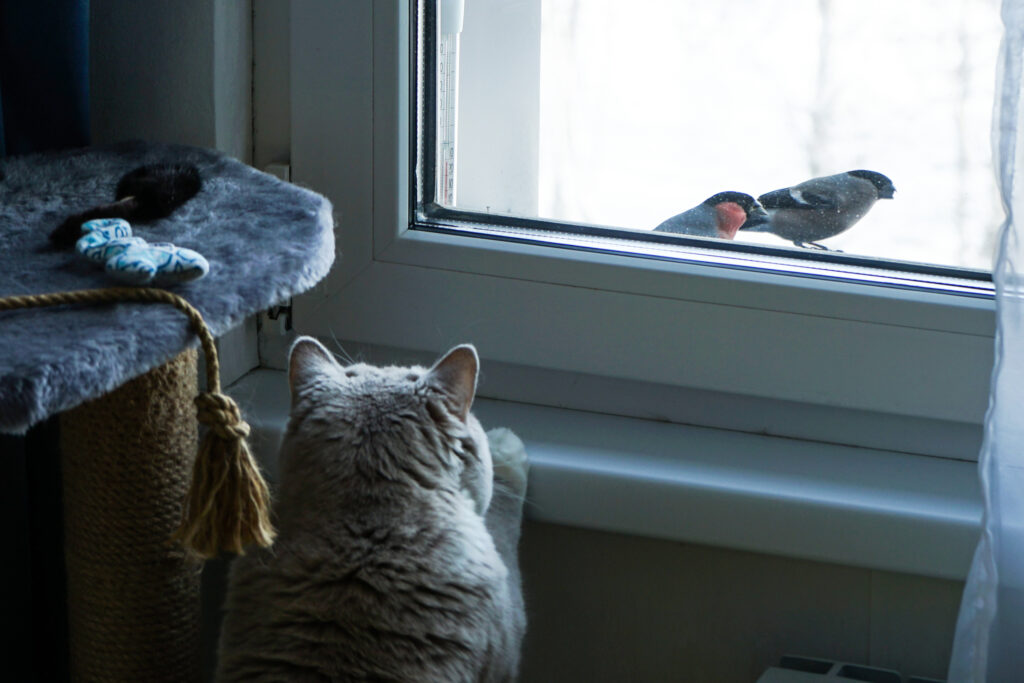
Which do you prefer to see in your backyard: a male northern cardinal glowing red in the morning sun or a crouching cat ready to pounce?
The post America long ago solved its dog problem. But what about the cats? appeared first on Washington Post.