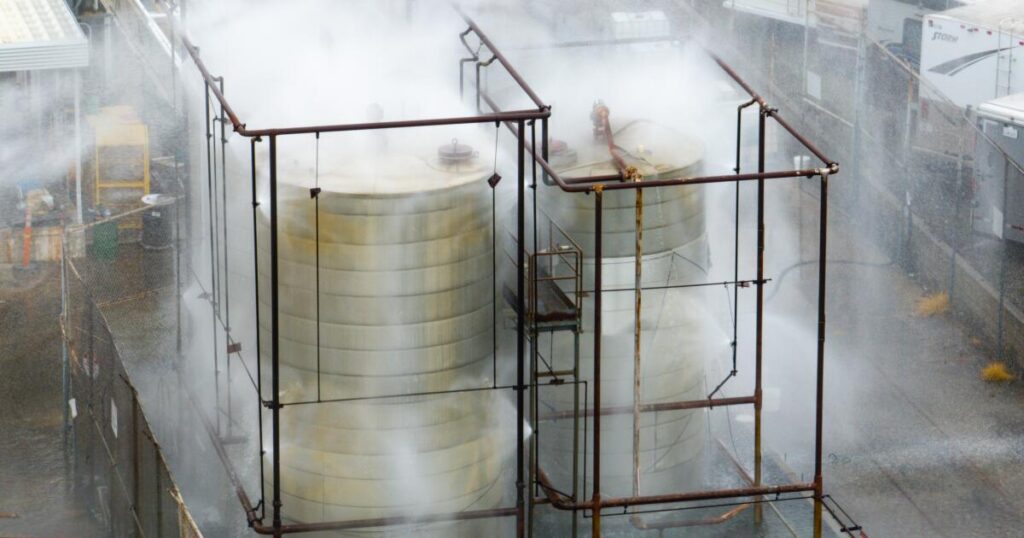
With evacuation shelters reaching capacity as more than 40,000 people were asked to leave their homes, officials laboring to prevent an explosion at a crippled chemical tank in Garden Grove reported tentative progress Sunday in ending the crisis.
TJ McGovern, interim fire chief for the Orange County Fire Authority, said firefighters had discovered what appeared to be a potential crack on the tank’s surface that could be alleviating some of the pressure resulting from the chemical reaction inside.
If they are right, it would make a catastrophic explosion or an uncontrollable leak less likely.
“With this new information, it could change our trajectory and our strategy to this event,” McGovern said. “This was a step in a right direction, and there’s going to be a lot more coming shortly.”
Lee Zeldin, Environmental Protection Agency administrator, said the new development was promising.
“I’m being told this morning that the most likely scenario is one of a low volume release, where the local authorities are going to be able to monitor, neutralize and contain the threat,” he said during a Sunday morning appearance on CNN.
McGovern gave no indication as to when the 40,000 people who had been forced from their homes and into shelters due to evacuation orders would be allowed to return.
“We know you’re out of your homes. We want to get you back,” he said. “But we cannot do that until it’s deemed safe.”
The positive note was a welcome development in a situation that has left much of Orange County on edge since Thursday.
The crisis began when the Orange County Fire Authority responded to reports of a hazardous materials incident at GKN Aerospace on Western Avenue in Garden Grove. Officials found a tank containing 7,000 gallons of a toxic chemical called methyl methacrylate, or MMA, stored in liquid form that was in danger of exploding due to a buildup of pressure from a runaway chemical reaction.
Methyl methacrylate is used to make plastics. While the polymer itself isn’t toxic, its liquid MMA predecessor is. If it gets into the air, it can harm people at high concentrations and through chronic or extended exposure.
The primary solution would have been to pump a neutralizing agent into the problem tank, quenching it and making it no longer explosive, but the necessary valve clogged leaving no way to get the neutralizing agent into the tank.
Officials feared that there were only two possible outcomes: a devastating explosion or a devastating leak.
A crack in a tank containing a toxic chemical may not sound like a cause for hope, but Elias Picazo, an assistant professor of chemistry at USC, said it might be the best-case scenario.
“If the tank is going to fail, you want it to fail through a crack rather than fail through an explosion,” he said. “With a controlled leak, you can route liquid or gas out of the tank, relieving pressure and buying more time.”
He explained that as material leaks out of the tank, the pressure inside increases more slowly, potentially reaching a safe equilibrium. The leak also depletes the source for a chemical reaction, which is generating heat that, in turn, accelerates the reaction in a process called “thermal runaway.”
But the situation remains uncertain, he said. Depending on the size of the crack and the speed of the chemical reaction, it’s possible that the growing pressure within the tank will exceed what can be released through the crack, leading the tank to explode.
“It’s a positive step, but it’s not over,” he said of the new development.
If the failing chemical tank in Orange County does explode, the aerospace plant where it sits and dozens of homes surrounding it could suffer severe damage, according to a map released by authorities Saturday.
Areas within roughly 1,100 feet of the tank would suffer the most severe damage; and beyond that, areas within about 0.3 miles, moderate damage; and beyond that, areas within about 0.4 miles, light damage, from the blast.
The severe blast zone represents “areas where we can expect severe structural damage and significant harm,” said Nick Freeman, an Orange County Fire Authority division chief. There are dozens of homes in that area in a neighborhood of the city of Stanton, including along Santa Rosalia Street, south of Laurelton Avenue and north of Lampson Avenue.
In the moderate blast zone, “we would expect again structural damage and harm to those within that zone,” Freeman said.
The light-damage zone includes Wakeham Elementary School and a Home Depot on the corner of Chapman Avenue and Beach Boulevard. “There, we might see some structural damage, but it would be a little bit more limited,” Freeman said.
Officials have also warned that in the event of an explosion, there could be fire or flash fire in some areas, as well as areas where the chemical cloud would be immediately dangerous to life and health, and a much larger area where the chemical would be smelled, but at nontoxic levels.
Evacuations around the failing tank in Garden Grove currently include tens of thousands of residents in six Orange County cities: Garden Grove, Cypress, Stanton, Anaheim, Buena Park and Westminster. Four of the five shelters that the county set up are full. As of Sunday afternoon, only Los Amigos High School in Fountain Valley still had space.
On Saturday, three days into the crisis, a South Pasadena law firm filed a lawsuit on behalf of two people residing in the evacuation zone. The X-Law Group and Presidio Law Firm are seeking class-action status.
The lawsuit says that residents were subjected to “evacuation orders, shelter-in-place directives, exposure concerns, noxious chemical odors, fear of contamination, interference with the use and enjoyment of their homes and properties, and other damages.”
The suit seeks unspecified monetary damages, alleging that GKN Aerospace did not protect the community from the crisis.
The lawsuit is also asking for “accountability for residents facing evacuation orders, property disruption, potential health risks, loss of use of their homes, related expenses, and diminished property values.”
“Clients are naturally very concerned,” said Carlos X. Colorado, an attorney at the X-Law Group. “It’s a scary situation, especially for those in the vicinity, and in addition to that. For a large number of people, it’s an inconvenience.”
GKN Aerospace didn’t immediately respond to a request for comment.
In a nod to the seriousness of the situation, three federal lawmakers representing California have appealed to the Trump administration to issue a disaster declaration over the incident.
U.S. Rep. Derek Tran (D-Orange) co-signed a letter with Sens. Adam Schiff and Alex Padilla requesting that the federal government provide additional resources in response to the event. Tran posted a copy of the letter on X.
“The severity of this disaster requires additional coordination and federal support. Therefore, we urge you to expeditiously approve California’s request for an Emergency Declaration and to provide emergency protective measures and direct federal assistance under the public assistance program for Orange County,” says the letter, dated May 24. “The safety and security, and well-being of evacuated residents and the surrounding communities remain our absolute highest priority.”
Gov. Gavin Newsom also made a similar appeal to the president. The White House did not respond to a request from The Times.
In the meantime, officials have stressed that they are trying to keep the chemical inside the damaged tank at the aerospace facility as cool as possible. They said they have received help from experts nationally to come up with alternative plans. Nothing specific, however, has been mentioned.
Continuing to pour cool water on the tank could allow the liquid chemical inside to cure at a slower rate — becoming a solid at a slower speed — and reduce the buildup of pressure inside the tank, said Craig Covey, an Orange County Fire Authority division chief.
“Like an ice cube that freezes from the outside in — this stuff cures, it heats up and cures from the outside in,” he said. “While it’s doing that process, it’s building that pressure.”
The tank has some capacity to hold some pressure. There is a gap between the MMA chemical surface and the tank ceiling.
“We’re hoping that that space can absorb a slower cure rate and not over-pressure and blow up,” Covey said.
The post Potential crack found on Garden Grove chemical tank, reducing explosion risk appeared first on Los Angeles Times.