On the day of the kidnapping, the campground at Gumboot Lake happened to be nearly empty, so Joseph Charles Henrichsen was one of the only people to see the two Forest Service biologists pull up in their pickup truck. Federal employees didn’t visit all that much—campers who’d been coming to the small alpine lake for years told me they’d never seen a ranger on patrol in these Northern California woods. But some of the regulars had noticed the “frog people,” as one called them, quietly collecting their specimens the previous summer. These particular biologists, both women, were there to survey the Cascades frog, whose well-being can help signal the health of the overall ecosystem.
People at Gumboot Lake tended to give one another space, but that July morning, Henrichsen approached the biologists as they worked. He was holding, authorities would later allege, an AR-15-style assault rifle, and told the biologists to turn around and put their hands in the air. He zip-tied their wrists behind their backs and ordered them to walk to his camping trailer, parked at a site strewn with crates and refuse, the clothesline heavy with towels. His 23-year-old son, Phoenix, made room for the biologists inside.
What Henrichsen’s intention was that day—what he thought he might achieve by abducting two government scientists, whether he had a clear motivation at all beyond an impulse of self-righteousness and a loaded gun—remains uncertain. Before long, he escorted one of the biologists back to their Forest Service truck. He drove several miles with her down a winding road along the Sacramento River. Glimpses of Mount Shasta, the volcano looming to the east, reared up through the trees. Along the way, he made calls, according to the FBI. He spoke with a Forest Service ranger and left a message with another person who has not been identified. “I’ve taken two Fed biologists hostage from the Forest Service,” he said, according to authorities. “What I’d like to have happen, I’d like to have you send me a fucking Fed investigator, with a goddamn badge, preferably from the FBI. And we can talk things through a little bit.”
Over the next few hours, Gumboot Lake and the surrounding Shasta-Trinity National Forest would swarm with law enforcement in helicopters and Bearcat armored vehicles. Local SWAT teams and snipers, then more than 50 FBI officers, poured into the national forest. A Boeing 757 flew across the country, from Virginia, with an elite FBI hostage-rescue team.
All of these officers were confronting a man who had a history of erratic behavior: Henrichsen had been released from a Washington State psychiatric hospital a few years before, after allegedly tormenting a neighbor by firing a gun, throwing fireworks on his porch, and placing zip-tie handcuffs on his property. But Henrichsen had also managed to stay at Gumboot Lake for months—well past the official seven-day limit—apparently without triggering any official response from the Forest Service. Many of the campsite’s regulars had crossed paths with the Henrichsens over the summer, and although Charles held himself apart, he struck them as a familiar type, not so out of place here among the free spirits and drifters living in their cars. That he’d turned out to be unhinged or anti-government enough to kidnap a couple of federal frog biologists didn’t seem to shock them. In fact, with the way things are going on the woolier fringes of America’s public lands, maybe something like this was bound to happen.
Siskiyou County, the area that includes Gumboot Lake, has a reputation for fierce independence and the hostility toward government meddling that often comes with it. The county leans conservative, though Mount Shasta is a magnet for a crunchier type: crystal enthusiasts, New Age spiritualists, pilgrims on the road to Burning Man. Hikers stream down the Pacific Crest Trail, which runs along a ridge above the lake. On Sundays, some of the campers at Gumboot Lake like to gather for a drum circle, and when the full moon arrives, people convene to celebrate.
The Gumboot Lake campground is free and has no assigned spots, no running water, limited cell signal, and a lone pit toilet. It’s one of dozens of alpine lakes in the Trinity Divide accessible by car or off-road vehicle. Others are more popular. The Forest Service described the campground in one write-up as a “typical meadow type lake, not very beautiful.” But it’s relatively easy to get to, just a 40-minute drive up from Interstate 5.
I made that drive last month, not long after the Forest Service had reopened Gumboot Lake, less than a week after the kidnapping. I saw old vans and school buses parked along the Forest Service road leading to the campsite; people had strung up hammocks between the trees. At the lake, several campers had already set up their tents and parked their mobile homes. One camper, a 24-year-old backpacker from Australia, told me the campsite was a place to “drop in with the land, drop in with each other, cook meals with each other, and just be super present.” As we talked, a large shirtless man, whom she called Zephyr, appeared and handed her a slice of papaya.
The Forest Service is supposed to be a steward of its public lands, preserving them while still allowing people to enjoy the woods and use their resources. Dispersed camping—outside of established campgrounds—is allowed in most national forests. And although people here are supposed to move on after seven nights, locals say that plenty of people live out of their cars for much longer. Informal settlements are widespread on the national-forest lands of Oregon and Northern California. People tend to cluster along the river corridors, most of them peaceable campers. “But the last 10 percent of them are pretty sad,” says Gabriel Howe, the executive director of the Siskiyou Mountain Club, a group that maintains trails and campgrounds in the region. “People living out there, people manufacturing drugs and all sorts of nasty stuff.”
Policing a remote forest is unlike any other job in law enforcement. The Shasta-Trinity spans more than 3,000 square miles, and the Forest Service is perennially under-resourced. Carmen Kinch, a Forest Service law officer who patrolled the area around Gumboot Lake in the late 1990s and 2000s, told me that back then, seven law-enforcement officers worked across the entire forest. Today, there are four. Not one, she said, is currently based in the Forest Service management unit that includes Gumboot Lake.
The drop in personnel is not just a problem in this one forest. Since last year, the Forest Service’s staffing across the country has fallen by about 20 percent as a result of firings and departures encouraged by the Trump administration, part of its push to reduce the federal workforce. In the Shasta-Trinity forest, excluding firefighting roles, the permanent staff—employees who maintain campsites and conduct wildlife research—has been reduced by about a quarter, one former U.S. official, speaking on condition of anonymity because of the sensitivity of the topic, told me. (Bob Doucette, a Forest Service spokesperson, told me that staffing levels are “similar” to what they’ve been in the past few years and said that “all employees continue to meet public needs.”) Howe has worked in the region for 15 years, and he sees the Forest Service as a slowly dying patient. “Around COVID, it went into palliative care, and now it’s on hospice,” he told me.
A sense of lawlessness seems to be growing on the public lands in the region. People on Howe’s staff have returned to find their cars stripped at trailheads—no wheels, no batteries, gas siphoned. They’ve encountered mountain roads blockaded by hostile civilians. Michael Kauffmann, an ecologist and the executive director of the Bigfoot Trail Alliance, told me that he’s recently instituted more training for his researchers and trail crews on safety measures and defusing confrontations. More than anything, Kauffmann has noticed a greater disregard for the rules—more graffiti, a lot more garbage, and less appreciation for these lands as places to care for rather than to joyride over with guns and four-wheelers. One person who regularly hikes in the area around Gumboot Lake told me that he’d felt safer during “close encounters with bears and lions” than with some of the armed and unfriendly people around.
The Henrichsens had apparently lived at Gumboot Lake since at least early May, when Todd Heie, another camper who visits the lake regularly, first encountered them. In early June, Joseph Charles Henrichsen, who goes by his middle name, asked a neighbor at the campground, Kevin Airoldi, for a lift into town. On the 45-minute drive, Charles said that he and his son were “just traveling around, trying to do it on the cheap.”
Charles mentioned that they’d come down from the Pacific Northwest but not what he’d left behind. He’d once been a successful mortgage-loan broker in Orange County, California. But he had run into business trouble, and his relationship with Phoenix’s mother had fallen apart. By 2022, he was divorced and living near Bellingham, Washington, up by the Canadian border. That year, he spent six months in a county jail, charged with a hate crime for allegedly harassing his neighbor. Police said that he “appeared to be spiraling in his mental health,” according to court documents. Henrichsen, who kept multiple guns at his home, would rant about world events, including the war in Ukraine; an evaluation found that he likely had schizophrenia or another psychotic disorder. Although a judge ordered him to be admitted to a hospital for psychiatric treatment, bureaucratic delays kept him out for months. Even then, he was admitted only briefly, after the charges had been dropped.
At Gumboot Lake, both Charles and Phoenix Henrichsen tended to keep to themselves in their Feather Ultra Lite trailer, parked amid the lodgepole pines. The other campers would watch them pacing around the lake, lap after lap, as the father appeared to loudly lecture, or preach, to the son, who kept his head down and rarely said a word. Many found Charles intense and standoffish. He would burn red sage during the day, and at night he would play a type of chanting Indian music that Heie, a former director of the county’s department of corrections, sometimes listened to as he drifted in his kayak, looking up at the sky. At one point, Aaron Sullivan, a software engineer who was working remotely out of a Winnebago along the lake, stopped by the Henrichsens’ campsite. He’d been impressed by Charles’s strong, lean frame and “big, beautiful beard.” Sullivan invited them to one of the full-moon gatherings. We won’t be doing that, Charles told him.
The Thursday morning of the kidnapping, on July 16, Charles Henrichsen must have been watching the biologists before he approached them—it’s unclear how long. After he had captured the women and herded one of them into the pickup truck, he kept her tightly restrained. He told the unidentified recipient of the message he left while driving down the mountain that “her hands are behind her fucking back, and I’ve got live rounds ready to fucking [inaudible] anyone who fucks with me,” according to the criminal complaint.
When Siskiyou County Sheriff Jeremiah LaRue was alerted to the situation that morning, he thought the man could be swatting, he told me—attempting to trick his office into scrambling to respond. His county is larger than Connecticut, and more than half of it is public land. Sheriff’s deputies soon arrived at Gumboot Lake to find the campsite gate closed and a gray Subaru blocking the road. (The Subaru, police would later learn, was stolen, possibly by the Henrichsens, and likely parked there to block others from entering during the kidnapping.) The sheriff’s deputies flew a drone overhead and quickly spotted the Forest Service truck that Henrichsen had commandeered, LaRue said. A man stepped out of the trailer, carrying a rifle, and later the deputies saw him with someone whose hands were bound. “He’s now pointing a rifle at the drone,” a deputy said over the radio. LaRue knew he had to get more people up there.
Police set up in a dirt roundabout on the north side of the lake, within shouting distance of Henrichsen’s trailer, where he had holed back up with Phoenix and both biologists; they blocked access to the campground, and law enforcement streamed in from California and elsewhere, their cars crowding the narrow Forest Service road. Hank Magnuski, a retired tech executive who owned a nearby cabin, came upon the pileup of armored vehicles and heavily armed agents in the early afternoon, at the end of a long drive from his home in Palo Alto. He was startled by the military-style occupation of this out-of-the-way wilderness, but he gave two SWAT-team members a ride up the road. “What’s the occasion?” he asked one of them.
At about 3:30 p.m, more than four hours after his initial calls, Henrichsen’s voice came over law-enforcement radio. He had taken one of the biologists back to their truck, where she helped him access the radio to contact the Forest Service’s dispatcher and the FBI. He seemed calm; he repeated his request to speak with FBI officials, “so I can release these hostages. Over.”
The reception was choppy enough that he started negotiating with the FBI agent Russell Quiniola about how they might speak in person. “Are you comfortable putting the rifle down and coming to a point where you feel safe?” Quiniola asked.
“Listen, you come and talk to me,” Henrichsen responded. “I would suggest coming unarmed, because if you have one, that might trigger something in me, you never know. Or you may have a rifle, and you see me, that might trigger something in you. But I suggest we get the show on the road. These ladies would like to go home. Over.”
The fact that Henrichsen had initiated contact with authorities by requesting to talk with the FBI was, to some degree, encouraging. It suggested that his intentions went beyond simply harming the biologists, Gary Noesner, a former chief of the FBI’s crisis-negotiation unit, told me. In such situations, every hour that negotiators can keep the kidnapper talking is one without violence. Unless they sense that the risk is increasing, Noesner said, “we’ll talk ’til the cows come home.”
Quiniola and other FBI agents spoke with Henrichsen over the next nine hours. By 1 a.m., the standoff had gone on so long with such little progress that LaRue was surprised when someone in his vehicle said, “One of the females is coming out,” and the first biologist opened the door of the trailer and walked toward the police. Her colleague followed six minutes later. Another hour and a half would pass, during which FBI agents exploded flash-bangs around the trailer—a commotion heard by hikers on the Pacific Crest Trail above the lake—before Phoenix and then Charles finally turned themselves over and the government vehicles lining the road to Gumboot Lake started heading back down the mountain.
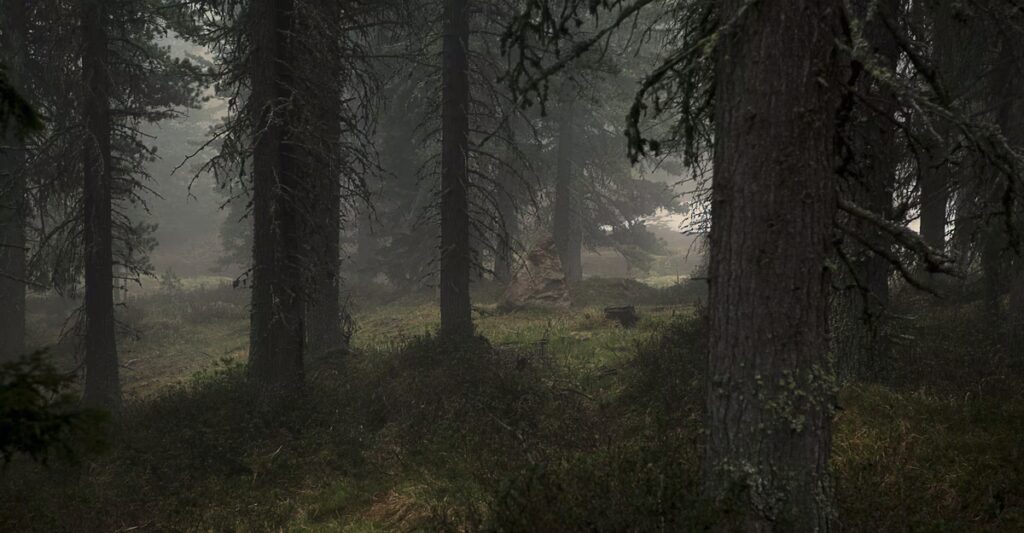
By the time I arrived at the lake, almost all signs that this place had been the site of such force were gone. The Henrichsens’ trailer had been towed away; their debris had been bagged and left in the outhouse, along with a note that read, “Trash from the kidnappers campsite.” One camper had held on to three wooden billy clubs found amid the mess. I set up my tent at a campsite next to the Henrichsens’, where I could see the lake through the pines. Everything was serene. The day was cloudless, and the sun sparkled on the water.
Charles and Phoenix Henrichsen eventually pleaded not guilty in federal court in Sacramento to charges of kidnapping federal employees and other felony counts that carry the prospect of life in prison. Charles’s lead defense attorney, Mia Crager, told me that her client had intended no harm to the biologists; according to police, the two women, who have not been named publicly, did not appear to suffer major injuries during their 15 hours as hostages. “What happened on July 16 was preventable and resulted from system failures on a number of levels,” Crager said in a statement. She did not elaborate on the type of failures she was referring to, and didn’t respond to questions about any specific allegations against Hendrichsen. She said that Charles “hopes that some good will come of the case, including that his son Phoenix will get the mental health care he sorely needs.”
Phoenix’s lawyer, Kresta Daly, told me that Phoenix had been an unwilling participant in the standoff: He had no gun, didn’t know what was going to happen, and, once the crisis had started, he hoped that it would resolve peacefully. His main thought, Daly said, was “How do I stop anyone from dying today, me included?” His father, Daly told me, had hurt him before; he’d been in the hospital earlier this summer after Charles beat him up. Charles Henrichsen, through his lawyers, did not respond to questions about that accusation, but agreed that his son “was not at all at fault for what happened that day, nor was he an active participant.”
Henrichsen’s specific demands during the hostage crisis have not yet been fully explained. He did not leave a manifesto. An FBI spokesperson declined to describe those hours of discussions with Henrichsen, citing the ongoing investigation. Sheriff LaRue, who had been inside a Bearcat with the FBI negotiators during part of the process, said he couldn’t hear Henrichsen “discussing anything as to why he was doing this, what his motives were.” At least in that moment, he seemed to want the attention of the federal government. He got it.
The day of the biologists’ release, the chief of the Forest Service, Tom Schultz, wrote an email to agency staff expressing his gratitude to law enforcement and his support for the two women after their ordeal. A safety manager with the agency followed up the next week, with links to security tips and videos with titles such as “Avoiding Trouble” and “Building Trust in Small Towns.” Despite such internal gestures, some former Forest Service leaders heard little public support for the staff from an administration that has shed civil servants without much remorse. “There’s not an ounce of empathy for federal employees,” Vicki Christiansen, a former chief of the Forest Service during the first Trump administration and the Biden administration, told me. “Not an ounce.”
As I talked with people at the lake, the hostage episode began to seem inseparable from the deepening neglect of our country’s public lands. Whatever the Henrichsens’ personal motives may have been, the erosion of day-to-day management has made ruptures in the fragile relations among strangers in the woods all the more likely. “They shouldn’t be letting someone stay here for months on end,” Heie, the former corrections officer, told me. In the early evening, I watched him paddle his kayak to the middle of the lake. Another man stood in the shallows, casting a fishing line. Through the trees, I heard a couple laughing. I kept looking around at the peaceful scene, unable to shake the unsettling feeling that something was off. As darkness settled, I sat in my camping chair, listening for the sounds of the frogs.
The post The Growing Lawlessness in California’s Forests appeared first on The Atlantic.