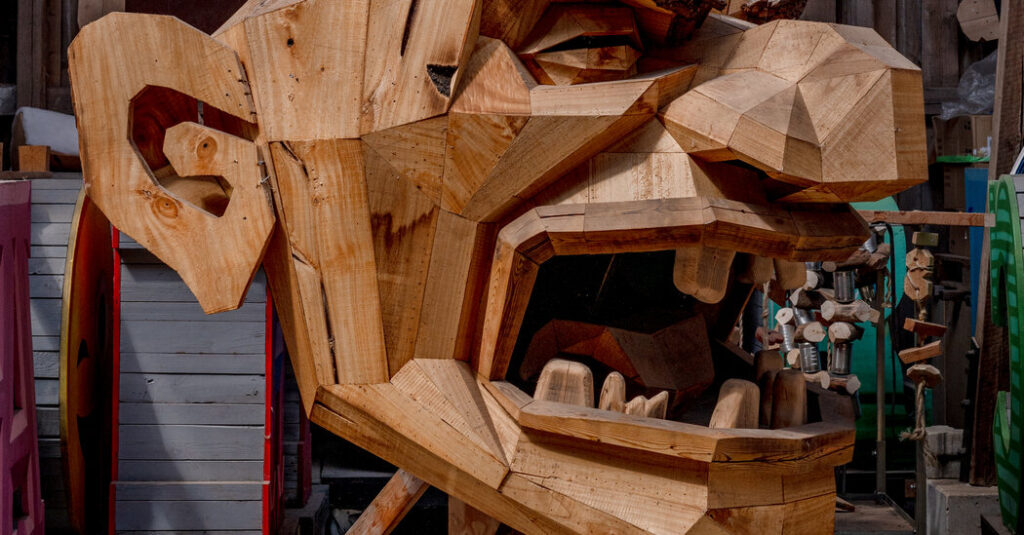
It was a few weeks before his debut exhibition in a museum, and Thomas Dambo was peering into a storage unit containing the raw materials for the show. It was filled with trash.
Dambo had scavenged the junk from recycling stations near Copenhagen and was preparing to fashion it into a landscape of garbage featuring some of his signature giant troll sculptures. For over a decade, Dambo, 47, has created nearly 200 trolls from recycled wood and installed them in off-the-beaten-track spots, in places from Scandinavia to California.
Like his fellow street artist Banksy, Dambo has a huge worldwide following. Fans seek out Dambo’s trolls in the wilderness and share their findings online. But approval from the art world has been elusive — until now. Dambo’s exhibition, “The Garbage Man,” opens Sunday and runs through Nov. 29 at the Arken Museum of Contemporary Art, southwest of Copenhagen.
“I am not the weirdo in the forest anymore,” Dambo said in an interview. “What I have created is interesting and cool to the people who run the cultural world.”
Dambo fans often climb onto the trolls to pose for photographs, but the presentation at the Arken Museum will be a little more staid. “You won’t be allowed to touch the trolls and you won’t be allowed to touch the piles of garbage,” said Rasmus Stenbakken, a curator at Arken. He added that the museum was nevertheless preparing for an influx of visitors, and he expected many of them to be first-timers at the institution.
The concept for “The Garbage Man,” Dambo explained, would be a playful inversion of his usual practice: It would look as if a group of trolls had broken into the museum and dragged in mounds of trash to build a human out of garbage.
He was hyper-aware of his own waste, he said, and hoped the show would change people’s relationship with garbage. There should be no shame, he said, in “opening a trash can and looking inside to take something of value.”
“Trash is not disgusting,” Dambo said. “It’s disgusting to throw it out.”
Dambo was introduced to dumpster diving as a child in the Danish city of Odense, where he would go to the local recycling station with his father. As a teenager, Dambo listened to American hip-hop artists like KRS-One and Chuck D, and he started making graffiti with a group of friends. He wasn’t very good, he said, but graffiti was where his “fire for the arts” started.
While studying at the prestigious Kolding School of Design, he took a job in a warehouse, a gig that gave him access to a large amount of plywood, and he began thinking about making recycled sculptures with a street art ethos. “Nobody was doing that,” Dambo recalled thinking. “I could claim that spot.”
His work with recycled wood began with 250 birdhouses that he put up all over Denmark as he cycled around on his cargo bike. It felt like a “hack,” he said, “because nobody is going to call the police” over a birdhouse.
They were well received, and Dambo went on to experiment with larger recycled art projects: a cardboard boat, a temporary hotel made from boxes, and gigantic animals, like a pink pony made from wood that Dambo installed in the Osterbro neighborhood of Copenhagen. (The pony was later stolen, but Dambo tracked it down and got it back.)
Dambo has been interested in trolls since childhood, when he first learned of the beasts from Nordic folklore. He made his first examples in Denmark in 2014, and over the years, he began installing them farther afield.
The trolls have a particular following in the United States, where Dambo has scattered them across 22 states, with plans to build them in the remaining 28. He was drawn to America’s “big, wild spaces,” he said, adding, “We don’t have anywhere you can get lost like that in Denmark.”
In Breckenridge, Colo., one of the trolls drew such large crowds that it was relocated to a more out-of-the-way location. A troll that he created for the 2025 Burning Man festival now has a permanent home at Filoli, a historic property about 30 miles from San Francisco. And this week, one of Dambo’s trolls burned down in a park in Austin, Texas, the city’s Fire Department said.
Dambo works with a team of over 20 assistants to build the trolls on a 54-acre farm near Roskilde, Denmark, where he lives with his wife and twin sons. The property, which he calls “Rancho Dambo,” features workshops, a sauna, a bar and a huge collection of discarded materials, including cable drums, wooden pylons, plastic boxes, trash cans and refrigerators.
The work of Dambo’s studio is almost entirely funded by commissions from local governments, nonprofits and festivals, though Dambo said he can accept only a fraction of the requests. “I can then decide which countries, and where to go from there,” he said.
Many of Dambo’s assistants have worked with him for years. One of them, Julian Lynch, met Dambo in 2011 at the Roskilde Festival, the annual music event that takes place near the ranch, where Lynch now lives. In an interview in one of the workshops, Lynch explained how the team has honed the troll-building process over a decade.
The heads take two or three weeks to make in the studio, Lynch said, before the body is constructed with locally sourced, recycled materials and the help of extra volunteers. “With every troll, we build a little community,” Lynch said, “and people are craving community.”
Dambo oversees as much of the work as he can, though he “can’t control all the small things,” he said. For those, he leans on studio assistants like Lynch and the volunteers. That collaboration could be seen as a kind of “recycle school,” he said, which spreads the word about the importance of reusing trash.
At Arken, Dambo has devised what he called a “trash hurricane” that surrounds the trolls and their human sculpture. These piles of garbage invite artists and institutions to reconsider the way they consume materials, while also confronting local visitors with items they might have thrown away.
It was also an opportunity, Dambo said, to use materials like cardboard and textiles, which would perish outside, and to make something that went beyond trolls. While those were his “number one hit,” he said, waste was his overarching focus. “My art is not the trolls; my art is to change the perspective of trash,” he added.
That project involves a lot of energy and ambition. He said he was “manifesting” an onward life for the Arken trolls, in which they “will go to one of the top five museums in the United States.”
Stenbakken, the curator, said that creating a museum presentation had “posed a fun challenge” for the artist. For “The Garbage Man,” Dambo has had to reckon with crowd and fire safety regulations, as well as the architecture of the building, which has curtailed the trolls’ size.
It will be a different experience for Dambo’s fans, too, who must pay for admission during the museum’s opening hours, in contrast to the freedom of the outdoors. Dambo said he still felt that the trolls were best viewed in nature, where people can have a less regimented interaction.
While the Arken show had offered a new opportunity and departure, Dambo wasn’t sure that his art belongs in museums. “I’m a street artist and a graffiti artist,” he said. “I don’t go to the fancy cafe. I like to sit on a bench and drink a beer with my homeboys.”
Thomas Dambo: The Garbage Man May 24 through Dec. 29 at the Arken Museum in Ishoj, Denmark; arken.dk.
Michaela Towfighi contributed reporting.
The post He’s Trolling Your Trash, and Turning It Into Art appeared first on New York Times.