When President Trump tapped Kevin M. Warsh in January to become the next chair of the Federal Reserve, the policy debate centered on when, not whether, interest rates would fall.
Four months later, the economic challenges Mr. Warsh inherits after being sworn in on Friday have all but eviscerated expectations of any immediate decrease in borrowing costs.
Inflation is rising again, and the war with Iran has raised concerns that surging commodity prices could broaden out and morph into a more persistent problem. Officials at the central bank have begun to embrace the possibility that rates may need to rise to get inflation back to their 2 percent target, a reality that has rattled global bond markets and sent yields on U.S. government debt soaring.
Higher rates are far from what Mr. Trump wanted from Mr. Warsh. The president had long stipulated that whomever he chose to replace Jerome H. Powell — who faced such aggressive attacks from Mr. Trump that he decided to stay on as a Fed governor after his term as chair ended to safeguard the institution — agreed with him about the need for lower borrowing costs.
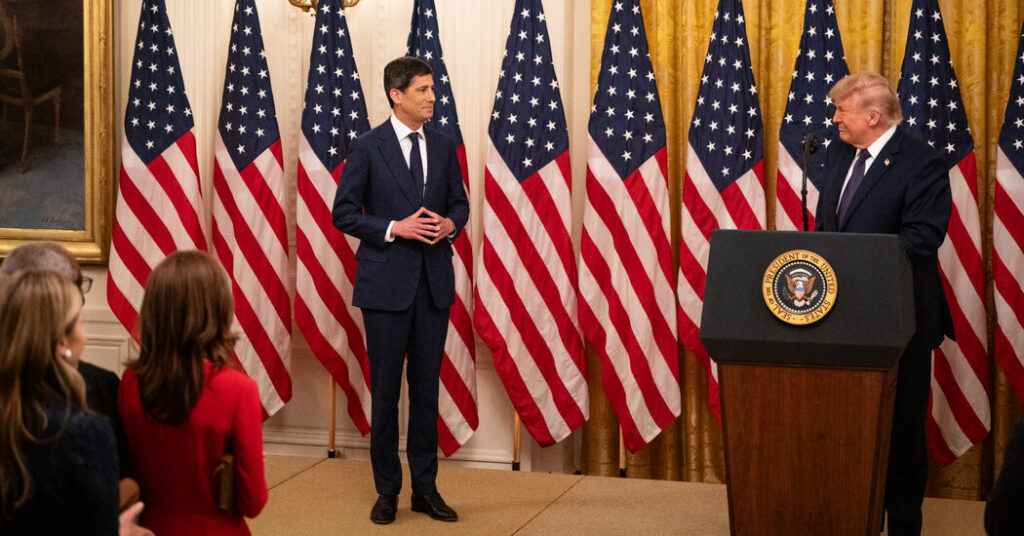
But even Mr. Trump now appears cognizant of the tough task ahead for Mr. Warsh. Days before his swearing-in, which was held at the White House for the first time in roughly 40 years, the president said he would let him “do what he wants to do” on rates.
At Friday’s ceremony, Mr. Trump emphasized that he wanted Mr. Warsh to be “totally independent,” a nod to concerns about the president’s own unrelenting pressure campaign against the Fed for lower rates.
“Don’t look at me. Don’t look at anybody. Just do your own thing and do a great job,” Mr. Trump said.
Speaking after the president, Mr. Warsh acknowledged the importance of that independence, saying that when the Fed pursues its goals of low, stable inflation and a healthy labor market “with wisdom and clarity, independence and resolve, inflation can be lower, growth stronger, real take-home pay higher and America can be more prosperous.”
He also made clear he would lead a “reform-oriented Federal Reserve — learning from past successes and mistakes both, escaping static frameworks and models, and upholding clear standards of integrity and performance.”
Long before the war with Iran began, Mr. Warsh promoted several theories for how the Fed could approach its job differently and open new pathways to lower rates.
He has argued that the Fed has fundamentally misunderstood how inflation gets embedded in the economy and focused too much on growth, rather than overzealous fiscal and monetary stimulus, as a source of price pressures. Its approach for measuring inflation was also flawed, he contends, emphasizing instead a shift toward real-time metrics and those that remove outliers caused by tariffs and energy shocks, for example.
To Mr. Warsh, the Fed has also underappreciated the magnitude of the economic shift due to artificial intelligence and other policies that boost supply, like deregulation. He expects wider use of the technology to unleash a productivity boom that will eventually help temper inflation, giving the Fed space to lower rates.
He has also argued that if the Fed shrinks its massive portfolio of government bonds and mortgage-backed securities, it can offset whatever increase in long-term rates that is likely to follow by lowering short-term ones.
The appetite among Mr. Warsh’s 18 new colleagues at the Fed — 11 of whom will vote alongside him on policy matters — to take a leap on any of these theories appears tepid at best. Resurgent inflation has honed policymakers’ attention on the latest data, as they search for signs that their policy settings are tuned appropriately.
“The president wanted the Fed chair to come in and cut rates, and that was a very plausible story several months ago,” said Joseph Lavorgna, who until recently served as an adviser at the Treasury Department. “But the way the economy and the geopolitics have evolved, it just doesn’t make it likely, at least in the near term.”
Mr. Lavorgna, now chief economist at SMBC Nikko Securities America, said the Fed’s next move was more likely to be a rate increase. “How much is hard to say,” he added.
According to Michael Feroli, chief U.S. economist at J.P. Morgan, there is little evidence that rates at the current range of 3.5 percent to 3.75 percent are constraining the economy.
The labor market has held up relatively well, with the unemployment rate stable at 4.3 percent. Consumers, buoyed by ebullient stock markets, are still spending. And economic growth has defied the odds and expanded at a solid pace.
“It just doesn’t feel like we’re restrictive,” said Mr. Feroli, who forecasts the Fed to hold rates steady for the rest of the year before raising them in 2027. “We might even be easy.”
Just before Mr. Warsh’s swearing-in, Christopher J. Waller, a Fed governor who once competed with Mr. Warsh for the top job, became the latest policymaker to acknowledge mounting inflation risks and the dimming prospects of lower rates anytime soon.
“I can no longer rule out rate hikes further down the road if inflation does not abate soon, and that is especially true if measures of inflation expectations, some of which have risen lately, show signs of becoming unanchored,” he said in prepared remarks at an event in Germany.
Mr. Waller seemed especially worried about Americans’ expectations about future inflation shifting significantly higher, given that the energy surge caused by the war represents the fourth economic shock in five years that has exacerbated price pressures.
“The lesson for policymakers is that it may be easy to look through a single price shock such as tariffs, but it may be more risky to look through a series of positive price shocks,” he said.
After Mr. Waller’s remarks, traders in federal funds futures markets penciled in a rate increase by the end of 2026.
Mr. Warsh will need to contend with far more than internal opposition if he decides to pursue lower rates right now. Any indication that the Fed is not taking inflation seriously risks jolting financial markets. If investors begin to question how wedded the central bank is to its 2 percent target, the Fed will have to raise rates even more aggressively to re-establish its credibility.
“This is an environment where if you’re too aggressive with the policy rate or the balance sheet, you very well could see that become counterproductive and you end up with higher, not lower, long rates,” said Dan Ivascyn, chief investment officer of PIMCO, the asset manager.
Complicating the outlook for rates is a potential shift in how the Fed communicates with the public. Mr. Warsh has argued that Fed officials speak out too much and offer too many signals about the path forward for policy. He says this boxes in the Fed, making it harder to change course when economic conditions change, and mutes important signals that policymakers would otherwise glean from markets.
Instead of getting an independent judgment on the state of the economy, for example, markets reflect what the Fed has signaled, creating a self-reinforcing loop. Mr. Warsh believes this makes investors ill prepared for moments when the central bank needs to shift its stance quickly, creating new hazards.
Mr. Warsh has not specified how significantly he will scale back the Fed’s communications. His first meeting, in June, is one where the Fed publishes economic projections that show how policymakers see rates, inflation, unemployment and growth changing in the years ahead.
In March, the last time the “dot plot” was published, most officials expected one rate reduction this year. That cut is likely to be pared back in next month’s forecasts, with some officials even writing down a rate increase down the line.
What is less clear is how much slack Mr. Trump will give Mr. Warsh if rate increases start to be seriously considered.
“Kevin Warsh went into this eyes wide open,” Mr. LaVorgna said. “Maybe you can make a case to hold off on rate hikes, but beyond that, the data is going to ultimately dictate where things go, not political pressure.”
Colby Smith covers the Federal Reserve and the U.S. economy for The Times.
The post Warsh Takes Charge of a Fed Facing Rising Inflation Threat appeared first on New York Times.