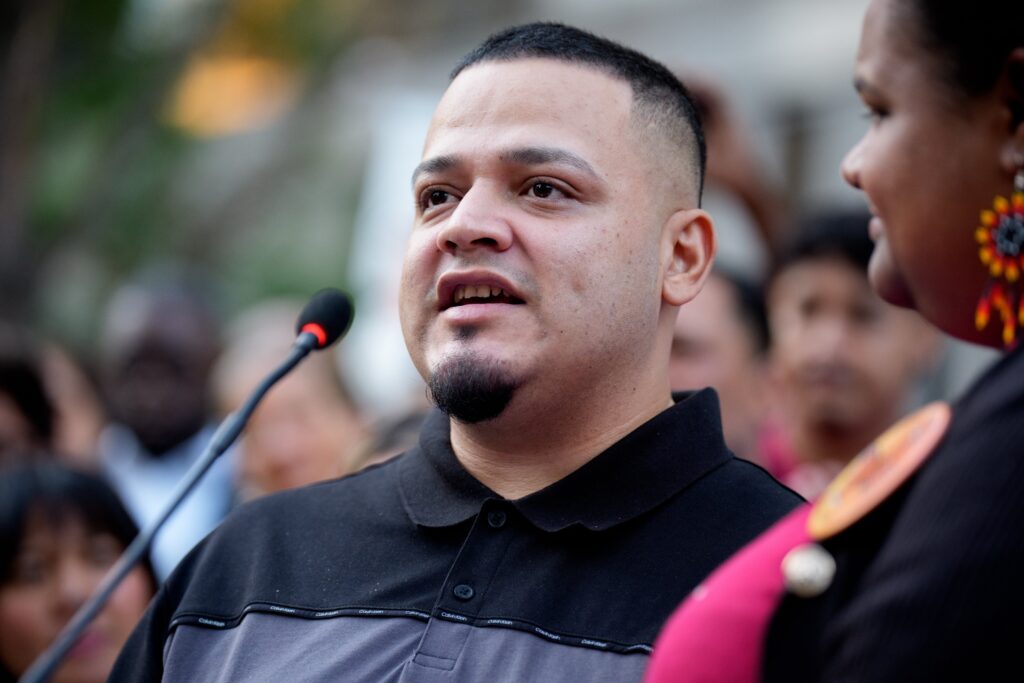
A federal judge on Friday dismissed the Justice Department’s human-smuggling case against Kilmar Abrego García, ruling that the Trump administration improperly brought it to punish him for successfully challenging his illegal deportation last year.
U.S. District Judge Waverly D. Crenshaw Jr. in Tennessee wrote that “evidence before this Court sadly reflects an abuse of prosecuting power.”
The decision delivered an extraordinary defeat for the administration, which marshaled the resources of multiple federal agencies to publicly malign Abrego after court rulings concluded that officials had unlawfully deported him to his native El Salvador, in violation of a 2019 immigration court order.
Crenshaw’s ruling also marked the first time a judge validated what has become an increasingly common defense raised by high-profile defendants targeted by the Justice Department in Trump’s second term: the claim that they are being prosecuted not in pursuit of justice but rather for political revenge.
In a decision released Friday afternoon, the judge acknowledged the incredibly high bar defendants must meet to warrant a case’s dismissal on those grounds. It requires defense attorneys to prove that charges would not have been brought but for improper, vindictive motives on the part of government attorneys.
Crenshaw, who was appointed by President Barack Obama, wrote that in Abrego’s case, it was clear that the investigation into him was tainted “with a vindictive motive.”
The judge wrote in a 32-page opinion that while he found “insufficient evidence of actual vindictiveness,” he also concluded that the Trump administration “failed to rebut the presumption of vindictiveness.”
Crenshaw said he did not reach the conclusion lightly. But the evidence, he wrote, showed that if Abrego had not challenged his deportation, the Trump administration would not have brought this case.
The Justice Department assailed the decision.
“Another activist judge has placed politics above public safety,” a spokesperson said in a statement. “The judge’s order is wrong and dangerous, and we will appeal.”
Despite Crenshaw’s decision, U.S. immigration authorities have previously signaled they still intend to deport Abrego, 31 — who entered the country illegally from El Salvador as a teen. But their ability to do so has been temporarily blocked by a federal court ruling from Maryland, where Abrego lives with his wife, a U.S. citizen, and children.
Abrego praised the judge’s ruling.
“Justice is a big word and an even bigger promise to fulfill; and I am grateful that today, justice has taken a step forward,” he said in a statement released by We Are Casa, an immigrant advocacy group.
Sean Hecker, an attorney for Abrego, said his client was the “victim of a politicized, vindictive White House and its lawyers at what used to be an independent Justice Department.”
“We are so pleased that he is a free man,” Hecker said in a statement. “Justifiably so. As this Administration continually chips away at our democracy, we remain grateful for an independent judiciary that will dispassionately apply binding precedent to the facts.”
The high-profile legal saga that ensnared Abrego since officials deported him to a notorious terrorism prison in El Salvador in March 2025 has, for many critics, come to epitomize what they view as some of the worst aspects of the Trump administration’s aggressive deportation agenda.
Abrego, who before his deportation was working as a sheet metal apprentice, has said he came to the United States as a teenager to flee death threats from the Barrio 18 gang.
An immigration judge in 2019 barred officials from deporting him to El Salvador because of that gang threat. Multiple courts have found that when the Trump administration re-detained him and sent him to the Central American nation anyway last year, it did so in violation of that order.
Still, for months the administration resisted demands from the courts — including one from the Supreme Court — to facilitate Abrego’s return to the United States. Officials publicly derided him as an “animal,”a gang member and a domestic abuser, accusations he has repeatedly denied.
Abrego was brought back to the country only last June, after federal investigators reopened a previously shuttered investigation and secured a two-count indictment against him.
The case was based on evidence from a 2022 traffic stop in Tennessee in which authorities alleged Abrego was caught driving nine undocumented immigrants through the state as part of a human-smuggling conspiracy. They opted not to pursue charges at the time.
In a ruling last year finding that there was a “realistic likelihood” that the investigation was reopened in retaliation for embarrassment Abrego had caused the administration, Crenshaw cited an interview then-deputy attorney general Todd Blanche gave to Fox News about the case the day the indictment was unsealed. Blanche is now the acting attorney general.
Blanche had said then that the department launched its probe of Abrego after the federal court in Maryland found the Trump administration “had no right to deport him.”
“What should we do as the Department of Justice when a judge is accusing us of doing something wrong?” Blanche said. “We have an obligation … to investigate it, and that’s exactly what we did.”
Though Robert McGuire, the former acting U.S. attorney in Nashville, maintained that the decision to prosecute Abrego was his and his alone, emails from top deputies in Blanche’s office later surfaced showing that officials at the highest level of the Justice Department took an interest in the case from the beginning.
Messages made public as part of Abrego’s legal fight showed McGuire was in near constant communication with Blanche’s office about the investigation.
Department of Homeland Security officials referred the human-smuggling matter for possible prosecution in late April 2025, just days after the Supreme Court ordered the government to facilitate Abrego’s return to the United States.
And even before McGuire had informed his superiors in Washington that he was opening his own investigation, a top Blanche aide already had taken steps to facilitate a potential prosecution.
Associate Deputy Attorney General Aakash Singh, who oversees matters involving U.S. attorney’s offices around the country, emailed McGuire the same day the Tennessee prosecutor has said he learned of the 2022 traffic stop to set up a conversation about a potential witness who might have information about Abrego’s alleged crimes.
Singh also helped flag potential evidence for McGuire that the then-U.S. attorney said he was previously unaware of. In one email, he described bringing a case against Abrego as a “top priority” for the Justice Department.
In his opinion Friday, Crenshaw sharply rebuked the chain of events, saying the Trump administration effectively handled the case backward.
“Blanche started the investigation to implicate Abrego,” Crenshaw wrote.
Crenshaw wrote that McGuire was “a talented, gifted prosecutor brought into a tainted investigation.”
And while federal officials argued McGuire alone decided to indict Abrego without influence or direction from Blanche or Trump administration agencies, Crenshaw wrote, “the persuasive, credible, objective evidence shows otherwise.”
Crenshaw’s decision is one of the first to address the proliferation of vindictive-prosecution motions challenging Justice Department cases during Trump’s second term.
Other top Trump administration targets — including former FBI director James B. Comey, New York Attorney General Letitia James, Rep. LaMonica McIver (D-New Jersey) and voting machine company Smartmatic — have all sought the dismissal of criminal cases filed against them, saying they were brought to satisfy Trump’s personal grievances.
Charges against Comey and James were thrown out last year before they could fully advance in court. The cases were dismissed over issues with the appointment of the U.S. attorney overseeing them.
A judge has not yet ruled on the vindictive-prosecution claim filed in Smartmatic’s case.
And in McIver’s case, a federal court in New Jersey ruled in November that she had not proved that charges alleging she had assaulted federal officers during a visit to a New Jersey immigration detention center were brought in retaliation for her critical statements about the Trump administration. She has appealed that decision.
For Abrego, it was not immediately clear how Crenshaw’s ruling would affect his ability to return to the life he led before his deportation last year.
He has been under house arrest in Maryland due to the Tennessee case, but the order restricting his movements was vacated Friday along with the indictment.
Abrego has stated he is willing to voluntarily leave the country for Costa Rica if immigration authorities would permit him. However, the Trump administration so far has refused that offer and threatened to send him to countries in Africa instead.
The post Judge drops criminal case against Kilmar Abrego García, deeming it vindictive appeared first on Washington Post.