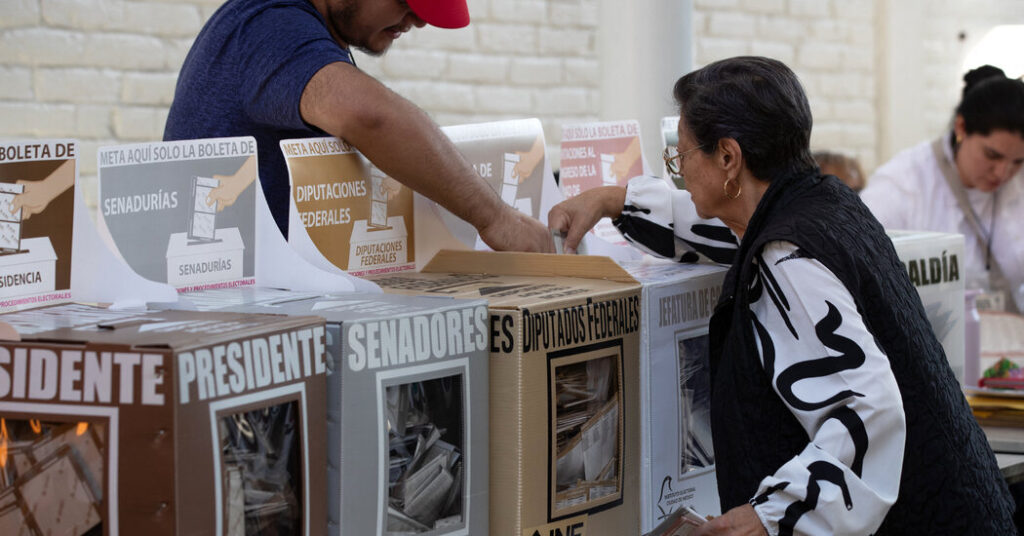
Mexico’s dominant political party advanced legislation on Thursday to annul elections compromised by foreign interference, a clear shot at Washington after months of complaints from President Claudia Sheinbaum that the Trump administration is threatening Mexico’s sovereignty.
The proposal, which will be voted on next week, broadly defined such interference to include any “political, economic, diplomatic or media pressure intended to alter the popular will.”
That expansive wording could also open the door for Morena — Ms. Sheinbaum’s party, which effectively controls all three branches of the Mexican government — to hold on to power or sideline opposition candidates. Next year, Mexicans will vote in important midterm elections that could alter Morena’s control of the government.
The new rules would empower Mexico’s electoral court, which is largely aligned with Morena, to throw out a vote if it determines a foreign government, organization or citizen unfairly meddled in the election.
The legislation reflects Ms. Sheinbaum’s struggle to deal with President Trump. She has vacillated between cooperating with the U.S. government and trying to safeguard Mexican sovereignty, including in ways that have raised questions in Mexico about the government’s priorities.
Most recently, Ms. Sheinbaum has acted to protect the governor of Sinaloa state, a member of her party, after U.S. prosecutors charged him with colluding with drug cartels. She has denied a U.S. request for his arrest, saying she needs more proof he broke the law. She couched her decision in a broader defense of Mexico and its leftist movement from what she calls efforts by the “international right” to undermine her government.
As a result, the U.S.-Mexico relationship has hit one of its rockiest stretches in years.
“I see it as an echo of the president’s pro-sovereignty activism in response to concerns in Mexico about an intervention by Trump,” Rafael Fernández de Castro, a former foreign policy adviser to the Mexican government, said of the bill.
On Thursday, hours after the bill was introduced, a congressional committee approved it for a full vote in the Mexican Congress next week. The legislation is expected to pass, as Morena controls both chambers.
The bill’s definition of foreign interference is particularly broad, including any “intervention of foreign governments, organizations or agents to favor or harm candidacies, political parties or electoral authorities.” This encompasses foreign illicit financing, disinformation campaigns and territorial violations, among other things.
Territorial violations have become a growing point of tension between the United States and Mexico.
For more than a year, Mr. Trump has threatened military strikes against Mexican drug cartels, which Ms. Sheinbaum has said would be a violation of Mexico’s sovereignty. And last month, it was revealed that Central Intelligence Agency personnel were operating on the ground in Mexico after two officers died in a car crash. Ms. Sheinbaum said her government was unaware of their presence in Mexico.
Trump Administration: Live Updates
Updated
- Trump to deploy 5,000 troops to Poland, surprising the Pentagon.
- G.O.P. pulls a measure to end the Iran War, lacking votes to defeat it.
- Judge appears hesitant to order work stopped on reflecting pool.
Shortly after, the United States indicted the Sinaloa governor and nine other current and former Mexican officials, several of whom are political allies and members of Morena, accusing them of protecting a drug cartel. Since then, Ms. Sheinbaum has hardened her rhetoric against the Trump administration and foreign media, claiming they are colluding to bring down Morena’s left-wing movement.
“There are many people who are betting on the defeat and failure of the Mexican government,” she said.
Near the end of his term, Ms. Sheinbaum’s predecessor and mentor, Andrés Manuel López Obrador, was also wary of foreign interference. In 2024, after The New York Times revealed that U.S. officials had spent years investigating allegations that some of his allies had met with cartel members and taken millions of dollars from them, Mr. López Obrador suggested that the probe was an example of foreign meddling against Morena.
“What gives one country the right to meddle in the internal affairs of another?” he said at a news conference at the time.
The recent bill does not explicitly mention that episode or cite the United States. On Thursday, reporters asked the bill’s sponsor, Ricardo Monreal, the lead Morena congressman in Mexico’s lower chamber, whether the proposal was a response to Mr. Trump’s threats against Mexico. “It has to do with everything,’’ he said.
Mr. Monreal dismissed concerns that the bill could help Morena strengthen its grip on Mexico, saying, “I completely reject the existence of any such risk.” Instead, he said, the rules would protect Mexican sovereignty “from any country in the world that might be tempted to intervene in Mexico through economic, diplomatic or military means.”
Mr. Trump has proved eager to influence other nation’s elections.
In Hungary this year, Vice President JD Vance campaigned for Viktor Orbán, then the nation’s prime minister. During a campaign rally, Mr. Vance even phoned Mr. Trump, who praised his right-wing ally over speakerphone for the Hungarian crowd. And 36 hours before Hondurans chose a president in November, Mr. Trump threatened to cut U.S. support for the country if his preferred right-wing candidate did not win. That candidate, Nasry Asfura, went on to win by less than 27,000 votes.
The United States casts a far larger shadow over Mexican politics, given the two nations’ shared border, $1 trillion in trade and often tricky cooperation against cartels.
Publicly, Ms. Sheinbaum and Mr. Trump have continued to speak positively of one another. Last week Ms. Sheinbaum said she “had a cordial and excellent conversation” with Mr. Trump, and on Thursday, she met with Homeland Security Secretary Markwayne Mullin in Mexico City.
Since 2014, Mexican law has allowed for elections to be annulled when candidates exceed campaign spending limits, buy illegal media coverage or use illicit funds, such as money from drug cartels.
Yet Mexican officials have essentially never thrown out an election under those rules, said Javier Martín Reyes, a law professor at the National Autonomous University of Mexico. That is because the law requires proof that any irregularity was intentional and decisive to the election’s outcome. “Those are things that are almost impossible to demonstrate,” Mr. Martín Reyes said. The bill proposed on Thursday carries a similar requirement, he said.
Lila Abed, a former Mexican government official who runs the Mexico Program at the Inter-American Dialogue, a Washington-based research group, said that Morena was trying to show Mexicans that it would stand up to the United States. Yet the broad wording of the rules could also “create the legal basis for Morena to bring down any candidate that it doesn’t want.”
But, she added, “what’s more concerning is the state of U.S.-Mexico relations.”
Jack Nicas is The Times’s Mexico City bureau chief, leading coverage of Mexico, Central America and the Caribbean.
The post In Jab at Trump, Mexico Targets Foreign Election Meddling appeared first on New York Times.