Republicans postponed their plans to pass tens of billions of dollars in additional funding for immigration enforcement agencies Thursday after widespread frustration over a new $1.8 billion “Anti-Weaponization Fund” derailed the bill.
Senate Republicans peppered acting attorney general Todd Blanche with questions about the payout fund during a lunch meeting Thursday, according to two Senate GOP aides familiar with the meeting, including who would be eligible for the money and what guardrails would exist to prevent people convicted of attacking the Capitol on Jan. 6, 2021, from benefiting.
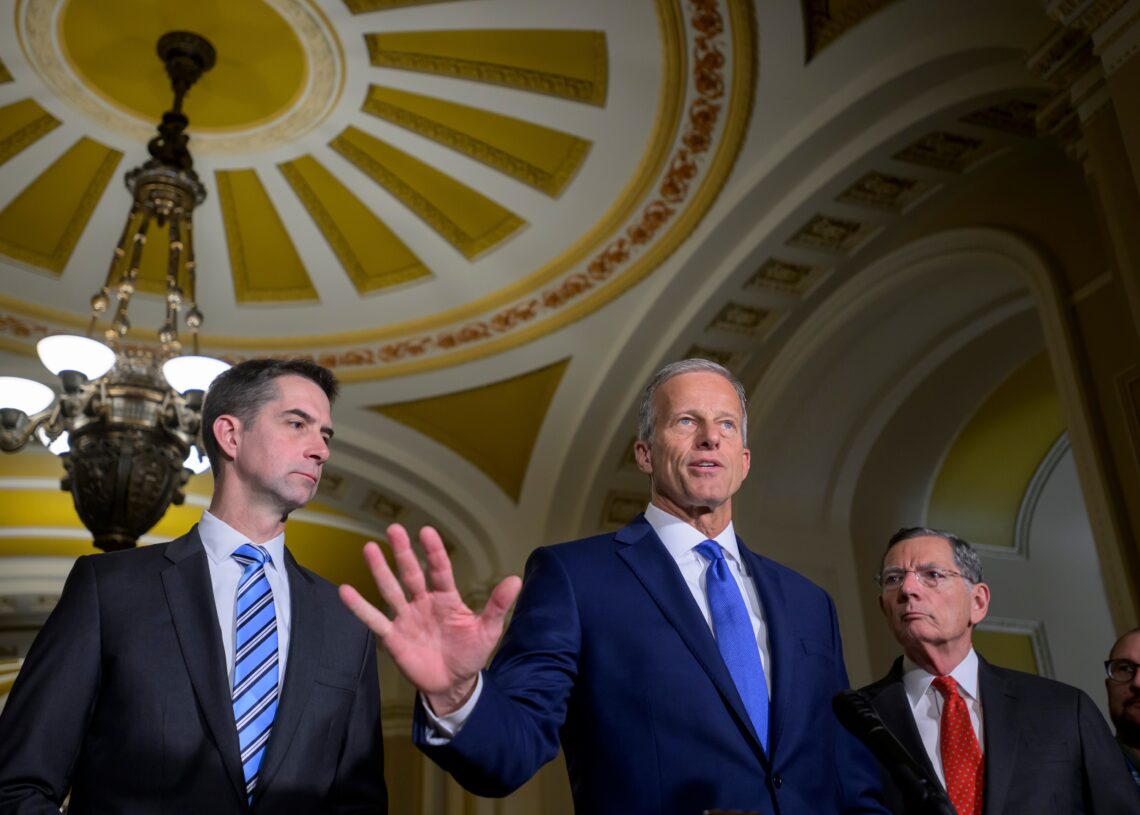
The two aides, who spoke on the condition of anonymity to describe internal negotiations, said Blanche did not adequately answer those questions. Senate Republicans didn’t feel they could move forward with their funding bill without a plan on how or whether they would address the new fund in the legislation, they said. White House officials “need to help with this issue, because we have a lot of members who are concerned,” Senate Majority Leader John Thune (R-South Dakota) told reporters after the meeting.
Republicans had been rushing to finish the legislation before they leave for a week-long Memorial Day recess. President Donald Trump had told lawmakers to complete the funding bill by June 1.
Senators were already going to strike their plans to include in the bill $1 billion for security in the “East Wing Modernization Project,” as the administration refers to Trump’s proposed ballroom and underground renovations, as multiple Republican senators made clear they wouldn’t support it. The bill could lose only three GOP votes and still succeed if all senators were voting.
The administration’s new fund to compensate people who believe they were victims of “weaponization” by the Justice Department was created Monday, when Trump agreed to drop his family’s lawsuit against the IRS in exchange for the creation of the fund and an agreement to bar audits of his, his family’s and his businesses’ past taxes.
Thune’s decision to send senators home without passing the bill caps a week in which Trump and Senate Republicans have found themselves at odds more than at any other point in the president’s second term.
Many Senate Republicans were shocked when Trump endorsed Ken Paxton, the Texas attorney general who is challenging Sen. John Cornyn (R-Texas) in a primary runoff next week, over their long-serving colleague. That came after Sen. Bill Cassidy (R-Louisiana) lost his primary to a Trump-endorsed opponent.
But almost nothing Trump has done since returning to office has aroused more opposition among Senate Republicans than the Justice Department’s move to set up a fund that would dole out taxpayer money to people who claim to be victims of the federal government, with few additional details.
Thune acknowledged Thursday that Trump’s role in Cornyn’s and Cassidy’s races inflamed the reaction to the fund.
“I think it’s hard to divorce anything that happens here from what’s happening in the political atmosphere around us,” he said. “There’s a political component to everything we do around here. So yeah, you can’t disconnect those things.”
A Justice Department official confirmed that Blanche talked with Republican senators to explain that the Justice Department fund for Trump allies had “nothing to do” with the immigration enforcement funding bill.
Democrats, who oppose the bill, criticized Republicans for the delay.
“The Republican Party is in complete disarray,” Senate Minority Leader Charles E. Schumer (D-New York) said on the Senate floor. “They’re in complete meltdown. They can’t come to an agreement with each other. They’re angry with each other.”
The blowup over the payout fund is a surprising setback for Republicans’ strategy to fund Immigration and Customs Enforcement as well as Border Patrol without Democratic votes.
The bill is intended to fund ICE and Border Patrol through the rest of Trump’s term. It would be the conclusion of a months-long debate between Republicans and Democrats over funding the immigration agencies that started in January amid the administration’s immigration surge in Minneapolis.
Lawmakers agreed to fund the rest of the Department of Homeland Security through a bipartisan measure that passed last year, leaving only ICE and Border Patrol to be funded through the party-line reconciliation bill. Reconciliation bills bypass the filibuster’s 60-vote threshold but must adhere to strict rules.
All but two Republican senators voted last month to support the budget resolution, the first step in the time-consuming process of passing the legislation.
Republicans had sought to include $1 billion in the bill for presidential security, including security measures related to the ballroom that Trump is trying to build where the East Wing of the White House once stood.
But the ballroom security funding has run into roadblocks. The Senate parliamentarian rejected Republicans’ attempt to include it on Saturday, ruling that it did not comply with the budget rules to which the bill must adhere to allow Senate Republicans to pass it without Democratic support.
Trump on Wednesday called for firing the parliamentarian. But even if the parliamentarian had signed off on the measure, Senate Republicans said they did not have enough votes to pass the bill with funding for the Secret Service and the ballroom.
A handful of Senate Republicans have shown an increasing willingness to break with Trump less than six months ahead of the midterm elections. Cassidy and three other Republicans voted Tuesday to advance a war powers resolution that would block Trump from further strikes on Iran.
“We want to support the president every time it’s good policy and good politics and never … if it’s either bad policy, bad politics or both,” Sen. Thom Tillis (R-North Carolina) told reporters. “This is about our elections. There’s not a presidential election on the ballot.”
There has also been bipartisan pushback in the House of Representatives against the payout fund. Reps. Brian Fitzpatrick (R-Pennsylvania) and Tom Suozzi (D-New York) introduced a bill Thursday to bar federal money from being used to pay out claims through the new fund. Securing a vote on the bill would require support from House Speaker Mike Johnson (R-Louisiana), or a successful discharge petition signed by a majority of House members.
Mark Berman contributed to this report.
The post Senate GOP, frustrated with Trump’s $1.8B payout fund, delays vote on ICE money appeared first on Washington Post.