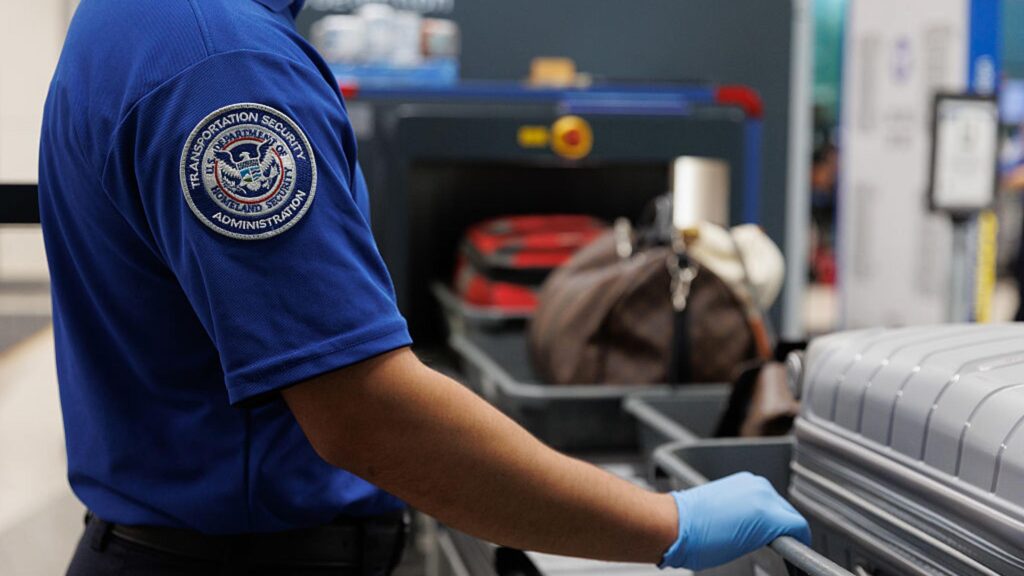
The Transportation Security Administration (TSA) has launched an initiative to enable private companies to take on a larger role in airport security screening, marking a step toward President Donald Trump’s broader goal of further privatizing the process.
TSA Gold+, announced this week, expands a decades-old program that already permits some airports to use contractors to conduct screenings instead of federal TSA officers.
The TSA says the aim of the new program is to move travelers through checkpoints more quickly while maintaining federal oversight and security standards.
Here’s what to know about TSA Gold+—and how it could impact your air travel moving forward.
What is TSA Gold+?
Though its name may echo those of various premium memberships and services on offer for consumers across industries, TSA Gold+ is not a program directed toward travelers looking to expedite or otherwise ease their passage through airport security. In fact, it’s not a program for travelers at all, but rather a public-private partnership that airports will be able to join—or not.
Under the program, airports can choose to partner with private security contractors to manage more of their screening operations, including staffing and certain screening technologies, while the TSA continues to oversee compliance with federal safety requirements.
According to the TSA, the initiative is designed to “rapidly enhance security” by allowing faster adoption of advanced technology and more tailored checkpoint operations.
The program builds on the TSA’s existing Screening Partnership Program, under which private companies currently handle passenger and baggage screening at 20 airports nationwide. But while in that model the TSA has maintained operational authority and provided screening equipment, Gold+ would see private partners take on a broader role, including responsibility for managing equipment and introducing new technologies. The agency said it would continue its federal oversight role, however.
The TSA said airports that participate in the new program would be able to customize screening operations for their facilities and potentially reduce exposure to staffing shortages that have, at times, disrupted airport operations during federal funding lapses.
“As the next evolution of the Screening Partnership Program (SPP), TSA Gold+ is a transformative upgrade to offer airports the opportunity to ‘opt in’ to a public-private screening model tailored to their unique needs, ensuring continuity and operational stability even during federal government shutdowns,” a TSA spokesperson said in a statement to TIME.
Read more: The DHS Shutdown Is Over, But Its Impact on the TSA—and Air Travel—May Persist
The agency also said the program could bring “the latest technology” to airports, including artificial intelligence tools, to help increase capacity and reduce wait times, though it did not detail how those gains would be achieved.
The TSA has said that participating airports will incur no additional cost.
What airports will participate in the program?
No airports have publicly announced plans to join TSA Gold+ yet.
Twenty U.S. airports already participate in the existing Screening Partnership Program, including San Francisco International Airport, Kansas City International Airport, Orlando Sanford International Airport, and Atlantic City International Airport.
How will this impact travelers?
For now, travelers are unlikely to see any notable changes resulting from the new program. Security rules remain the same. Identification requirements remain the same. TSA PreCheck and other expedited screening programs—which are separate from TSA Gold+—will continue to operate.
But as airports opt in to the new program and enable private contractors to take an expanded role in screenings, the impact of Gold+ could be felt by passengers moving through security.
TSA says Gold+ could help reduce wait times and improve consistency by allowing airports to adopt newer technologies, including artificial intelligence tools, more quickly. If funding for the TSA lapses again, as it has in multiple government shutdowns in recent months, the agency has also suggested the program could shield airports from staffing shortages and resulting travel disruptions.
At San Francisco International Airport, which participates in the Screening Partnership Program, private security staff from Covenant Aviation Security continued to be paid during the recent partial government shutdown, helping the airport avoid some of the staffing crisis that caused hours-long lines at others around the country, ABC7 reported.
“There is no denying that having a more modernized security program would be ideal for the millions of Americans who fly each day,” Katy Nastro, a travel expert with Going.com, tells TIME. “And there is no denying that our current transportation security program is fragile after the last elongated partial shutdown, which crippled some airport processing times.”
But Nastro says that it’s possible that rather than bolstering consistency in airport screenings, the program may lead to more variability in the process. “Airports opting into this could have very different tech, processing times, etc.” she says. “The experience over time at some airports could look better, or worse, from what we currently experience.”
Supporters of TSA Gold+ say the opt-in model is designed to give airports flexibility, allowing them to tailor staffing and screening systems to their size and passenger volume.
But critics, including labor leaders representing TSA officers, have said they oppose further privatization efforts such as TSA Gold+, arguing that they could weaken accountability and transparency in airport security operations.
Everett Kelley, who leads the American Federation of Government Employees union, which represents TSA agents, told NPR that the plan could result in lower pay for contract screeners compared with federal TSA officers, and raised concerns that the government would be shifting direct control of some of the most sensitive aviation security technology to private companies.
Nastro similarly expressed worry about the new program enabling private companies “to provide not just personnel but also the tech.”
“A main concern around this,” she said, “would be if for-profit companies are providing everything, is their main goal the same as a fully government program, which is for the protection of the traveler?”
The post What Travelers Should Know About TSA’s New Gold+ Program appeared first on TIME.