Trump administration officials, confronted by overlapping outbreaks of Ebola and the hantavirus, have taken a more aggressive approach to locking down potentially exposed people than in past outbreaks, surprising many public health experts.
The instructions from President Trump’s top health appointees, some of whom were vocal opponents of Covid-era public health restrictions, go well beyond tactics that were used to successfully contain previous outbreaks of the diseases.
They include instructing more than a dozen people to remain in home confinement with twice-daily checks; quarantining 18 passengers from a hantavirus-infected cruise ship at a federal facility in Nebraska for 21 days; and keeping American doctors exposed to Ebola at foreign hospitals, rather than repatriating them to specially designed U.S. treatment centers.
“I am utterly stunned by that,” said Jennifer Nuzzo, director of the pandemic center at Brown University’s School of Public Health.
Many senior federal officials, including the health secretary, Robert F. Kennedy Jr., have been staunch supporters of medical freedom, championing people’s right to choose or decline medical countermeasures, including vaccines.
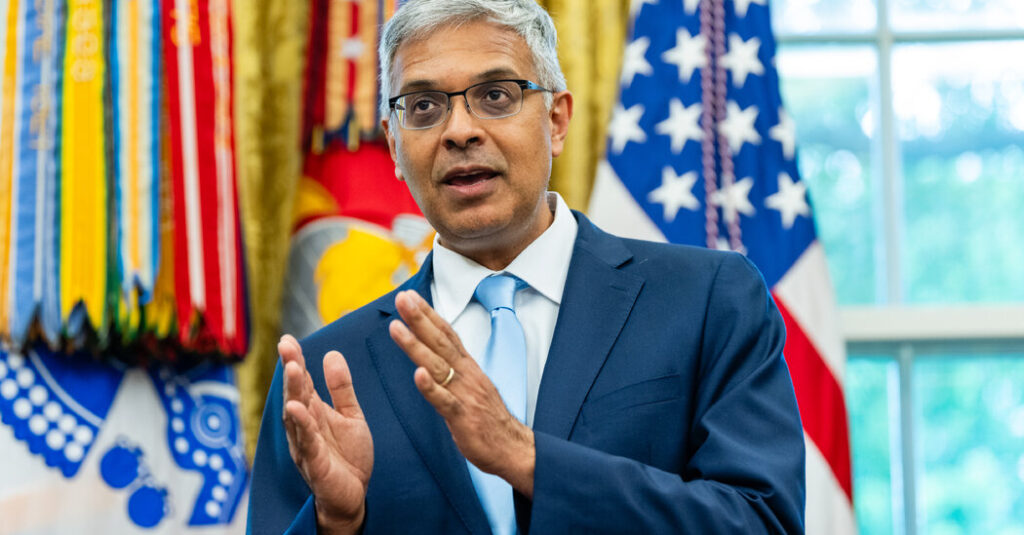
Dr. Jay Bhattacharya, acting director of the Centers for Disease Control and Prevention, drew notice during the Covid-19 pandemic for suggesting that the coronavirus should be allowed to spread freely among healthy people, and for arguing that mandatory quarantines and lockdowns were harmful to society.
Last week, however, he issued quarantine orders that cited public health laws for two passengers who wanted to leave the Nebraska facility and isolate in their home states.
“I think it’s incredibly ironic that Jay Bhattacharya signed the quarantine orders himself, given how much of a devotee he has been to the notion that people should feel free to do what they want if they are sick, regardless of who may be harmed,” said Gigi Gronvall, a biosecurity expert at the Johns Hopkins Center for Health Security.
In a call with state officials on Monday, Dr. Bhattacharya said he supported medical freedom, but that the decision to keep the passengers in Omaha had come from the highest levels of government, according to people familiar with the matter who spoke on condition of anonymity because of fear of retaliation.
Dr. Bhattacharya did not specify who had made the decision or respond to a request for comment. The White House also did not immediately respond.
Predicting the best course of action in an outbreak or other public health emergency can be difficult, though experts note that the United States has previous experience with successful containment of Ebola and the hantavirus, unlike with Covid-19, which was caused by a novel coronavirus.
The cruise ship on which the hantavirus outbreak emerged, the Dutch-registered MV Hondius, began its journey in Argentina in early April. Three passengers later died from the virus, and several others became ill or tested positive.
The roughly 150 cruise ship passengers were back in their home countries by mid-May, including the 18 Americans who were taken to Omaha. At least seven other Americans left the cruise earlier and returned home independently, on commercial flights, and are now being monitored by local health departments. Another 16 are being watched because they were exposed to an infected person during travel.
Federal health officials said when the 18 American passengers arrived in Nebraska that they would need to be screened and monitored for several days, but suggested they could leave soon if they were not showing signs of infection. Dr. Bhattacharya said in interviews that the passengers would be handed off to state officials within a day or two.
That plan seemed to change abruptly. Two of the Americans who were planning to leave, including Angela Perryman, 47, received orders requiring them to stay in federal quarantine for at least two more weeks. Health officials told her they would contact law enforcement if she tried to depart before then, she said.
“We were told that if we exercised our right to leave, then we would be detained against our will,” said Ms. Perryman, who remains in the facility and is threatening legal action.
Federal guidance to states monitoring people potentially exposed to the hantavirus also seemed to become more restrictive. The agency initially suggested that states check in with those quarantining at home once a day, by phone, text or email. It also said high-risk contacts should avoid commercial flights, but could travel via chartered flight or personal vehicle, and should limit their activities outside the home.
But the C.D.C. now says “individuals with high-risk exposure should stay home and away from others.” They may spend time outdoors within walking distance of their homes, the guidance says, as long as they avoid crowds and contact with other people.
The new guidance also tightens monitoring, recommending in-person check-ins by local health agencies twice a day.
“You’re actually putting health workers at risk by making them go in person to somebody’s home that has a potential infection,” said Dr. Debra Houry, who had served as the C.D.C.’s chief medical officer before she resigned in August in protest of the Trump administration’s actions. “It’s better to do the video monitoring.”
In practice, the protocol for monitoring people in their homes has differed from state to state.
Texas is sending health officials in person to check on two people who were passengers on the ship, following the current federal guidance. In Kansas, three people who were not on the ship but crossed paths with a person who had the hantavirus are being observed at the University of Kansas Medical Center.
In Georgia, the health department is making video calls twice a day to monitor two people at home. “Our travelers are following this strictly, so they do not need to be forced to do so,” according to a department spokeswoman.
In King County, Wash., officials instructed those who are quarantining not to take Tylenol or other medicines that reduce fever so that they can accurately gauge whether they are ill.
Hantavirus is a rare family of viruses carried by rodents that is most commonly transmitted to people through breathing in viral particles from dried rodent droppings or urine. Before this outbreak, there had been a total of 890 cases in the United States since surveillance began in 1993. About 35 percent of them were fatal.
The Andes virus, found primarily in Argentina, is the only hantavirus species known to spread from person to person. Scientists who have studied hantaviruses for decades agree that the Andes virus is not particularly contagious, and is unlikely to lead to a bigger outbreak.
The restrictive measures being followed by the Trump administration contradict the C.D.C.’s own procedures in 2018. The agency successfully contained a case of the Andes virus after a woman who had traveled to Argentina and Chile developed symptoms and, while ill, traveled on two domestic commercial flights. She was discharged from a hospital to her home after recovering.
Officials tracked down 51 of the woman’s 53 contacts and advised them to self-monitor their temperature daily for 42 days from their last contact with her. None became ill with the hantavirus.
During previous Ebola outbreaks, U.S. residents exposed to the virus were evacuated back to the United States for observation or medical treatment. Taxpayer funds have been used to build state-of-the-art facilities to quarantine and treat Americans in just such circumstances, Dr. Nuzzo said.
“If we don’t repatriate Americans in an emergency, what does citizenship mean?” she added. “I think it’s going to erode confidence in government.”
Sonia A. Rao contributed reporting.
Apoorva Mandavilli reports on science and global health for The Times, with a focus on infectious diseases and pandemics and the public health agencies that try to manage them.
The post Health Experts ‘Stunned’ by Trump Officials’ Strict Quarantine Measures appeared first on New York Times.