Philip Glass doesn’t turn 90 until the end of January. But the Glass year is already officially underway with two curiously enlightening projects this month. .
Paris Opera has mounted a shocking new “noir” production of Glass’ luminous “Satyagraha” that the company is now streaming(after a short delay thanks to a typical French strike) until May 24. It features a startling performance by Anthony Roth Costanzo that significantly elevates the American countertenor to the small ranks of one of the world’s most important singers.
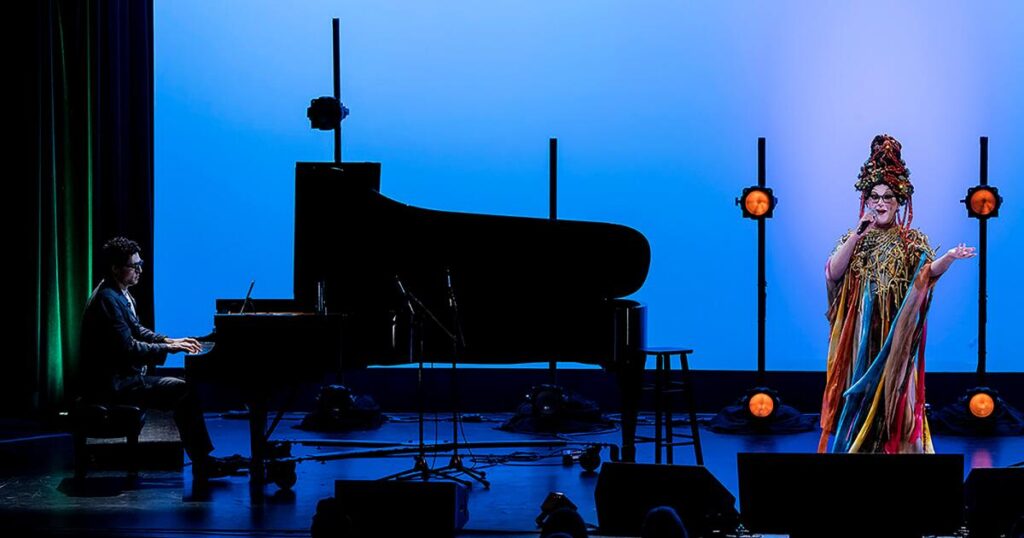
Meanwhile, UC Santa Barbara Arts & Lectures commissioned “Philip Glass and the Poets,” which was devoted to an overlooked but revealing aspect of what makes Glass great: his attachment to a repetitive, wandering musical style that may not seem to go anywhere but that creates an atmosphere where anything and everything can happen.. Its premiere was Sunday night at Campbell Hall featuring readings by performance artist Taylor Mac, in flamboyant drag, and unflustered dancer/choreographer Lucinda Childs.
In both cases, these events focus on the operation of music and text. Glass has written a significant quantity of pure music for a vast range of instrumental forces from multiple genres and cultures. He may well hold a record for the breadth of his collaborations. Robert Wilson, Woody Allen, David Bowie, Ravi Shankar, Fody Musa Suso, Allen Ginsberg, Gustavo Dudamel, Jerome Robbins, Gidon Kremer, Martin Scorsese, Brian Eno, David Henry Hwang, Leonard Cohen, the Dalai Lama — the list goes on and on and on.
With Ginsberg, Glass acted as the straight man. He would begin a performance with Glass at the piano, bestowing an ingratiating quality of quiet pleasure on Ginsberg’s flowery imagery. Gradually Ginsberg’s text and manner would rise to one of arresting spiritual and sexual ecstasy, while Glass remained ever cool.
The effect was not, however, of Glass and Ginsberg in two different worlds, but of Glass giving Ginsberg the space for expansiveness, while giving listeners the permission to follow Ginsberg to unexpected extremes.
The UCSB event was elegant. The pianist was the composer Timo Andres, who is also one of the participants in a traveling Glass etudes show. Members of the San Francisco Girls Chorus joined in on two songs. It began with Childs, who was dancer, choreographer and reciter in Glass’ “Einstein on the Beach,” sharing excerpts from that seminal Glass/Wilson music theater masterpiece.
At 85, Childs has lately been elegantly staging opera (including another recent “Satyagraha” in France), reciting bits of “Einstein” text by Christopher Knowles. You listen to DJs on 1980s New York City radio; you shop in the supermarket; you feel the earth move — it’s all one. Childs’ exquisite intonation never falters. In a miraculous Einsteinian world, no word, no image, no emotion wants emphasis.
Ginsberg, who died almost 30 years ago, has been a hard act to follow. In 2019, Patti Smith took on the challenge in this same auditorium, adding a new edge. Mac’s approach was to employ a sense of irony to the best-known Glass/Ginsberg collaboration, “Wichita Vortex Sutra.” Irony has little use for ecstasy, but Mac’s specialty is spectacle, and his slow, if showy, disposal of wit brought a new immersive quality to the text and performance.
Andres was the suave glue of the evening. He also performed Glass’ solo etudes 13 and 16. Theater is in Glass’ blood, and theater can inspire even his most untheatrical music, such as his set of 20 solo piano etudes that have in recent years become practically standard repertory. The 17th etude, however, happened to be inspired by a Ginsberg poem, “Magic Psalm,” movingly read by Mac, who also added a poem of his own, “While Ginsberg Wept.”
Glass, of course, set much text to music, sometimes with little stress and other times with robust melodiousness, but in all cases the words came first. That robustness was his way with Cohen’s “Mother Mother,” and of “Father Death’s Blues,” in which Ginsberg extols death as the world’s greatest lover.
In “Like This,” from the Glass/Wilson virtual reality “Monsters of Grace”originally created in 1998 at UCLA, the 12th century whirling dervish Turkish poet Rumi exalts the wonder of dying of love. Virtual reality fell short back then at Royce Hall, but the wondrous beauty of Mac and Childs did not.
Watching the stream of Paris’ “Satyagraha” after the resplendent (and possibly one-time) “Glass and The Poets” made the City of Light appear quite dark. The opera is regularly treated as an effusive exhibition of Gandhi’s coming of age in South Africa, along with the context of nonviolence as expressed by Tolstoy, Rabindranath Tagore and Martin Luther King Jr. The libretto is adapted from the Bhagavad Gita. The mix of worlds is giddy, begging for splendor.
In Paris Opera’s Palais Garnier, the stage in this production is stark and bare, like a rehearsal room or a prison. The characters wear 1940s street clothes. No longer historical figures, they are not named. The atmosphere is that of violent military oppression.
The direction is by choreographers Bobbi Jene Smith and Or Schraiber, who along with Costanzo and baritone Davone Tines (also in the cast) are founding members of the experimental AMOC (American Opera Company). The revelation for Paris was to turn “Satyagraha” into both a dark political exercise as well as an emotive dance-opera. On top of that, Constanzo’s soaring yet sensitive countertenor makes Gandhi, originally a role for tenor, all the more compelling.
All of this is hard to take at first. But the performance is sensational. However violent Gandhi’s quest for nonviolence becomes, the production evolves into impossible radiance, turning the opera into something resembling a Passion Play. In Costanzo’s closing aria, “Gandhi’s Prayer,” he leaves behind, Christ-like, hatred and exultation for unsullied love.
Everything around Gandhi remains grim but Costanzo’s voice and eyes glow with a supernatural aura.
Glass’ newest work will be one of his largest symphonies and include a text by Lincoln to celebrate America’s 250th anniversary. It was commissioned by the National Symphony at the Kennedy Center in Washington, D.C. Ever sensitive to text, Glass, however, withdrew the premiere, feeling the current political character of the Kennedy Center no longer reflective of Lincoln’s words.
The Boston Symphony will now present the premiere July 5 at Tanglewood. The symphony will then have performances at the Cabrillo Festival in Santa Cruz on July 31. It will reach the Los Angeles Philharmonic in March.
The post Turning 90, Philip Glass gets revelatory tributes that show his work in new light appeared first on Los Angeles Times.