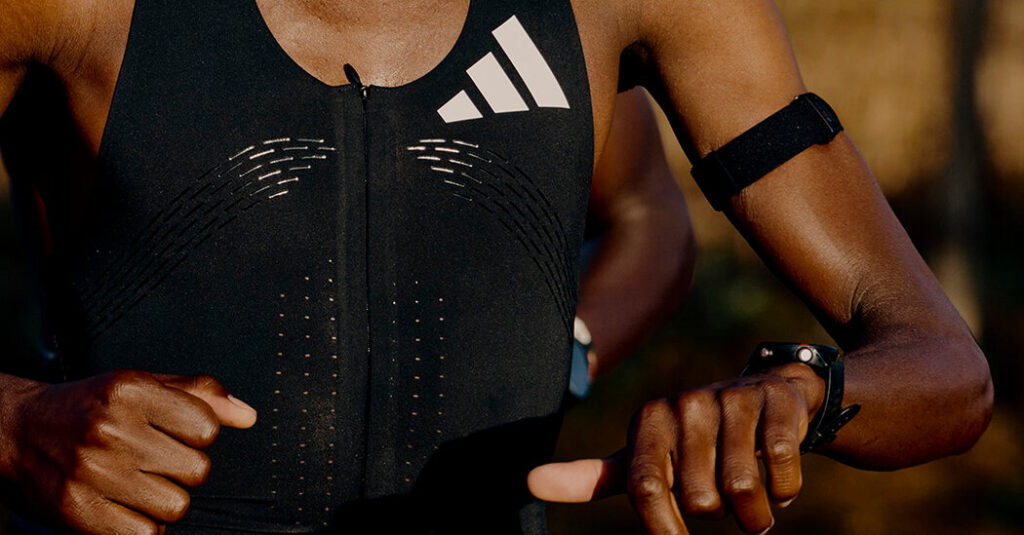
Last summer, Patrick Jacobson, a senior apparel designer at Adidas, sent a team of emissaries to Kenya to present some of the world’s top marathon runners, including the world-record holder Sabastian Sawe, with the Techfit Endurance Suit, the brand’s innovative running kit nearly a decade in the making. After the presentation, the reps sent a memo back to the company’s headquarters in Herzogenaurach, in southern Germany, to report the response.
“We showed them the suit,” the memo began. “And they all started laughing.”
Jacobson was not surprised by their reaction. The Endurance Suit, a tight, structured unitard which covers everything from the shoulders to the knees, combines deep biomechanical research with cutting-edge materials technology, using bands of thermoplastic polyurethane to stabilize the pelvis and hips — an effect that the company claims reduces fatigue over long distances and confers a more than 1 percent increase in running economy.
It’s radically different than the shorts and singlets favored by elite runners, many of them from Kenya and Ethiopia. Jacobson was used to them balking at the idea of running in a full-body suit.
“Every time we would show the suit to athletes, they would just burst out laughing,” Jacobson said. “The suit was almost dead quite a few times.”
Last month, two Adidas athletes, Sawe and Yomif Kejelcha, became the first two men in history to finish a marathon in under two hours, racing the London marathon in 1:59:30 and 1:59:41. Sawe trained in the Endurance Suit and seemed committed to wearing it for the race. It wasn’t until he was spotted at the starting line in a plain white singlet and black shorts that Jacobson learned he had decided against it.
“I guess today’s not the day,” he remembered saying to himself.
But Kejelcha did opt for the suit.
“I wanted to use the suit in training as soon I saw it for the first time,” he said. “I feel the hip and back support, and I wanted to use in competition, so I did it. It’s a special one for me.”
And while it’s impossible to measure precisely what impact it had on his performance, the estimated 1 percent improvement would be the difference between his 1:59:41 and 2:01:00. In other words, it’s possible that the Endurance Suit was the edge that got Kejelcha over the finish line in just under the historic two-hour mark.
Apparel designers have long understood that sportswear for runners has a great deal of room for improvement. In the late 1980s, the director of Nike’s sports research lab, Martyn Shorten, developed a concept that came to be called “zoned aerodynamics,” which concluded that runners could benefit from a full body “speed suit” constructed of different materials for each body segment, reflecting the different airflow and drag each produced while in motion. But the technology necessary to implement this idea didn’t exist, so the concept was shelved until 1999, when Nike was preparing for the Olympic Games in Sydney.
It was at the Sydney Games that Nike unveiled the Swift Suit, a hooded, one-piece suit coated in polyurethane, that the Australian sprinter Cathy Freeman wore to win gold in the 400-meter run. Bright green and streamlined, the Swift Suit looked like something an astronaut or a superhero might wear, but the purpose was mechanical rather than aesthetic. “The fundamental premise is that skin is slow,” said Jorge Carbo, a former researcher at Nike who worked in aerodynamics. “If you cover the skin with the right textures, you’re going to get a better improvement.”
Despite Freeman’s winning result, the Swift Suit failed to catch on — partly because runners disliked the constrictive feeling, and partly because the measurable impacts were minimal.
The discoveries soon made their way into other, faster sports, including cycling and speedskating, where Swift Suit-style apparel using zoned aerodynamic principles became the norm. “It worked fantastic for speedskating,” said Len Brownlie, a sports aerodynamics consultant for Nike. “At the Salt Lake City Olympics in 2002, the men who were wearing the Swift skin won all the gold medals. It really did work. I think it changed the sport.”
In running, Nike shifted its focus toward alternative means of providing aerodynamic support. “Nobody doing a two-hour marathon wanted to wear a full-body suit,” Carbo said. “So we started asking ourselves how else we could get those textures to the skin.” They developed a kind of aerodynamic tape called AeroSwift, which could be attached to the arms and legs in thin strips, and built half-length tights with aerodynamic nodules running along the thighs.
When Eliud Kipchoge tried to break the two-hour marathon barrier in 2017 at the Nike Breaking 2 event in Monza, Italy, he ran wearing the AeroSwift tape and the half-length tights, which Jacobson, at Adidas, said was a breakthrough. “Before Eliud ran Breaking 2, we were trying to get our marathon athletes to wear half tights, and they wouldn’t go near them,” he said. “It was a split short or nothing. But as soon as Kipchoge almost broke two hours, and did it in the tights, the runners were like, ‘OK, maybe there’s something here.’ Without Kipchoge doing that, a full body suit in a marathon — completely forget about it.”
The Breaking 2 event, though unsuccessful, was motivating for Adidas, Jacobson said. It drove his team to look for other performance-boosting opportunities in apparel beyond aerodynamics, including cooling, airflow and a more sophisticated kind of structural support. Several years ago, they developed a graded compression tight that would help blood flow in the leg to stave off the effects of fatigue, but the project was pricey, owing to expensive woven materials sourced from Italian suppliers. Jacobson said that while he learned a lot from the project, it “didn’t hit the mark.”
About four years ago, Jessica G. Hunter, a manager of athlete performance at Adidas, started looking into the effect of “stiffening elements” in suits for endurance runners. There was skepticism within the company that clothing could make much of a difference in a marathon. “Leadership didn’t think we would be able to improve running economy with apparel,” Hunter said. “Because nobody had ever done it successfully before.”
Hunter found that the stabilizing elements made runners faster for longer. “What we were trying to do was exploit the connection between the muscles that stabilize the pelvis and trunk and the muscles that stabilize the hip, and how those muscles tend to work together from a pelvic and hip stability,” she said. “In order to do that, you have to have something that crosses the whole body. And the only way to do that is with a full, connected suit.”
Her work was handed off to Jacobson’s team in Germany, where they fine-tuned the stiffening elements — laser-cut bands of TPU — to find “the sweet spot of science and performance with what is comfortable to wear,” Jacobson said.
The completed Techfit Endurance Suit, Jacobson said, “corrects and enhances” an athlete’s form in a race. It functions not unlike the high-tech LZR Racer, built by Speedo in the late 2000s, which reinforced a swimmer’s abdomen muscles to keep them more horizontal in the water.
The LZR Racer was so effective that it was banned from competition almost as soon as it was introduced — though not before dozens of world records were set in the suits. But while the dawn of performance-enhancing “super shoes” in the late 2010s provoked World Athletics to impose new regulations, banning shoes over 40 millimeters in height and with more than one carbon fiber plate, there are currently no rules in marathon running specific to apparel. These “super suits,” however beneficial to runners, are entirely unregulated, perhaps in part because so few top runners have embraced them.
“We were hoping to make a suit that was disruptive enough that people would freak out about apparel like they started freaking out about the shoes,” Hunter said.
“So far it hasn’t happened, which is a little disappointing,” she said. “If Kejelcha hadn’t come in second place, it might have been a bigger deal.”
The post This Suit Makes You Faster. But Will Runners Wear It? appeared first on New York Times.