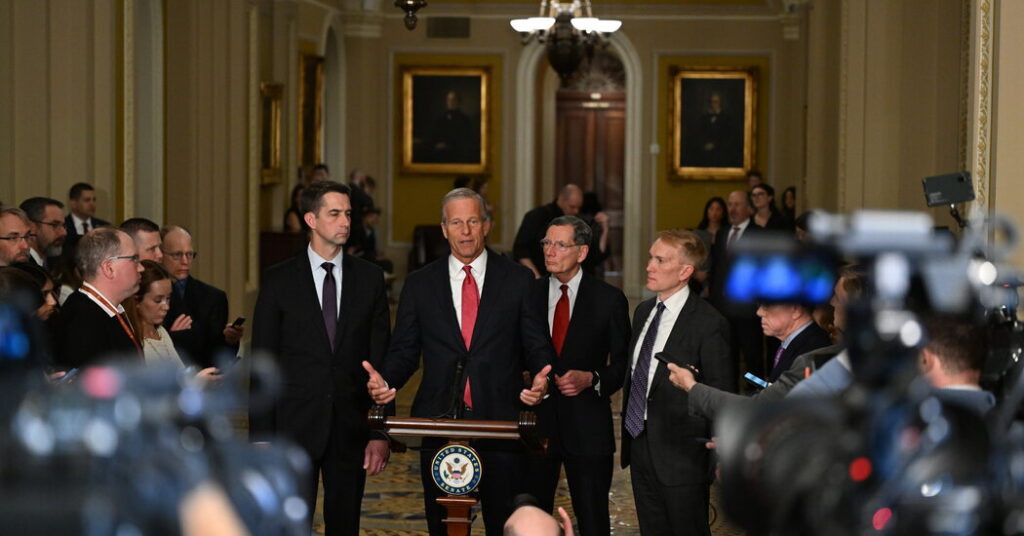
Republicans in Congress on Thursday faced a series of tests of their willingness to buck President Trump, with votes expected on his push for $1 billion for his ballroom project, his plan to use a federal fund to pay allies who claim to have been politically persecuted and the war in Iran.
The G.O.P. was expected to bring its filibuster-proof bill to fund Mr. Trump’s immigration crackdown to the Senate floor later Thursday, opening what could be a politically painful election-year debate over Mr. Trump’s priorities.
Leaders had not yet released the text of their legislation on Thursday morning, but they appeared ready to jettison the ballroom funding after several Republican senators objected to including it. They were also exploring adding language to curb the use of a Justice Department fund that Mr. Trump has said he wants to use to pay people who claim to have been unfairly targeted by the government, a plan that some of them have questioned.
Todd Blanche, the acting attorney general, was at the Capitol to meet with Senate Republicans about the fund.
“Our members have very legitimate questions about it, and we’ve had some conversations about if it’s going to be a feature going forward, what it might look like, and how we might make sure that it’s fenced in appropriately,” Senator John Thune, Republican of South Dakota and the majority leader, said Thursday.
The reservations in Republican ranks have been exacerbated by senators’ widespread frustration over Mr. Trump’s retribution-driven intervention in G.O.P. primaries, which has threatened incumbents, and political concerns that appearing to rubber-stamp the president’s personal agenda could cost them support in crucial midterm elections.
Across the Capitol, lawmakers in the House were facing their own politically thorny vote late Thursday afternoon: a resolution that would direct Mr. Trump to end the war in Iran or seek authorization from Congress to continue the military offensive. A similar measure failed on a tie vote last week, as Republican backing grows.
Both measures have set up a critical stress test for Republicans with fewer than six months until the midterm elections. Facing strong electoral headwinds, vulnerable lawmakers would prefer to focus on low-stakes legislation and partisan messaging bills. They will instead be forced to pit political calculations against Mr. Trump’s demand for absolute loyalty.
Passing a filibuster-proof bill so close to Election Day was always going to be a difficult task for Republicans. Though immigration enforcement has long been among the party’s top-polling issues, the G.O.P. lost considerable support with voters after the killing of two American citizens by immigration officers in Minnesota.
But Mr. Trump has made the task exponentially more difficult by insisting that the measure, which provides $72 billion for immigration enforcement, also allocate $1 billion for security enhancements for his prized White House ballroom project.
Polling shows that the ballroom is unpopular with voters, and several senators have said publicly that they oppose the funding. Many moderate Republicans in the House facing competitive re-election bids also warned that they did not want to vote on the funding.
Senate Democrats signaled that they plan to exploit the tension between Mr. Trump and Republicans over the ballroom project and the Justice Department fund, which they criticize as an act of political corruption meant to benefit Mr. Trump and his allies.
The process that Republicans are using to muscle their immigration enforcement legislation through the Senate free of a filibuster, known as budget reconciliation, will allow Democrats to force a series of votes on both issues and many more during a marathon debate that was expected to begin later Thursday and potentially last through the night.
Senator Chuck Schumer, Democrat of New York and the minority leader, said in a social media post on Wednesday that his party would bring “amendment after amendment about Trump’s ballroom, about Trump’s corrupt slush fund, and the rising costs of Trump’s war.”
Michael Gold covers Congress for The Times, with a focus on immigration policy and congressional oversight.
The post Republicans in Congress Face a Series of Tests of Loyalty to Trump appeared first on New York Times.