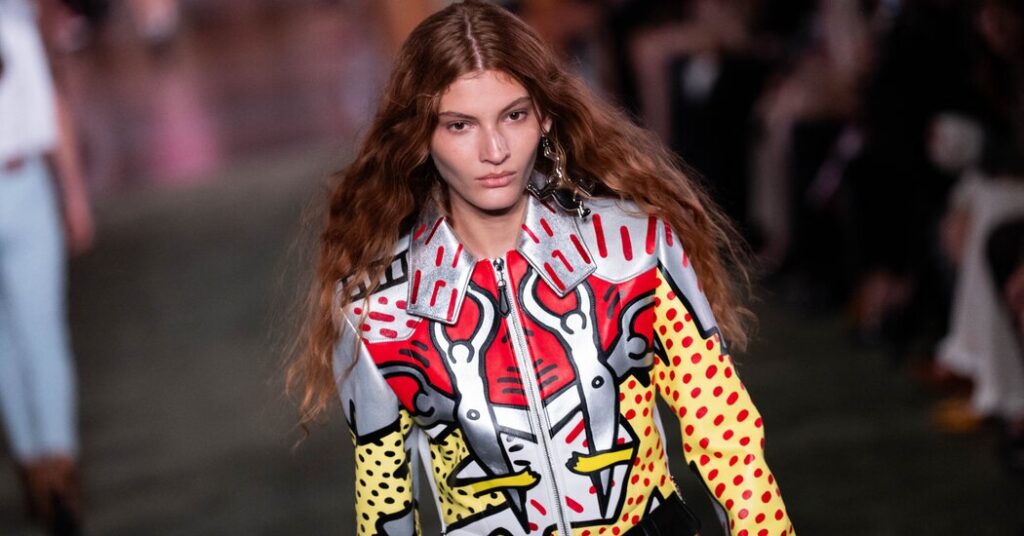
What is it with New York clichés and European designers? On Wednesday, Louis Vuitton took over the Frick to unveil a cruise collection that was nominally a meditation on the uptown-downtown divide and the way fashion travels between the two.
Or so said Nicolas Ghesquière in a preview before the show. Wearing a jeans jacket and matching Levi’s, he perched on a white silk chair and waxed nostalgic about his first trip to New York as an 18-year-old fashion assistant, when he stayed in a gritty NoHo loft from which he explored the city, north and south.
After Gucci’s mega-show in Times Square last Saturday, populated by cartoonish city characters of the most well-dressed kind, it was hard not to think that what was coming was some ready-to-wear psychographic costume party.
But it turned out that something altogether weirder was going on.
Imagine a smashup of the Belle Époque glamour of a private mansion turned museum, filled with soft-focus oils of society doyennes past, and Keith Haring graffiti art with its democratization of the exquisite, and you’ll get the idea.
Then throw in some references to yet more kitschy Americana — denim! cowskin! motorcycle gangs! — plus some boxing paraphernalia. (Why? No idea.) Add a bedazzled Chinese takeout food container and the result was even messier.
Kind of like the city itself. Not like the clothes worn by people who live in the city — these clothes didn’t look like clothes worn by any person I know — but the chaotic, constant remixing of cultures that feeds its imagination.
After all, the old distinctions between life above 42nd Street and below, or 14th Street and below, went by the wayside a few decades ago. The borders between subcultures have become porous. They zig and zag all over the place, often in unpredictable ways, and so did the show.
A lot of the stuff didn’t actually make much sense. Overalls were rolled down to the waist, the bib either tied like a sweater or draped over the hips like a peplum. In a collaboration with the Keith Haring Foundation, the artist’s paintings were reproduced on quilted boxing boots, bags and blouses with squared-off 1980s shoulders that looked like frames for a canvas. A satin-lined fishing vest topped lilac metallic leather pants. Little cocktail dresses were covered in intricate embroidery composed of spaghetti-meets-Haring squiggles. There were a lot of hobo hats. And some sheer, skinny knits.
And then there was the evening wear, which married elaborate Gainsborough ruffles with cropped knit unitards or sheer cargo pants in truly peculiar juxtapositions. Ghesquière has always liked remixing his decades and references in jarring compositions, but this time he may have reached a new extreme.
The point isn’t wearability. It is, by de- and re-contextualizing familiar variables, to make you see them in new ways. That includes the handbags, which are the brand’s bread and butter. And it is also why Vuitton is so committed to aligning itself with museums — or at least, art-world thinking.
In Paris, the house has a long-term relationship with the Louvre. Here, it is doing the same with the Frick. Vuitton has entered into a three-year partnership with the institution, which includes underwriting free public-access days known as Louis Vuitton First Fridays. It will also support the museum’s next three big exhibitions as well as a curatorial position: the Louis Vuitton Curatorial Research Associate.
After the show, Zendaya swapped out the gray minidress she wore to sit front row for a pair of gold satin boxer shorts and a black satin jacket that had just appeared on the runway, the better to model it for the after-party.
The party was held around the corner at Maxime’s, the private club that is an even more exclusive insider corner of the Upper East Side.
Vanessa Friedman has been the fashion director and chief fashion critic for The Times since 2014.
The post Louis Vuitton Mixes Things Up at the Frick appeared first on New York Times.