From time to time, ocean winds shift and the central and eastern Pacific Ocean experiences a heat wave.
The phenomenon, known as El Niño, occurs naturally roughly every three to seven years, and was documented well before people started raising the planet’s temperatures by burning huge amounts of fossil fuels.
But this year’s El Niño is shaping up to be one of the strongest on record, and could arrive as the world is already experiencing some of the hottest temperatures in recorded history as a result of human-driven climate change.
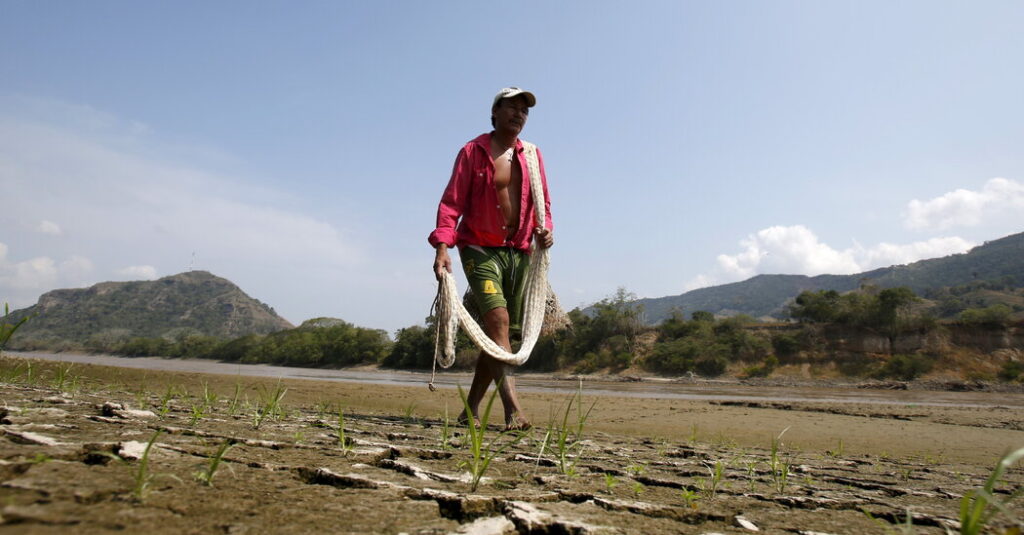
Over the years, El Niño patterns have led to intense flooding in some parts of the world, while other areas, including some of the planet’s most important agricultural lands, face drought. Already, countries are preparing for the possibility of food shortages.
While it’s not possible to know exactly how this El Niño will affect global weather patterns, experts are making dire predictions about what the next couple years might bring.
Historically, the phenomenon has led to wetter conditions in parts of the Americas while raising the risk of intense dryness in South and Southeast Asia, southern Africa and Australia.
This kind of weather pattern usually also reduces the chances of a strong hurricane season in the Atlantic Ocean. On Thursday, the National Oceanic and Atmospheric Administration released its annual hurricane forecast, which called for below-normal activity because of El Niño.
There is no evidence that climate change increases the frequency or intensity of El Niños. But the extra heat they produce can exacerbate the conditions brought on by global warming. “It can amplify associated impacts because a warmer ocean and atmosphere increases the availability of energy and moisture for extreme weather events such as heat waves and heavy rainfall,” according to the World Meteorological Organization.
The strongest El Niños of the past 50 years raised global temperatures by 2 degrees Celsius or more beyond the norm. This year, forecasters are predicting that the burst of warmth could push global temperatures up by an unprecedented 3 degrees Celsius.
A fearsome legacy
As Chico Harlan writes, some academics claim to see the fingerprints of the phenomenon on political and economic crises in ancient Egypt, and on the downfall of the Moche civilization in present-day Peru, more than 1,000 years ago.
An El Niño in the late 1700s might have played a role in the crop failures that contributed to uprisings in the French Revolution, Harlan writes. And in 1877 and 1878, a famine fueled by El Niño killed millions of people across the tropics.
Last year, a team of researchers released a study that analyzed 160 famines in Europe from the years 1500 to 1800 and found that 40 percent of the famine onsets were associated with El Niño.
More recent episodes have also wreaked havoc, Raymond Zhong and Harry Stevens report. El Niños brought severe floods to southern Brazil in 1982-83, drought to Colombia in 1997-98 and below-normal rain and wildfires in the Amazon in 2015-16.
The most recent El Niño, in 2023-24, wasn’t as strong as its predecessors, but it still dried up rivers in the Amazon basin while leading to catastrophic flooding in Brazil’s southernmost state, Rio Grande do Sul, displacing half a million people.
A hotter, but more prepared world
This El Niño is just gathering strength, and the effects will play out over the next year. The phenomenon usually peaks late in the year, pushing up global temperatures in the months that follow.
As a result, many forecasters are predicting that 2027 will be the hottest year on record.
Thanks to advances in agriculture and disaster preparedness, some potentially vulnerable nations claim they are ready for disruptions to food supplies.
Harlan reported that Indian authorities had already held meetings to prepare, and that experts in the country said that grain supplies and improved government food distribution would mitigate the risk of famine.
But a combination of other factors may make the heat pouring out of the Pacific especially disruptive this time. The effective closure of the Strait of Hormuz after the U.S. and Israeli war against Iran has throttled many countries’ access to fuel and fertilizer. And then there is the fact that the planet is already hotter than at almost any time in recorded history.
“What makes it so dramatic is not the event itself and whether it’s a ‘Super El Niño’ or not, but that it is happening in a dramatically changing climate,” Friederike Otto, professor in climate science at Imperial College London, told Climate Home News. “The records will still be broken because of human-induced climate change and the continued burning of fossil fuels.”
Trump administration
Trump to ease restrictions on climate ‘super pollutants’
President Trump announced on Thursday that his administration is easing restrictions on the potent planet-warming chemicals used in air-conditioners and refrigerators — restrictions put in place because of a bipartisan law Trump signed during his first term in office.
The move will slow plans to phase out hydrofluorocarbons, or HFCs, synthetic substances sometimes referred to as “super pollutants.” HFCs are a huge contributor to human-caused global warming. While they linger in the atmosphere for a shorter time than carbon dioxide, they are hundreds to thousands of times more potent at trapping heat.
The new regulations would relax existing requirements for grocery stores, air-conditioning companies, semiconductor plants and others to reduce production and use of the chemicals.
The administration framed it as an effort to lower grocery prices that are testing voters’ finances before November’s midterm elections, and said relaxing the restrictions on HFCs would save businesses and families more than $2.4 billion. — Lisa Friedman and Maxine Joselow
Conservation
A very lonely caterpillar, possibly the last of its kind, has died
The last known caterpillar of its kind has died.
The critically endangered Sacramento Mountains checkerspot was in human care at the ABQ BioPark in Albuquerque. Scientists hoped, against all odds, that it would transform into a butterfly and they would find it a wild mate, creating another generation.
A subspecies of the broader anicia checkerspot butterfly, the insect is found only in the Sacramento Mountains of New Mexico. A few decades ago, the showy butterflies could easily be seen.
But global warming, changes to wildfire, excessive grazing, invasive plants and recreation activities led to its decline, according to the U.S. Fish and Wildlife Service’s interpretation of the best available data. The insect has not been seen in the wild since 2022, but it may still exist. — Catrin Einhorn
One last thing
Europe’s green-energy future has a problem: reindeer
Each summer, Nils Mikkelsen Utsi guides his reindeer to highland pastures overlooking a fjord, known to locals as Repparfjord, in northern Norway. There, under the Arctic midnight sun, female reindeer give birth, and Utsi marks the ears of the calves. His ancestors have done this for generations.
“This is my reindeer district,” he said. “This is my life.”
Nearby, workers are building out the Nussir copper mine, the site of one of Norway’s most contentious environmental disputes. If it’s fully developed, Utsi fears the mine will cast a shadow over his way of life.
For centuries, local cultures in the area have organized their lives around reindeer herding and fishing. Now, as with many traditional cultures, their way of life is colliding with the demands of a warming world. — Alexa Robles-Gil and Sachi Kitajima Mulkey
More climate news from around the web:
-
The number of new coal-fired power plants built around the world hit a 10-year high last year, Carbon Brief reports, though the world burned less coal last year thanks to the growth of wind and solar power. About 95 percent of the coal plants built last year were in India and China.
-
The Wall Street Journal reports on one of the nation’s largest coal-fired power plants in the booming suburbs outside Houston. Three of the plant’s four units don’t use scrubbers to control the release of sulfur dioxide, a pollutant.
Read past editions of the newsletter here.
If you’re enjoying what you’re reading, please consider recommending it to others. They can sign up here.
Follow The New York Times on Instagram, Threads, Facebook and TikTok at @nytimes.
Reach us at [email protected]. We read every message, and reply to many!
David Gelles reports on climate change and leads The Times’s Climate Forward newsletter and events series.
The post A Strong El Niño Could Be Coming. Countries Are Already Preparing. appeared first on New York Times.