The year 2008 was ripe with hardship — mass unemployment, a housing collapse, racial tensions surrounding Barack Obama’s presidential election. With so many forces placing strain on the family unit, you can imagine the attractiveness of a relatively low-cost, culturally inclusive program like the Y.M.C.A.’s Indian Princesses: “Native-inspired” activities created to foster deeper bonds between fathers and daughters.
The playwright Eliana Theologides Rodriguez attended the program during that fateful year when she was only 10 years old. Her reflection on this experience lends an autobiographical tone to her charming play, “Indian Princesses,” which opened Tuesday at Atlantic Theater Company in a co-production with Rattlestick Theater. The production is her Off Broadway debut.
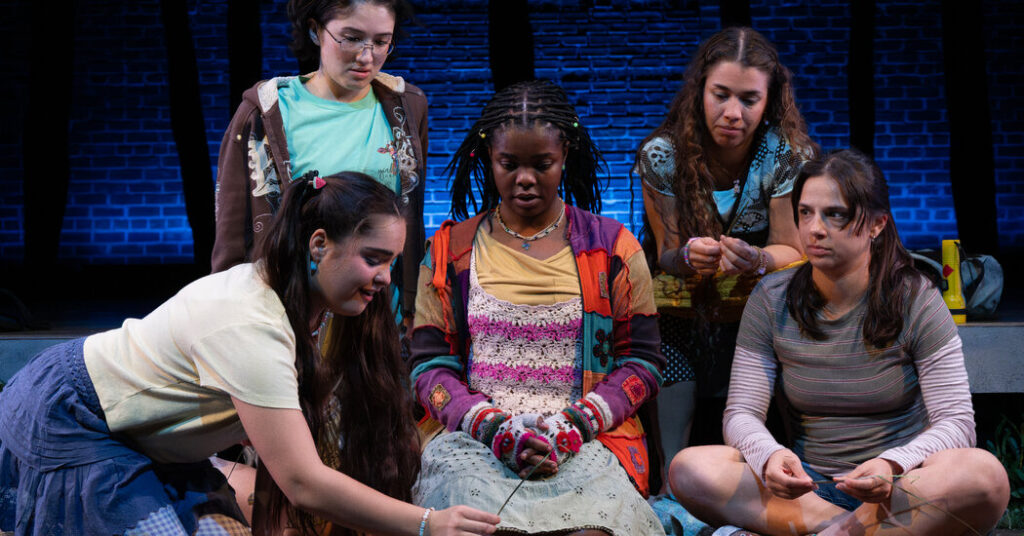
The clarity with which Rodriguez recalls, and overtly mocks, the ignorance running rampant through this program wins our sympathies immediately. The show plops us into a gathering somewhere in the Midwest where the Spirit Squirrels, five girls of color — Lily (Anissa Marie Griego), Hazel (Serenity Mariana), Andi (Rebecca Jimenez), Maisey (Lark White) and Samantha (Haley Wong) — and their hapless gang of all-white fathers and father figures meet for the first time. This small but mighty “tribe” partakes in family-friendly exercises led by Samantha’s cornball of a grandfather, “Chief Glen” (Frank Wood). He has made painstaking efforts to assemble the most diverse group of girls possible to enrich the experience: two are biracial, one is Black and adopted, and two even have Native heritage, much to Glen’s delight. “Wow,” he remarks, “two real-life Indian Princesses. I actually don’t know if this has ever happened in the history of the program!”
Something else that likely has not happened in the history of the program? Culturally informed or historically accurate education. Rather, Glen drowns these girls in a sea of stereotyped, cringe-worthy activities, including making up random chants and passing around “Native American storytelling sticks” — banal bastardizations of oral traditions.
Just as frequently as they are “playing Indian,” we also see the girls in smaller worlds of their own making. Time away from their clueless guardians is spent relishing in their passions and poking around at each other’s bodies and minds — performing the sacred rituals of girlhood. Rodriguez smartly contrasts these scenes against the ones where the men are left to themselves: Note how awkward the grown-ups are at connecting, how much of it is facilitated by beer and ego-jostling, versus how chatty and inquisitive the girls are on their own.
Rodriguez admires these girls. It’s evident in the care she has taken in powering their imaginations. Maisey, for example, the only Black girl in the group, boasts knowledge about the supernatural arts and claims she’s a descendant of wizards and demigods. It’s folklore that the 10-year-old clings to in order to make better sense of her disorientingly white adoptive home, but by the play’s end, we believe in her magic.
The director Miranda Cornell, also making her Off Broadway debut, coaxes pitch-perfect, early-puberty performances from the sublime ensemble of adult actors. Each one does an excellent job of performing the tics, postures and growls unique to her little weirdo. And the costume designer Sarafina Bush is having her own laugh, outfitting the girls in layers of hilariously nostalgic pieces ripped from Old Navy catalogs and Disney Channel stars of the late aughts. Did we really wear so many capri pants?
The production is at its best during the girls’ group scenes, when lines of hyperactive dialogue roll on top of one another in hurried, oftentimes revealing conversations. Confessions of being othered — half-Japanese Samantha has been complimented on her English, half-Mexican Andi is questioned about the severity of her arm hair — slip in under all that feverish talk about Webkinz and “iCarly.”
The play’s title also carries a gravity for audiences to contend with. While it was the official Y.M.C.A.-authorized name — the organization later rebranded it as “Adventure Princesses” — it is also considered by some to be a racial slur. In a program note, Rodriguez describes the term Indian Princess as “an archetype invented to justify the ongoing brutalities of colonization.”
Still, that acknowledgment might not be enough to address every concern. In September, a group of Native theater workers hosted a public town hall, during which the actor-playwright Chingwe Padraig Sullivan referred to the title of Rodriguez’s play as “grossly inappropriate,” connecting it to a broader web of American works whose misuse of language and erasure of Native representation “echo the broken treaties that defined this country.”
It’s true that Rodriguez’s play won’t satisfy viewers looking for a reparative act. It’s most effectively a reflective one. It does not offer corrective cultural lessons, but rather careful insight into how young women of color make themselves even when the building blocks are withheld.
Indian Princesses
Through June 7 at the Linda Gross Theater, Manhattan; atlantictheater.org.
The post ‘Indian Princesses’ Review: A Search for a True Identity appeared first on New York Times.