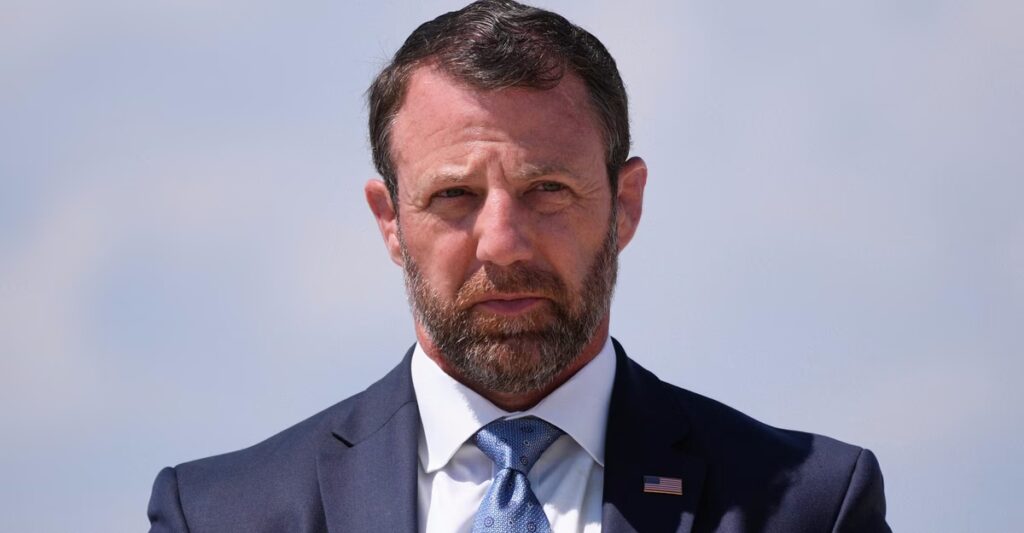
In early April, shortly after Markwayne Mullin took over the Department of Homeland Security, he floated an idea on Fox News that wasn’t taken seriously; it sounded, in fact, like a proposal from someone very new on the job: Mullin threatened to cut federal screening of international passengers and cargo at airports in cities with “sanctuary” policies, which limit cooperation with Immigration and Customs Enforcement. Such a move would trigger flight cancellations to airports in New York, Los Angeles, Chicago, and other major cities and force airlines to reroute to other destinations. Mullin’s proposal seemed more like a wild swing than a real plan.
The new secretary is pushing forward anyway. Last Wednesday, Mullin convened a small group of airline and travel-industry executives at DHS headquarters in Washington and told them he may reduce Customs and Border Protection staffing at major airports that serve sanctuary jurisdictions. Mullin told the executives the locations could include Portland International Airport, in Oregon; New York City–area airports such as John F. Kennedy International Airport and Newark Liberty International Airport; and Washington Dulles International Airport, according to two people with knowledge of the discussion who were not authorized to speak publicly. Mullin did not indicate when DHS would begin the pullback, but it would likely occur sometime after the United States finishes hosting the World Cup in July, the two people told me.
Travel executives are alarmed, and have told DHS that international travelers and cargo cannot be easily routed elsewhere, these people said. The disruption would cause chaos in major U.S. airports and inflict significant economic damage beyond the cities Mullin is seeking to pressure, executives have told the department. “The message was this is a real proposal that is being considered by the administration,” one of the people with knowledge of the meeting told me, calling the potential impact on the airline industry “devastating.”
When Mullin first mentioned the idea during the interview on Fox News, he described it as a creative way to pressure the cities to comply with ICE. The Trump administration wants access to city and county jails so ICE officers can take custody of potential deportees before they are released. “If they’re a sanctuary city and they’re receiving international flights, and we’re asking them to partner with us at the airport, but once they walk out of the airport, they’re not going to enforce immigration policy—maybe we need to have a really hard look at that,” Mullin said. “I’m going to have to be forced to make hard decisions.”
Mullin’s proposal appears to reflect a thin grasp of global-travel logistics, as well as an inflated sense of the government’s ability to impose economic pain on specific cities, according to industry executives and former DHS officials I spoke with. The U.S. airports where international travelers and cargo first arrive are often not their final destination. A German business traveler flying into JFK may be en route to a meeting in Cincinnati. A Korean family landing at Los Angeles International Airport could be headed for Disney World. The proportion of economic pain imposed on sanctuary cities might be relatively small compared with the wider ripple effects on the U.S. travel industry.
“If you thought the economy was bad with Trump’s war driving prices at the pump up … just wait until international travel is halted at some of the busiest airports in the world,” California Governor Gavin Newsom’s press account posted to X after Mullin first mentioned the proposal. “Talk about a stupid idea.”
DHS declined to respond to questions about Mullin’s meeting with the travel executives, instead pointing me to his interview with Fox News six weeks ago. One senior administration official told me no decision on the airport plan has been made, but DHS is looking at several ways to gain more leverage over sanctuary cities. Those options could include curbing federal benefit programs for legal immigrants through U.S. Citizenship and Immigration Services, such as green-card processing or citizenship naturalizations. The official, who spoke on condition of anonymity to describe the internal discussions, said those options remain preliminary.
Mullin and other administration officials have been looking for new ways to revive the mass-deportation campaign President Trump promised in 2024. The administration last year tried pressuring sanctuary cities—including Los Angeles, Chicago, and Minneapolis—by flooding their streets with thousands of Border Patrol agents and ICE officers. That phase of the campaign came to an end, at least for now, after the killing of two protesters in Minneapolis, Renee Good and Alex Pretti.
Since then the administration has been trying to shift attention away from ICE; Mullin told lawmakers during his confirmation hearing in March that he didn’t want DHS in the headlines every day. Greg Bovino, the brash Border Patrol commander who led the roving crackdown, was removed from the job and has now retired. Trump ousted his first DHS secretary this term, Kristi Noem, in March and replaced her with Mullin. Tom Homan, the White House border czar, has been mentoring Mullin on ICE operations and immigration politics. From the moment Trump sent Homan to defuse public anger in Minneapolis, the border czar has sought to shift blame to sanctuary policies and insisted that cooperation with ICE is urgent for public safety.
Homan has not been able to shield himself, or Mullin, from attacks by immigration hard-liners on the right—including Bovino—who say the administration has backed off the president’s mass-deportation promises. ICE statistics show arrests and deportations are down slightly since January. Homan has blamed the 76-day DHS-funding shutdown this spring. Both he and Mullin say ICE is taking a smarter, more targeted approach that prioritizes violent criminals and public-safety threats over mass roundups.
[Read: Kristi Noem is gone. Now mass deportations can really begin.]
Getting more cooperation from sanctuary cities, even on a limited basis, would amount to a political win for Mullin and Homan. Trump officials are suing many of these cities in federal court and have threatened to withhold federal grants, but Mullin’s airport proposal goes a step further, enlisting the travel industry in the pressure campaign.
John Rose, a risk analyst and consultant for the travel company Altour, told me he was struggling to understand how Mullin’s proposal would work. “It doesn’t really give the government a lot of leverage over those cities,” said Rose. “It hurts the airlines. It hurts the airports. But I don’t know if it’ll put a lot of pressure on the cities.”
Rose told me it would not be a simple matter for an airline to shift its international flights to airports in Texas or Florida or another non-sanctuary destination. Those locations have neither the capacity nor the personnel to absorb much traffic from large airports such as JFK and LAX. “There are only so many gates. There are only so many connection-availability options possible for travelers,” Rose said.
The restrictions would hit the tourism industry hard. “If travelers abroad want to go to New York, they won’t be able to fly there, and will have to fly somewhere else first,” Rose told me. But it’s not as if the burden would fall solely on foreign visitors. A traveler living in the New York City metro area would potentially have to fly to another U.S. city in a non-sanctuary jurisdiction just to leave the country.
Another challenge is that most of the country’s largest coastal cities have adopted sanctuary policies, so restricting travel to some might simply benefit the others. If, for example, Mullin began implementing his plan in a relatively small city such as Portland,where local leaders are staunch defenders of sanctuary policies, the flights would need to divert elsewhere. The Portland International Airport has routes to Mexico, Canada, and several European cities, although international flights account for only about 4 percent of operations, according to the most recent data. International travelers traveling to Portland would potentially have to connect through other West Coast hubs such as Seattle, San Francisco, or Los Angeles. But all of those cities are sanctuary jurisdictions, too, and they would end up benefiting at Portland’s expense, by the logic of Mullin’s proposal.
One senior DHS official I am in touch with—who is not authorized to speak to the media—said he remains skeptical Mullin will go forward with the plan. It risks drawing the administration into a new fight over immigration policy with Democrats at a time when the polls show Trump’s approval ratings on the issue have dropped. Trump created havoc at international airports at the beginning of his first term with his “Muslim ban” on travelers from majority-Muslim nations, and more recently, his administration didn’t appear to convince a majority of Americans that long security lines at airports during the congressional shutdown were the fault of Democrats. It may not be eager to produce a third airport debacle.
DHS officials first need to get through the World Cup, which the United States will co-host with Mexico and Canada. DHS says that it is preparing to process as many as 7 million international travelers during the tournament, and Mullin has likened the security responsibilities of hosting the matches to protecting “78 Super Bowls.” There are worries about long waits for screening at airports and land-border crossings for fans traveling back and forth to matches in Canada and Mexico. DHS has been under significant strain as it recovers from the shutdown and scrambles to prepare for the tournament. But even when the World Cup is over, there may not be much appetite to use American airports and international-arrival halls as tools of political leverage.
The post Homeland Security’s Plan to Strong-Arm ‘Sanctuary’ Cities appeared first on The Atlantic.