Humans do not have to cut down trees or build roads to disrupt wildlife. Their mere presence in a landscape can change how wild animals use space and resources, according to a new analysis of human and animal movements during the Covid-19 pandemic.
The researchers paired GPS tracking data from 37 species of wild birds and mammals with cellphone location data across the United States. For two-thirds of those species, the presence of humans appeared to affect how much geographic space the animals used or how varied their environments were, the researchers found.
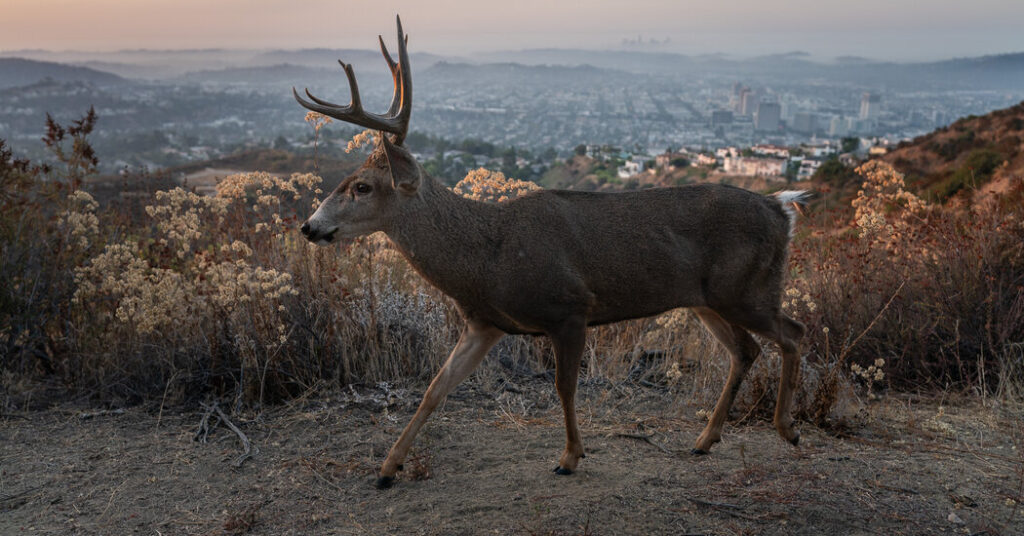
But these human impacts were complex, and in many cases, the effects of human presence were intertwined with the effects of landscape modification. For example, when humans disappeared, elk and mule deer expanded their land use. But these effects were more pronounced in rural or undeveloped locations than in highly developed ones like cities.
“We really can’t understand the full picture without information on both of these factors,” said Ruth Oliver, an ecologist at the University of California, Santa Barbara, and a co-author of the new paper.
Human activity also had different effects on different species. “The ravens in Yellowstone are behaving really differently than white-tailed deer on Staten Island,” said Scott Yanco, a research ecologist at Smithsonian’s National Zoo and Conservation Biology Institute and a co-author of the study.
The research, which was published in the journal Science on Thursday, was conducted by a large international team as part of the Covid-19 Bio-Logging Initiative, which has been studying how animals responded to the pandemic-related slowdown in human activity known as the “anthropause.”
Scientists have long known that as people, and their settlements, expand across the landscape, wild animals can dwindle or even disappear. But it has not always been easy to identify why this happens. Is biodiversity loss a result of changes to the physical environment? Or is the simple presence of living, breathing humans enough to have an impact?
Those questions have been difficult to answer, in part, because these phenomena typically go hand-in-hand: There tend to be more humans present in environments like cities than in undeveloped ones, like protected forests. It has also been difficult to get fine-scale data on human activity.
The pandemic — during which human developments remained intact but people largely stayed home — provided an opportunity to disentangle these effects. Previous research has suggested that the movements of wild animals changed when strict lockdown orders were in effect.
That research, however, used the strictness of lockdown policies as a proxy for human activity. In the new study, scientists used cellphone location data to measure human presence more directly. (A private company that collects this aggregated, anonymized data temporarily made it available to researchers studying human mobility during the pandemic.) The researchers estimated how many people were physically present, each week, in census blocks across the United States in 2019 and 2020.
They also collected data on the movements of more than 4,500 individual wild birds and mammals, which had been outfitted with tracking tags for other scientific projects before the pandemic hit. They assessed how much geographic area each animal covered on a weekly basis.
They also investigated whether human activity was pushing wild animals into new types of habitats by tracking how broad their niches were, or the range of environments they moved through each week. An animal that stuck to one specific type of habitat — say, cool, low-elevation locations with dense vegetation — had a narrow niche, while a creature that spent time in places with more varied conditions had a broad one.
“We’re not just looking at how their movement changed, but how that movement is actually affecting their experience of an environment,” Dr. Yanco said.
Many species — including coyotes, moose and wild turkeys — covered less area when more people were present, suggesting that humans were shrinking their living space. The effect was often amplified in undeveloped areas. That could be because animals living in more pristine habitats were more sensitive to people, the researchers said, or because the animals living in more developed areas had already reduced their space use as much as they could.
But there was also considerable variation between species. For instance, human presence seemed to increase the amount of space used by gray wolves, which have long been hunted and harassed by humans. One possible explanation is that gray wolves may be traveling longer distances in an effort to avoid potentially fatal encounters with people.
The consequences of these behavioral changes remains unknown. “Is this evidence of them successfully adapting to us, or is this evidence of pressure on them?” Dr. Oliver said.
That’s what the researchers are hoping to explore next. But even the current findings suggest that effective wildlife conservation will require understanding and addressing both habitat modification and human presence.
They also raise the possibility that even modest, short-term changes to human activity, such as restricting access to a particularly critical animal habitat during breeding or migration season, could yield significant conservation benefits.
“There’s the opportunity for coexistence in a smart, nuanced way,” Dr. Oliver said.
Emily Anthes is a science reporter, writing primarily about animal health and science. She also covered the coronavirus pandemic.
The post When Humans Went Away, the Wildlife Strayed appeared first on New York Times.