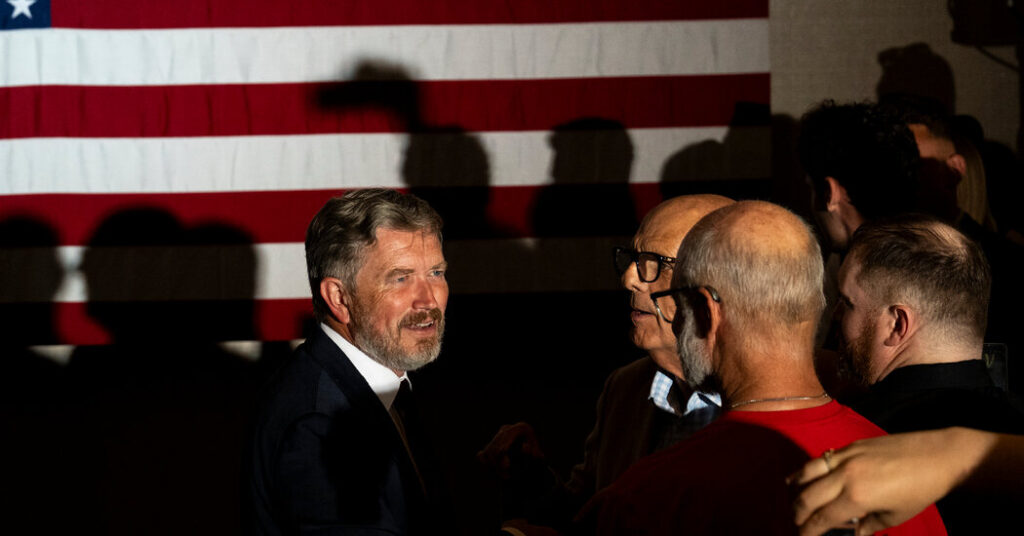
The defeat of Representative Thomas Massie on Tuesday served as an emphatic exclamation point on an extraordinary three-week vengeance tour that displayed President Trump’s enduring sway over his own party.
Yet Mr. Trump’s viselike hold on the Republican base — a full decade after he locked up his first presidential nomination — poses a distinct conundrum for the party ahead of the fall’s critical midterms. He has appeared more keen to leverage his popularity with the MAGA base to oust wayward Republicans than to repair his image among the independents his party will need to defeat Democrats this fall.
For years, Mr. Trump has imposed party discipline by electoral force. His message to any Republicans considering breaking with him in 2026 is unmistakable: Cross me at your peril.
The example making began in Indiana, where Mr. Trump recruited challengers who ousted five state senators who had refused to succumb to his pressure to draw new congressional districts in the state more favorable to the G.O.P. It continued in Louisiana, where Senator Bill Cassidy, who voted five years ago to convict Mr. Trump during his second impeachment trial, won a measly 25 percent of the vote in his re-election run, failing even to advance to a runoff after the president threw his weight behind a challenger.
It concluded on Tuesday in Kentucky, where Mr. Massie, one of Mr. Trump’s most outspoken critics still inside the G.O.P. tent, went down in defeat in the most expensive House primary in recent history. As a bonus for Mr. Trump, Brad Raffensperger, a Republican candidate for governor of Georgia who as secretary of state had refused to help him “find” votes to change the outcome of the 2020 election, failed to advance to a runoff.
The impending sweep left Mr. Trump feeling emboldened even before the Kentucky results were in. Earlier on Tuesday, he endorsed Ken Paxton, the state attorney general and a MAGA loyalist, for Senate in Texas over the incumbent, Senator John Cornyn. The president disregarded months of fierce lobbying by Senate Republican leaders that Mr. Paxton could endanger the party’s hold on the seat.
“MAGA is most of the Republican Party,” Mr. Trump said on Tuesday as he teased his coming endorsement. “The RINOs are gone, to a large extent.”
Then there is the flip side of the Trump effect: If Republicans cannot win primaries without him, his deepening unpopularity with independent voters threatens their chances of surviving in November.
The numbers are stark.
However wildly popular Mr. Trump is with Republicans — he garnered 82 percent approval inside the party in a recent New York Times/Siena poll — he is just as unpopular with the independent voters who so often decide general elections.
The same survey showed him with a meager 26 percent approval rating among independents.
How bad is that?
It is actually lower than former President Joseph R. Biden Jr.’s 28 percent approval rating among independent voters that the Times poll found in the aftermath of his disastrous debate in the summer of 2024, shortly before he quit the race.
Mr. Massie, in a defiant concession speech, mocked Mr. Trump’s focus on extraneous and extravagant projects, such as a White House ballroom, as voters struggle economically.
“By the way, while gas is almost $5 and diesel is almost $6, they’re talking about this big ballroom they’re going to build,” Mr. Massie said. “It looks like the Roman Empire, architecture from the Roman Empire. I see a few analogies there, and people are just trying to make ends meet.”
The thoroughness of Mr. Trump’s remodeling of the Republican Party was clear even in the races that were not as obviously part of his revenge tour.
In Kentucky, the retiring Senator Mitch McConnell, who has been an occasional Trump antagonist, is now likely to be replaced by Representative Andy Barr, a staunch Trump ally who coasted to the nomination with Mr. Trump’s support. In Georgia and Alabama, the Republicans who advanced to each state’s runoff for Senate are running as unalloyed pro-Trump candidates.
“The grass roots underneath Donald Trump are unlike anything I’ve seen in my 40 years of politics,” said Michael Caputo, a Trump-allied Republican strategist who worked on Mr. Trump’s 2016 campaign. “Coming up against him today, it’s like, ‘Abandon all hope, all ye who enter here.’”
But Mike Madrid, a Republican strategist who co-founded the anti-Trump Lincoln Project, said Republicans in battleground races this fall who yoke themselves to Mr. Trump are effectively “tying yourself to the railings of the Titanic.”
Still, Mr. Madrid said, he understood the impulse to align with the president to survive party primaries.
“There is this resilience with the base — it’s nothing short of remarkable,” Mr. Madrid said. “Through pandemic, through recession, through war, through the Epstein files.”
Nearly all of Mr. Trump’s Republican critics tend to add “former” to their job title, whether they quit, try to curry favor after crossing Mr. Trump or, like Mr. Massie, stay defiant to the end.
“You can take the Marjorie Taylor Greene way out, you can take the Cassidy way out or you can take the Massie way out,” Mr. Madrid said. “Those are three different ways to go out — but either way, you are going out.”
In no primary race this spring was the president more personally engaged than he was in his drive to defeat Mr. Massie. He campaigned there himself. On the eve of the election, Defense Secretary Pete Hegseth made an unusual detour from overseeing the war in Iran to northern Kentucky to make the case against Mr. Massie, who has been the conflict’s loudest Republican critic in Congress.
Recently, Mr. Trump filmed a video sitting at the Resolute Desk in the Oval Office and called Mr. Massie the “worst congressman in the history of our country.”
In other words, he elevated him as a political enemy above any Democrat. The president was so enamored with the phrase that he used it twice in a period of about 30 seconds.
Mr. Trump has long treated political cleansing of his own party as crucial to his own projection of power, even when that has meant losing seats to the opposing party.
In 2018, he held an infamous news conference at the White House the day after Republicans lost their House majority in a wipeout. The president proceeded to mock those Republicans who had distanced themselves from him, seeming to almost relish their defeats at the hands of Democrats.
“Mia Love gave me no love, and she lost,” Mr. Trump said. “Too bad. Sorry about that, Mia.”
This year, some endangered Republicans are embracing Mr. Trump. On Friday, Representative Mike Lawler of New York, one of the few Republicans to hold a seat that Mr. Trump lost in 2024, is set to appear with the president in his own district.
In an interview before the election, Mr. Massie said that for Mr. Trump, his race was partly about keeping the party in line.
“For my colleagues, this election is about, Can we deviate occasionally from the plan,” he said, “and still survive our primaries.”
The answer on Tuesday — and in all of May — was a resounding no. Other states have moved to redraw congressional lines in recent weeks following a Supreme Court decision and the defeat of state legislators in Indiana.
“You can disagree with President Trump, but if you try to destroy him, you’re going to lose,” Senator Lindsey Graham, Republican of South Carolina, said on NBC’s “Meet the Press” on Sunday. “Because this is the party of Donald Trump.”
Some evidence remains of the risk Mr. Trump faces for so thoroughly alienating Republicans whose votes he will need on Capitol Hill. Republican senators fumed about Mr. Trump’s endorsement of Mr. Paxton over their colleague, Mr. Cornyn, fearing his nomination could cost the party the seat.
Hours later, Mr. Cassidy became the latest Republican to vote with Democrats to take up a measure to force Mr. Trump to end the war in Iran or win authorization from Congress.
But members of Mr. Trump’s team relished the victories at the ballot box on Tuesday, with some of them taking to social media on Tuesday to gloat profanely as the results rolled in.
“Do not ever doubt President Trump and his political power,” wrote Steven Cheung, the White House communications director.
Shane Goldmacher is a Times national political correspondent.
The post Trump’s Spring Revenge Tour Routed G.O.P. Foes. But Fall Headwinds Loom. appeared first on New York Times.