When I was in college in the 2010s, some of my classmates would go to the dining hall, take their meals to their dorm rooms, eat and then dispose of everything that was left — food scraps, ceramic dishes and stainless steel utensils — in the dorm trash cans. It wasn’t like we had to wash the dishes ourselves. We were just supposed to walk them a few yards back to the dining hall and stick them on a conveyor belt that took them to the kitchen.
This behavior was the exception, not the norm, and I never did it. But I thought I understood the thinking behind it.
The cost of dining hall dishes was not even a rounding error in the university’s huge budget. No one suffered from their loss. The action landed without ripples. Like, well, a plate in an overstuffed trash can.
It was the same sort of thinking that powered much of campus life: The point of your college education was to serve you — your knowledge, your résumé, your personal growth. Anything that could be done faster, more efficiently, should be. If you couldn’t pick out a specific individual harmed by your actions, you were probably OK. You had no obligations to the school. You were there to feed on the university, to feast and to grow fat like one of the cows in Pharaoh’s dream. The university was, in this way, a sort of model for the world.
The last few years have not been kind to American higher education.
There are the academic problems: widespread artificial-intelligence-enabled cheating; digitally castrated attention spans; rampant grade inflation. There are the political tensions: the collapse of public trust; the protests, encampments and counter-protests that were so mishandled on college campuses after Oct. 7; now the Trump administration’s research funding cuts and threats.
And there’s the demographic cliff, finally here: This year’s high school graduating class is expected to be smaller than last year’s, and the next will be smaller still. Already, about 60 colleges are closing on average each year. That number could soon be considerably bigger.
These challenges have, rightly, occasioned some soul-searching for American higher education. In April, a committee of Yale professors published an unusually self-critical report, arguing that schools need to take the public’s low trust in institutions of higher learning seriously.
They urged their school to protect free speech, make higher education more affordable and pricing more transparent, and streamline bureaucracy (it is troubling, they wrote, that neither the Yale administration nor their committee was easily able to answer the question: “What share of Yale’s resources is devoted to its core academic functions and what share is not?”).
These reflections are a start, but they ignore a core problem at the root of so many campus and social issues. It is not just that we lack civility and the capacity to respectfully disagree, but that many of us live as collections of strangers, each pursuing our own ends, and that our college education does almost nothing to develop the sense that what we do in our day-to-day lives resonates with people beyond ourselves.
Oh, our schools claim to foster community. They advertise residential communities and student clubs and intellectual fellowship. But, in reality, many are opaque, bureaucratized, customer-service institutions that offer students little stake in a common life. You might even say that they work against it: Whether in housing assignments, dietary arrangements or extra time on tests, gaming systems to gain an edge is becoming one of the best-learned lessons of an elite college education.
The first American colleges were created to train clergymen and educate them in virtue. Since then, the central goals of American higher education have shifted. But perhaps that goal of character formation has faded too far into the background.
We are beginning to see that a nation of individuals unconstrained by virtue or a sense of communal responsibility has few ways out of collapsing social trust — and the political and economic problems that creates. Our colleges and universities are not the only institutions we can look to to change this. But as a traditional gateway from youth to adulthood, they’re a good place to start.
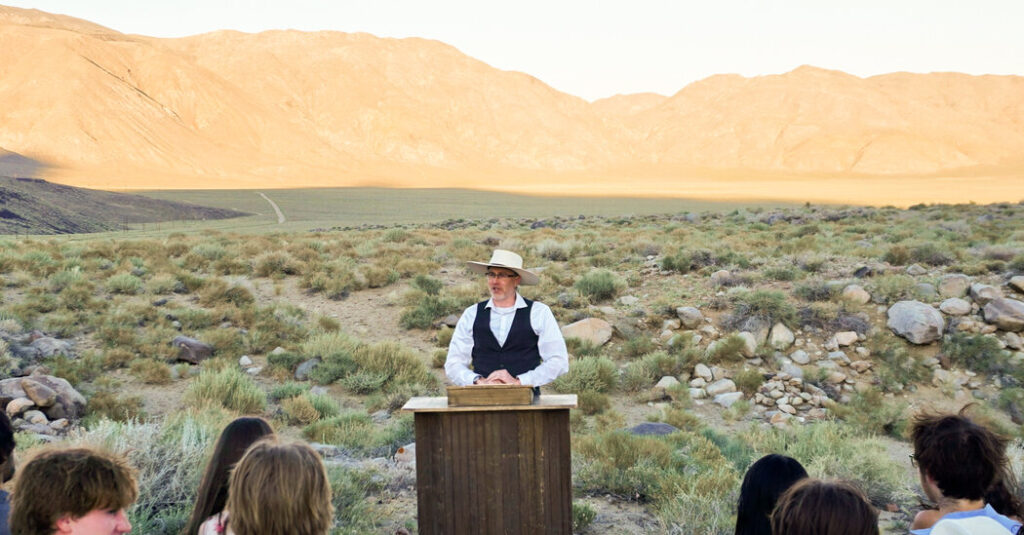
“We all, technically, legally own the place,” Will Xu told me last year. We were sitting at a picnic table on the campus of Deep Springs College, a tiny, experimental school in the California desert where he is a student. The White and Inyo Mountains were ringed around us.
The college was founded in 1917 by a hydroelectric tycoon, L.L. Nunn. Today, Deep Springs educates about 26 students each year, offering them a free, two-year liberal arts education on a working cattle ranch. Many go on to elite colleges like the University of Chicago. After Mr. Xu graduates in June, he plans to work in tech policy.
The students of Deep Springs are the sole beneficiaries of the Deep Springs trust. This college is theirs to look after and to safeguard.
This isn’t a symbolic position. Of course, millions of American students work part or full time while trying to get an education. But the students at Deep Springs have an unusual kind of responsibility for their collective lives: They work as cowboys and butchers, they mow the lawns and they serve on the board of trustees, the curriculum committee and the communications committee. They staff a team of volunteer firefighters, responding to accidents on the twisting roads beyond the school. They help make the food that feeds everyone here — students, faculty, staff members and their families.
And they care for the animals that share the ranch with them — the chickens, cattle, pigs and horses. Rebecca McMillin-Hastings, who graduated last year, described the process of cleaning an infected wound on the flank of a dairy cow named Euclid: “You just kind of have to get your soap in your water and, just like, push on the wound. And it really hurts her.” She described throwing her entire body weight against the animal, knowing that she was hurting her, feeling that she was hurting her, but also knowing that it had to be done.
Hearing her talk, I thought of the German sociologist Hartmut Rosa. Dr. Rosa has argued that some contemporary feelings of alienation are due to a lack of “resonance” in our lives — a genuine, responsive relationship to the world, one in which we are touched by it and answer it in turn.
At other, bigger schools, students are freed from the drudgery of cleaning, of fixing the old campus vehicles and toilets, of collecting the tumbleweed that poses a fire risk in the valley: chores that even the students of Deep Springs admit can sometimes feel rote, and that, if they’re honest, they don’t always do to the highest standards. Except for its gleaming new dining hall, Deep Springs is grimier than most top American institutions, which are staffed by fleets of janitors. When I visited last year, there was a torn couch lying abandoned on its side outside the dorms. The students had gotten rid of it because it was infested with mice.
Still, there is a logic to what Deep Springs demands of its students. One of the defining moments in the transition to modernity is when people begin working outside of the household. Before that, the philosopher Alasdair MacIntyre wrote, it was “easy and right” to understand “work as part of the sustaining of the community of the household and of the wider forms of community which the household in turn sustains.”
One way to understand Deep Springs is as a place that has recreated the pre-modern household. Its community members can’t help but see their labor as a part of what sustains the college and common life in the valley.
David Neidorf has filled just about every role there is at Deep Springs College over his many years at the school: lecturer, professor, dean, vice president of operations, president and interim dean again. He told me that most students come here to live up to some kind of demanding ideal. “They wanted more responsibility than they’re going to get — for their individual lives, for their communal lives — elsewhere,” he said.
The students must choose not only which classes to take but also which ones will be offered to the college at large. They help pick the professors, run the admissions process for incoming students and are involved in ever bigger decisions about the future direction of the college, like whether to hire someone for fund-raising.
Perhaps this is why A.I.-enabled cheating does not seem to be a problem at Deep Springs. At other schools, students can tell themselves that they are, at worst, only cheating themselves. Students at Deep Springs learn to see themselves not as consumers of a degree (an individual good), but as creators of an education (a collective good). It’s important, too, that when second-year Deep Springers, as they’re known, make decisions about admissions and the curriculum, they know they are shaping a school that will exist when they are no longer there.
Deep Springs is unique, but it isn’t singular. Berea College is a selective, four-year liberal arts school in Kentucky, one of 10 federally recognized work colleges in the United States. Founded in 1855 by abolitionists, it was the South’s first interracial, coed college. Today, its 1,500 undergraduates pay no tuition, and like at Deep Springs, they all work a campus job — at least 10 hours a week. At Berea, they receive pay to put toward housing and living expenses.
With a much bigger student population than that of Deep Springs, Berea offers a wider scope of work: Students might handcraft brooms as part of the Student Craft program, or work cattle on the farm, or produce code as a programmer on the student software development team. The labor program at Berea is marketed in large part as pre-professional development, not just as a character-building enterprise. But many of the jobs make campus livable for everyone: landscaping, janitorial duties, staffing the dining hall — each of those tasks gives students a stake in the institution and the opportunity to see their actions reflected in the world around them.
Students may even find a kind of relief in the unglamorous work that is so different from the influence-farming and image management that is characteristic of our age. Manual labor, the philosopher Matthew Crawford has written, seems to relieve man “of the felt need to offer chattering interpretations of himself to vindicate his worth. He can simply point: the building stands, the car now runs, the lights are on. Boasting is what a boy does, who has no real effect in the world.”
I think of something Jacob Harms, a rangy Deep Springer, now at Yale, told me as he loosened soil in the college garden: “This place asks you to create a reputation for yourself in a way other places don’t.”
Or as another student, Sasha Halperin, put it, “There is no place to hide.”
Deep Springs and Berea — as well as other work colleges — sit on the edges of America’s education system, experiments that have managed to sustain themselves and even flourish, without becoming mainstream. But there are aspects of both of these idealistic schools that could be incorporated into Yale or Harvard or Pomona. (It’s telling that the Yale committee’s 30-plus page report on trust in higher education included only a few sentences about giving students a greater role in the university.)
Those schools could create or revive cooperative living to give students at least a taste of what it means to live in a context where their actions matter. (Student housing co-ops, which began in the early 20th century at many schools as a cheaper alternative to dorm life, often require residents to clean or cook to keep costs down. Many have closed or had their autonomy curtailed in recent years.)
They could empower students to take on greater roles in the stewardship of their schools: running the honor board, managing the campus recreation centers, serving as trustees or full members of hiring committees. They could create campus work programs: not work-study, which marks needy students as financial aid recipients; not internships, which are part of the résumé-building race; not service work, which positions the doers as beneficent givers, but mandatory labor roles that give students a bigger stake in their institutions.
These are not wild propositions: Every single one has precedent at American colleges.
Some of these changes would run into legal liability or regulatory issues. The living conditions at some co-ops run by the Berkeley Student Cooperative, for example, are reportedly bleak — a situation the University of California, Berkeley, sidesteps by avoiding formal affiliation with the properties.
Perhaps the more difficult obstacle to overcome is that students and parents may not like it. In a tough white-collar job market, with the threat of A.I.-led unemployment, community projects might seem a distraction from the important work of landing a good job.
It is hard to argue with this logic — not because it’s so very strong, but because it folds into itself so many anxieties and assumptions: that you can A.I.-proof yourself for the future. That it is possible to put life — relationships, community, meaning — off until you’ve made it in finance or technology, only to pick them up when you’re more financially secure. That everyone else is working single-mindedly toward professional aggrandizement, so that by even stopping to question the race, you are falling behind. That the most efficient way to get to a destination is always the best. That your individual future is the only thing you are responsible for and that it is all that is at stake.
I think many of these assumptions are wrong. Yes, college education should help prepare students for the work force. But as many have pointed out, it must also prepare them for the task that can never be outsourced to technology: living. Which is a project we all undertake, in conditions of inherent uncertainty, within mortal bodies and within a shared social world.
If you ever visit the valley where Deep Springs is nestled, you may be struck, as I have been, by the confidence with which these students, particularly the second years, move through their little world. They move — and this is the best way I know how to put it — like natives. Over their time at the school, the students come to know one another and be known by one another. They are, for the most part, accepted. They have challenged themselves, and they have all failed — the curriculum, almost by design, demands too much. And they have survived it all.
Along the way, they have been given an opportunity to learn what many people don’t learn until well into adulthood, or even then: A good life can consist of things that are not for sale, that cannot be résumatized, that are not best understood as investments in your future so much as brushes with life itself.
Michal Leibowitz is an editor at Times Opinion.
The Times is committed to publishing a diversity of letters to the editor. We’d like to hear what you think about this or any of our articles. Here are some tips. And here’s our email: [email protected].
Follow the New York Times Opinion section on Facebook, Instagram, TikTok, Bluesky, WhatsApp and Threads.
The post A Cattle Ranch Is Doing What the Ivy League Can’t appeared first on New York Times.