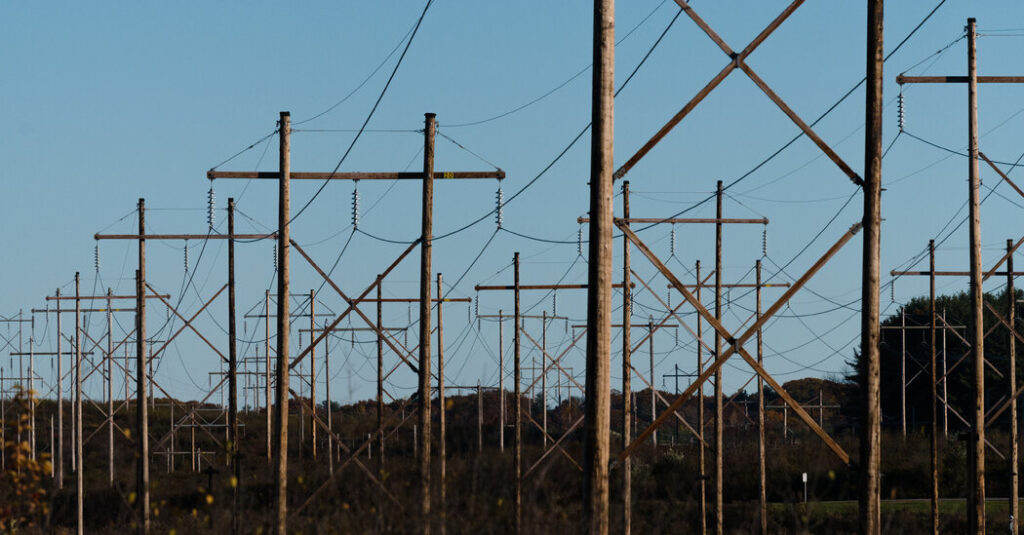
NextEra Energy’s proposed acquisition of Dominion Energy will make it the nation’s largest utility and power company, placing it at the center of national debates about why electricity bills are soaring and how the country should meet the seemingly insatiable energy demands of data centers.
The deal, which was announced Monday, would bring together utility operations serving around 10 million customers in Florida, Virginia and other Southeastern states. NextEra will also own nuclear power plants, renewable energy projects, transmission lines and pipelines from Maine to Hawaii.
The companies and some analysts say that combining all those operations under one corporate roof will result in big benefits, including lower costs and the speedier addition of new sources of electricity.
But who reaps those rewards from this deal, which values Dominion at more than $120 billion including its debt, is a big question. Even before the war in Iran sent fuel prices soaring, anger was building about the rising costs of energy, especially for electricity. Residential electric rates are up around 34 percent since 2020. At least some of that increase can be linked to the rapid growth of data centers used to develop artificial intelligence.
Most utility industry experts do not expect electricity rates to drop but say that policymakers can do a lot to arrest their rapid rise. One early sign of their willingness to do so will come when federal and state governments weigh NextEra’s purchase of Dominion. Regulators could try to block the deal or impose conditions aimed at keeping electricity rates in check.
What does this deal mean for electricity rate and bills?
It is hard to say with any certainty.
NextEra, based in Juno Beach, Fla., said on Monday that if its deal is approved, it will offer Dominion’s roughly four million customers in Virginia, North Carolina and South Carolina $2.25 billion in bill credits over two years. That amounts to about $550 per customer.
Customers would also “benefit from the shared expertise and best practices of America’s leading regulated utilities, laser-focused on low customer bills, customer service, storm resiliency and reliability,” John Ketchum, the chief executive of NextEra, said in a statement.
NextEra declined to make Mr. Ketchum available for an interview.
But some analysts and consumer groups said the bill credits were a temporary salve for a deal that could leave the larger NextEra with outsized market and political power. In states where it has significant operations, the company could ultimately ask regulators to let it raise electricity rates, said Marissa Gillett, a senior fellow at the American Economic Liberties Project, a nonprofit group that works on the concentration of corporate power.
“Anticipating anger and fear from customers, the companies are promising $2.25 billion in temporary credits,” Ms. Gillett, who was previously chairman of the Connecticut Public Utilities Regulatory Authority, said in a statement. “They think a big number is going to trick people into complacency.”
Another analyst, Jonathan Lesser, president of Continental Economics, a utility consulting firm, said the savings from mergers and acquisitions are often overstated or primarily benefit the investors of the companies involved.
Trump Administration: Live Updates
Updated
- Trump is said to have proposed a new helipad at the White House.
- A top Treasury lawyer resigns hours after the Trump administration announces the fund.
- The Justice Dept. fund creates a pipeline to funnel taxpayer money to Trump allies.
“A lot of times, what you’ll see is the merging utilities promising rate reductions as an inducement to let the merger go through,” said Mr. Lesser, who is also a senior fellow at the National Center for Energy Analytics, a research group. He added: “In the long run, do I think there are any merger savings? No, not at all.”
Is this all about data centers?
NextEra, which owns the biggest utility in Florida, has tried for years to buy other utility companies. But increasing demand from data centers has created an opportunity for it to make one of its biggest and most ambitious plays.
Dominion, based in Richmond, Va., is attractive because it serves the world’s largest cluster of data centers, known as Data Center Alley, in Northern Virginia. But it has been slow to provide enough power to meet the demands of tech companies and other businesses that want to move to Virginia, said Jigar Shah, a former Energy Department official in the Biden administration and a clean energy entrepreneur.
“If you’re a governor, what you really want is a partner that can help you win business on the economic-development front,” Mr. Shah said in an interview with The New York Times. In a post on LinkedIn, he described Dominion “as a fixer-upper.”
Dominion declined to comment on Mr. Shah’s statements.
Other industry experts noted that NextEra has moved relatively quickly to add new sources of electricity, large battery installations, power lines and other equipment needed to serve data centers. That experience will help it if it is allowed to buy Dominion, said Jon Wellinghoff, a former chairman of the Federal Energy Regulatory Commission.
“This is a lot about data centers,” said Mr. Wellinghoff, who is now the chief regulatory officer for Voltus, a company that provides energy to the electric grid from batteries and other equipment installed at businesses and homes.
Will this deal lead to more consolidation in the utility industry?
The utility and power business has been buzzing with merger and acquisition announcements and rumors for months, though none as big as the NextEra-Dominion deal.
BlackRock, the world’s largest asset manager, bought Minnesota Power last year. It announced in March that a consortium led by one of its subsidiaries would buy AES, a power company with utilities in North and South America and power plants and other equipment around the world.
The deal fever is largely a result of expectations that the demand for power will grow quickly because of data centers and an increase in the use of electric cars, heat pumps and other equipment that run on electricity, rather than fossil fuels.
NextEra’s Dominion acquisition may also compel other companies to pursue deals because they fear becoming too small to effectively compete.
“I think that also is going to lead to more consolidation,” Mr. Wellinghoff said.
But there is a big potential downside to trying to ride the A.I. boom. If fewer data centers are built, or if they require less energy than expected, utility companies that grow too quickly could be left with significant debt and not enough revenue. That, in turn, could drive up electricity rates even more because those costs would have to be spread over fewer customers.
Mr. Shah said this and other deals will face close scrutiny from regulators especially in state governments. Virginia recently elected Abigail Spanberger, a Democrat, as governor in part because she promised to address rapidly rising energy costs. NextEra previously failed to win approval for several big deals, including takeovers of big utilities in Hawaii, North Carolina and Texas, either because regulators or the target company rejected its plans.
“There is not a lot of bedside manner there,” Mr. Shah said about NextEra’s failed efforts.
NextEra did not respond to requests for comment about its previous proposals. And Ms. Spanberger’s office did not respond to requests for comment on the deal.
Ivan Penn is a reporter based in Los Angeles and covers the energy industry. His work has included reporting on clean energy, failures in the electric grid and the economics of utility services.
The post Rising Energy Prices and Data Centers Are at Center of a Utility Deal appeared first on New York Times.