There’s a stillness that pervades Andrey Zvyagintsev’s “Minotaur,” which had its world premiere in Competition at Cannes. Adapted from Claude Chabrol’s 1969 French film, “The Unfaithful Wife,” the course of the next 135 minutes obliterates any conflation that such quiet means peace.
Morbidly humorous and shot with such patience as to conjure its latent anxieties up to the surface, “Minotaur” is a thriller about how the personal always intertwines with the political, and the damning reality that we can never deal with one crisis at a time.
For Gleb (Dmitriy Mazurov), a company director living in 2022 Russia, it would be nice if he didn’t have to wrestle with his wife’s infidelity, corporate pressures, and Russia’s invasion of other countries all at once, but those aren’t the cards he’s dealt. As we follow how the pressures crack his psyche and body, Zvyagintsev frames the site of Gleb’s grievances as a way to comment on Russia as a whole. What we see on screen isn’t just one man’s crash out but the soul of the whole country being corrupted, with little hope of resuscitation. It’s a quietly damning and riveting political thriller, dressed in the skin of a domestic drama.
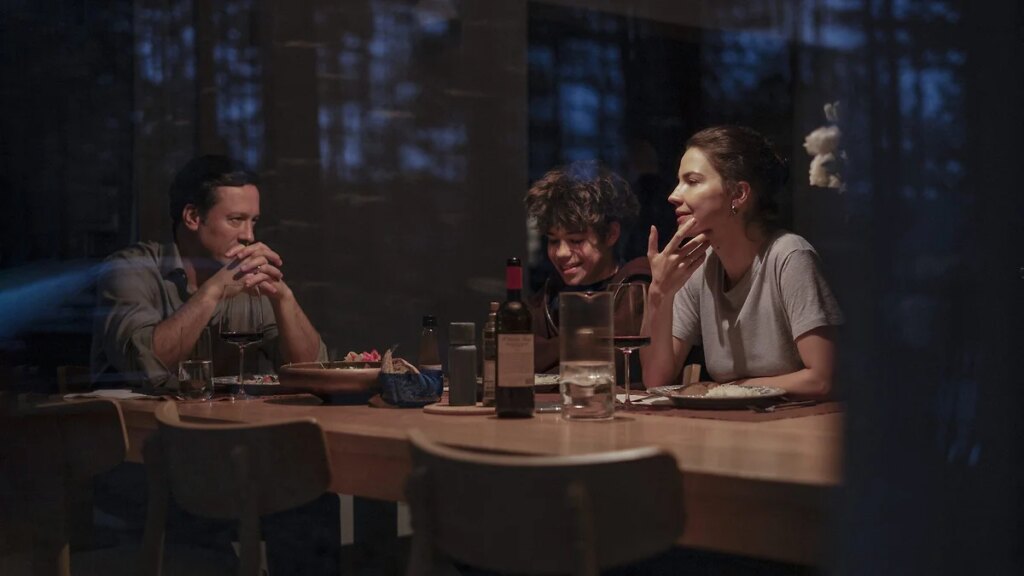
The clever disquietude about “Minotaur” is how it manages to make the intangible yet ever-present dread faced by his characters imbue spaces that should otherwise provide solace. It’s a masterclass of collaboration between his cinematographer, Mikhail Krichman, and production designers Andrey Ponkratov and Masha Slavina to transform the house of Gleb, Galina (Iris Lebedeva), and their son, into its own haunted house.
The three live in the countryside, which means they’re all totally isolated yet surrounded by beautiful scenery. While Gleb and Galina are affectionate with their son, it’s in these seemingly normal moments of domesticity that Zvyagintsev tips us off that not all is well. When his son divulges that he’s having trouble at school, Gleb tells him not to be afraid to intimidate his bully by using physical force. Gleb demonstrates a helpful tactic by grabbing his son’s lapels before telling him to do the same to him. There’s some dark humor here, but the scene is mostly played straight, and it’s the fact that it’s all portrayed so matter-of-factly that’s the most chilling.
Galina sees no issue with this pedagogy, and their son seems measured if excited by the newfound freedom such methods will bring him. It’s like staring at a mirror that’s both inverted and not; we see what Gleb must have been like when he was young (and was probably told the same advice from his father), while there’s a fairly clear 1:1 transference between Gleb and his son.
The other issues plaguing Gleb’s life revolve around his work and wife; at work, the Russian invasion of Georgia is causing strain on his workers, with many leaving. Furthermore, Gleb has to come up with a list of people in his company to be drafted to fight in the Russian army. His relationship with Galina has also curdled, and he begins to suspect that she may be having an affair. The combination of these factors pushes him to the breaking point, where violence becomes the sole way in which to assert autonomy over situations that strip people of control.
Interestingly, though, while many may relate to Gleb’s struggles to balance all that he faces, Zvyagintsev’s choice to make someone so deeply tied to Russia’s imperialism is a striking one. It complicates the notion of empathy in ways that make the film both harder to access and intriguing at once.
It’s not that the film is short on dialogue, but rather, the “Leviathan” and “Loveless” director understands how people’s body language and their surroundings can be purveyors of tone and mood. Take one sequence where Gleb drives back with suspicious cargo in his car and stops on the road to let a train go by. It’s clear that the train isn’t carrying passengers but military cargo: scores of tanks dot the cars, and Krichman superimposes those scenes of the tanks onto Gleb’s face, conflating his inner storms with the infectious and belligerence of the nation he’s in. The political has invaded the personal.
There’s another striking sequence after a swift and unexpected murder where Zvyagintsev observes with uncomfortable detail the cleanup process. It’s almost humorous in how protracted it is, as we witness a man try to clean up every splotch of blood in this apartment complex, but there’s a cold fear that pervades as well. Russia, like any country, is a nation with skeletons, thorough in its silencing of dissenters, which it masquerades as sanitation. The personal now invades the political.
These long, protracted takes and juxtaposition also mean that the actors get to deliver their finest work, in that they can’t hide behind editing or camera cuts. They have to react, lie and live in real time, and Lebedeva deserves encomium for the way she displays resiliency amidst the suffocating anguish she feels in relation to her family life.
Watching the film would also work in wonderful conversation with Andrius Blaževičius’s “How to Divorce During the War.” Blaževičius film also explored a couple going through a crisis amidst Russia’s invasion of Ukraine and other countries, but from the countries being invaded. Collectively, they paint a portrait of how, on either side, the aggressors and the victims try to live day to day amidst the backdrop of these larger conflicts.
The film is bleak right up until the film’s coda, such as a scene where two detectives are told to stop their work over a suspicious person, having been told by their higher-ups. “Why do we bother?” one of them asks before the other replies, “F–k if I know. Let’s have lunch.” For those in power, like Gleb, who use their desire to protect their country to justify heinous actions, there’s little to no recompense. For those who hold such positions, the currency is a system of favors, of scratching each other’s backs whenever the other feels an itch for protection. The problem with such frequent scratching is the scar tissue left behind from those gashes. You can only scratch so much before you’ve removed too much skin, with only bone and open wound left behind.
The post ‘Minotaur’ Review: The Personal and Political Collide in Andrey Zvyagintsev’s Chilling Drama appeared first on TheWrap.