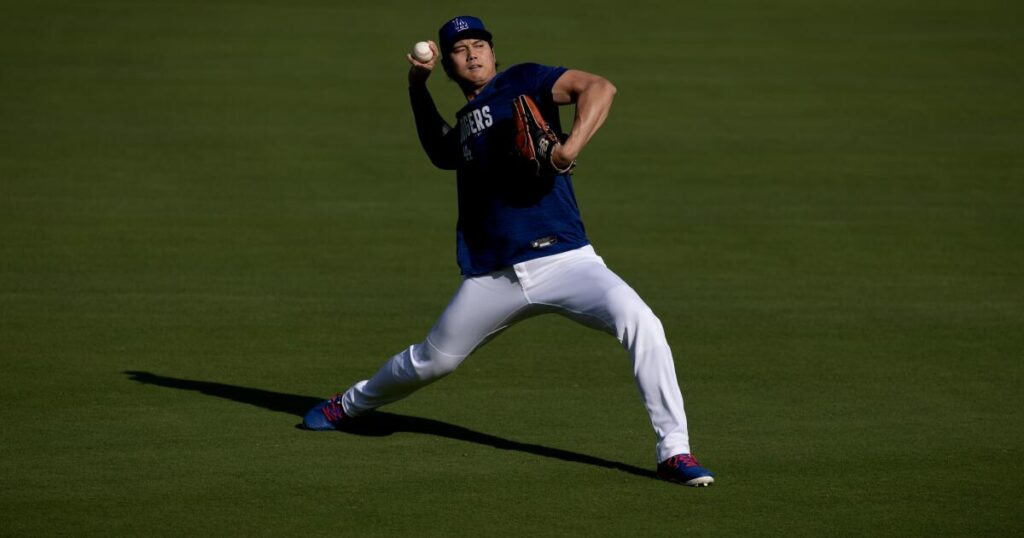
This isn’t the first time the Dodgers have grappled with workload questions while projecting out a full season of Shohei Ohtani’s two-way schedule.
When they pursued the then 23-year-old free agent, who was determined to pitch and hit in MLB like he had in Japan’s Nippon Professional Baseball, much of the Dodgers’ preparation for their presentation to him revolved around that puzzle.
The Dodgers, and the other three National League teams among the seven Ohtani sweepstakes finalists that winter, faced an added challenge: When Ohtani wasn’t on the mound, they couldn’t use him as a designated hitter.
“We knew that it was going to be an uphill battle because the National League didn’t have the DH,” Dodgers president of baseball operations Andrew Friedman recently told The Times. “And so we spent a lot of time selling the organization, selling the city — and also trying to lay out a mock schedule of how it could look with pitching, and starting in the outfield around these days, and having rest days, and pinch hit … and that the idea that DH would most likely come to the NL.”
It famously all worked out in the end. Ohtani chose the Angels in 2017 and proved he could not only balance the rigors of pitching and playing DH, but establish himself as the best baseball player in the world while doing so. He won American League rookie of the year and his first two MVP awards with the Angels before leaving as a free agent after the 2023 season. By then, MLB had implemented the universal DH.
Ohtani signed what at the time was a record-breaking contract ($700 million for 10 years) with the Dodgers, added two more MVP seasons to his resume, won consecutive World Series titles, is in pursuit of a three-peat, and has inserted himself into the Cy Young conversation this year.
As the Dodgers wrestle with his schedule, now that he’s back in the rotation from the start of the season for the first time in his Dodgers tenure, the team’s first attempt at the puzzle comes to mind.
What would Ohtani’s schedule have looked like in the early years of his career if he had chosen the Dodgers over the Angels?
“We spent a significant amount of time pursuing it,” Friedman said, “because as long as the chance was above zero, it was worth it.”
The mock schedule was a tool to make the case to Ohtani that the Dodgers could make his two-way workload work even without the DH. Manager Dave Roberts also remembers an organizational emphasis on flexibility.
“For us, the sales pitch is, whatever he was willing to do, we would acquiesce and accommodate,” Roberts said. “So, unfortunately, we never got to have that conversation, but I think that we were just prepared to get the player, and kind of have everyone on the roster willing to bend to make it work for him.”
Ohtani was breaking new ground. The closest MLB comparison was Babe Ruth — in a far-flung era of the game.
“There were a lot of unknowns of how to manage it,” Friedman said. “We just were honest in our presentation in 2017, which was: ‘We’re not exactly sure how this is going to play out. But we promise you, we’ll be thoughtful, deliberate and communicative as we’re learning and growing, hopefully together to figure out the best way to do this.’”
It would have been a challenge.
In that first year with the Angels, Ohtani didn’t hit on days he pitched or the next day. He still sprained his ulnar collateral ligament in June, pitched just once more that season, and underwent Tommy John surgery in October.
The Dodgers, of course, wouldn’t have been able to offer those regular half days of just pitching or just hitting. That may have meant fewer games total, but higher physical demands every game he did play.
Would his decorated career have played out differently in that kind of setup?
“I would never put nothing past this guy,” said Dodgers third base coach Dino Ebel, who held the same position with the Angels during Ohtani’s rookie season. “This guy’s so special. In all my years in baseball, I’ve never seen anybody this good. … I think it would be no different.”
When Ohtani returned to pitching and hitting full time post-surgery, he flourished under a more intensive schedule. He played a then career-high 155 games in 2021 and was in the lineup as a hitter on most of his pitching start days. He collected his first All-Star nod, Silver Slugger award and MVP.
Although he’s in a similar situation this year, Ohtani is 31 years old instead of 26, with a track record in MLB as a two-way player, on a team gearing up for a long postseason run.
As the Dodgers and Ohtani work through his schedule now, they at least have the precedent he’s set in past years as a base — plus the DH spot, and the flexibility of a roster built with a third consecutive championship in mind.
“We have so much more depth now than we had before,” Roberts said. “So to be able to plug in [Dalton] Rushing, or [Alex] Call against a lefty, or Will Smith on a day he doesn’t catch, it’s a lot more palatable than somebody else.”
The load-management questions are different than they were for the Dodgers’ 2017 pitch to Ohtani. But they’re still pressing.
As Ohtani has raised his performance on the mound to start the season (0.82 ERA) but dealt with a slow offensive start by his standards — “It’s pretty telling of just how good he is, that all of the talk is about how much he’s struggling, and he has like an .800 OPS,” Friedman pointed out last week — Roberts had taken a read-and-react approach to Ohtani’s days off.
Roberts’ decision to give Ohtani two days off from hitting, right after his first home run in two weeks, raised some eyebrows. But on Saturday at Angel Stadium, Ohtani was driving the ball with men on base and showing off his speed in a performance that included a stolen base, a Little-League home run (triple and an error), and bases-clearing double.
“There’s just more in the tank right now,” Roberts said after the game. “We were hoping to get a reset with a couple days off, and I think that’s what happened.”
After a three-hit day Sunday, Ohtani had a slightly different take.
“I actually felt pretty good the day before I pitched, hitting-wise,” he said through interpreter Will Ireton. “I think that helped more than the off days.”
As the Dodgers anticipated back in 2017, it’ll be an ongoing conversation.
The post Why Dodgers’ 2017 pitch to Shohei Ohtani remains relevant: ‘Acquiesce and accommodate’ appeared first on Los Angeles Times.