Richard Branson is the co-founder of Virgin Group. Brett Perlmutter is an investor and former head of Google Cuba.
The standoff between the United States and Cuba is taking a disturbing toll on ordinary Cubans. New research from the Center for Economic and Policy Research shows that infant mortality in Cuba has more than doubled since 2018, from roughly four deaths per 1,000 live births to nearly 10 today. Meanwhile, garbage is piling up in the streets as sanitation trucks are idle due to a fuel shortage caused by the U.S. blockade.
Rolling blackouts have become a defining feature of daily life. And with summer approaching, millions of Cubans face scorching temperatures without reliable electricity for refrigeration or air conditioning. The limits on oil reaching Cuba could disrupt fuel production and force hospitals to close, further compounding the deprivations caused by decades of communist rule. Warnings that millions of Cubans could be left without basic necessities “would be right,” the Cuban essayist Carlos Manuel Álvarez wrote, “if all of this were not already happening.”
Relief for more than 10 million people should not hinge on the resolution of a political standoff with no timeline. Regardless of one’s views about U.S. policy or the Cuban government, two facts are clear: Ordinary Cubans need help, and ordinary Americans — along with partners around the world — can help them.
The U.S. and Cuba are separated by just 90 miles and bound by deep family, cultural and economic ties that persist even in periods of political tension. Both of us have seen the power of these connections firsthand. Now, even as the larger geopolitical puzzle remains unresolved, those connections can be used to provide legal, nonpolitical relief for the Cuban people.
Existing on-island institutions are a practical starting point. The Catholic Church, through its Caritas Cuba humanitarian arm, maintains a nationwide distribution network that delivers food assistance through churches across the island. This operation supports community kitchens and provides supplemental food supplies to vulnerable populations, including the elderly and families without consistent access to remittances from relatives in America. It also works with small non-state entrepreneurs to strengthen local supply chains and extend distribution beyond urban centers.
The international community could bolster the church’s efforts. Friends of Caritas Cuba and Catholic Relief Services are two U.S. philanthropic organizations that legally direct funds and material support to this on-island distribution network. Expanding support speeds aid to the communities that need it most.
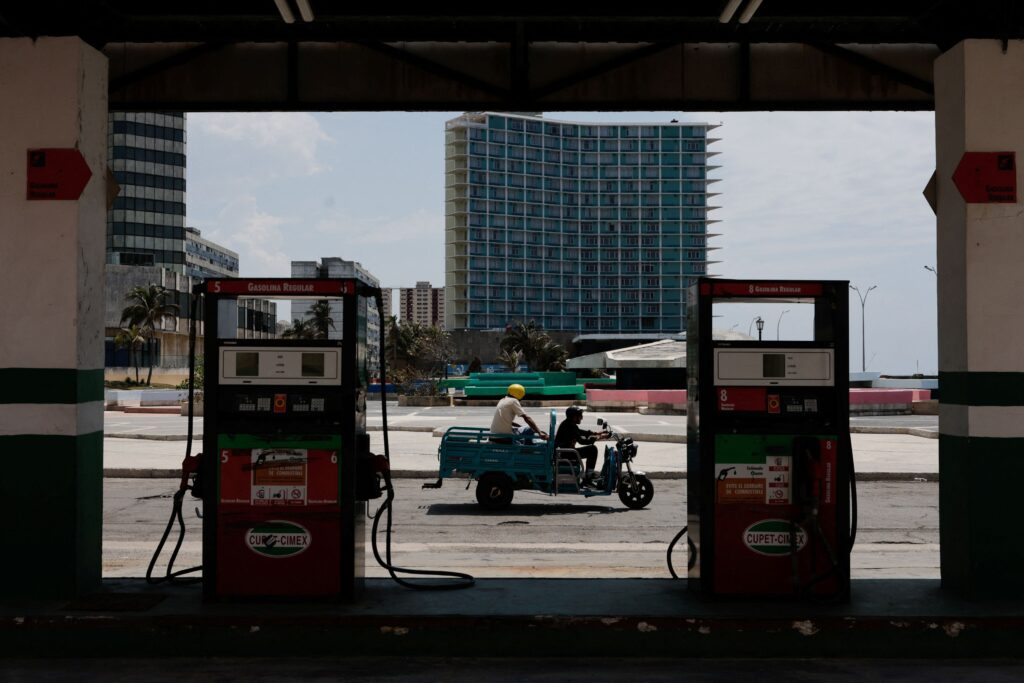
Any effort to build durable supply chains for humanitarian aid starts with transportation. Food, medicine and essential goods do not move without trucks, and trucks do not move without fuel. Recent guidance from the Trump administration has clarified that oil can be exported from the U.S. to Cuba’s private sector. That will help sustain these logistical networks, but without working capital and financing they cannot function at scale.
At the same time, distributed renewable energy can reduce pressure on an already fragile grid. Small-scale solar installations increasingly serve as a lifeline for households, clinics and local agriculture. The Caribbean Agroecology Institute and other organizations provide family farms with solar panels to help irrigate fields and power equipment. Funding these efforts would provide vital support to community farmers who feed everyday Cubans. The organization Medical Education Cooperation with Cuba is working to ease the effects of blackouts on high-risk expectant mothers by supplying maternity homes with solar power and medical supplies.
The U.S. and Cuba share a long history of useful back-channel negotiations — CIA Director John Ratcliffe recently met with Cuban officials. But the responsibility to alleviate human suffering cannot be left to governments alone. Business leaders and humanitarian organizations can act, through existing legal pathways.
Policy debates matter. But in the meantime, what matters more is saving lives.
The post The private sector can provide Cuba with the humanitarian aid it needs appeared first on Washington Post.