URUAPAN, Mexico — Grecia Quiroz sometimes felt like she was married to a superhero.
Most nights, after her husband, Carlos Manzo, tucked their small sons into bed, he donned a bullet-resistant vest, made the sign of the cross and strode out into the night.
The mayor of Uruapan, the capital of Mexico’s rich but violent avocado country, Manzo led police down dark alleys in search of kidnap victims and combed hillsides for cartel training camps. He chased car thieves by helicopter, exchanging gunfire with the suspects below.
Videos of these endeavors appeared online, and soon other people were calling Manzo a superhero, too.
In a nation fed up with leaders seen as tolerating or colluding with organized crime, Manzo, 40, stood out. He called out “narco-politicians” by name, and fired police who solicited bribes.
There was talk that he could become governor of Michoacán, or even president, a dream he had harbored since childhood.
Quiroz, 36, was proud of her husband. But she was also terrified, keenly aware of what happens in Mexico to those who challenge the status quo. She found herself inventing excuses to try to keep him home at night.
In the end, Manzo’s crusade would cost him his life — and force Quiroz to make a painful decision: abandon her husband’s fight, or embrace it as her own.
Manzo was 21 when gunmen stormed an Uruapan nightclub not far from his mother’s dress shop and rolled five human heads onto the dance floor.
He was 34 when sicarios, or assassins, hanged nine corpses from a downtown bridge.
He had friends who had been kidnapped, killed or faced extortion by the gangsters who fought over drugs and control of the region’s multibillion-dollar avocado trade. Manzo himself had once been stopped on a highway and robbed at gunpoint.
Confrontational since childhood — his mother recalls him challenging his teachers and practicing fiery speeches in the mirror — Manzo became disillusioned by his government’s failure to contain crime.
Two decades of federal strategies, including the deployment of soldiers and a sweeping social program called “hugs, not bullets,” had left the cartels stronger than ever. Gangs forced business owners to pay “protection fees” and had added to their arsenals roadside bombs and drones rigged with explosives.
While studying political science at university, Manzo had been seduced by theories of populism, which held that anger at elites could be weaponized at the ballot box.
He admired the vigilante armies that had formed in Michoacán beginning in 2013 — everyday men and women who took up arms against the cartels. And he was inspired by his father, an art gallery owner who had been a thorn in the side of local leaders, once staging a demonstration over what he claimed were rigged elections.
One day, Manzo and a friend, Esteban Constantino Magaña, set up a table in Uruapan’s central plaza and asked townspeople about their problems.
The pair helped the sick find medicine and guided others through the labyrinth of municipal bureaucracy. Once, Manzo stood outside a hospital with a poster and gag over his mouth until a patient was granted surgery.
Manzo dressed like a farmer, with leather sandals and a white straw hat. He and his friends and their growing community of supporters became known as the movimiento del sombrero — the hat movement.
In 2021, Manzo was elected to Congress with Morena, a political party founded by then-President Andrés Manuel López Obrador, another populist who had campaigned against corruption.
Quiroz, the daughter of local merchants and a former director of Uruapan’s family services agency, joined Manzo’s team. The pair grew close as they worked long hours to open free pharmacies and elder care programs. They married in 2022.
But the nearer Manzo was to the center of traditional politics, the more he disdained them. In Congress, he clashed with Morena leaders, whom he accused of corruption and complacency.
In 2023, he made national news after he confronted state police officers in Uruapan whom he accused of extorting from a woman and her daughter. He swung at the officers, who beat him and shoved him into a squad car.
“They don’t want us watching them because they’re robbing the avocado pickers,” Manzo said after being released. “We’ve had enough!”
He broke with Morena and in 2024 ran for mayor of Uruapan as an independent, campaigning with his first son, Carlitos, in his arms. Manzo was angry but oozed charisma, riding to events on horseback and often breaking into folkloric dance, clips of which went viral.
He won in a landslide, and three other members of the hat movement secured seats in the state legislature.
Manzo purged the municipal police and pleaded with the federal government to send troops and military-grade weapons to Uruapan. Aside from a few photos of his family, he never bothered to decorate his office, spending most of his time in the street.
“He’d call me in the middle of the night— at 2 or 3 a.m. — to say, ‘Hey, go fill that pothole,’” remembers Constantino, whom Manzo appointed as Uruapan’s director of public works.
Constantino frequently accompanied Manzo on law enforcement operations that were livestreamed for his 1.3 million Facebook fans, an impressive following for the leader of a city of just 350,000.
In one, Manzo spat expletives at a handcuffed man accused of leading the Jalisco New Generation Cartel’s operations in Uruapan. In another, he showed off AK-47 and AK-50 assault rifles that he said were discovered at a paramilitary training camp.
After a municipal employee was shot to death outside a school, Manzo instructed police to use lethal force against any criminal who attacked citizens or resisted arrest.
“We must take them down,” he said. “We are not going to do what other governments did, which was to go and kneel before organized crime.”
Critics branded him a showman who supported extrajudicial killings.
His comments were slammed by President Claudia Sheinbaum, who said accused criminals deserve their day in court.
Still, Manzo’s posture resonated with many in a region where polls show growing support for aggressive anti-crime tactics. Some compared him to El Salvador’s authoritarian president, Nayib Bukele, who is widely popular throughout Latin America for jailing alleged gang members with no due process. Manzo borrowed some of Bukele’s anti-corruption catchphrases, and Quiroz remembers him studying propaganda videos Bukele posted online.
Quiroz, who gave birth to the couple’s second child, Emiliano, last year, grew worried when Manzo began calling out politicians, including a former Michoacán governor whose brother, another politician, went on the run after being investigated for soliciting bribes from a cartel.
Last fall, Quiroz said, masked men on motorcycles began showing up outside the family home. Sometimes they rang the bell. Other times they just waited there menacingly.
Manzo asked Quiroz to keep the kids inside and arranged to have food delivered.
After an Uruapan police officer was assassinated at a checkpoint, Manzo pleaded again for more help from the federal government.
“I am very afraid,” he said. “I don’t want to be just another name on the list of people who have been killed.”
Michoacán is known for its annual Day of the Dead celebrations, and Manzo had spent weeks readying the city’s festival of lights.
On Nov. 1, Quiroz and the kids joined him in the plaza, which was filled with candles and thousands of people. Manzo, not wearing his bullet-resistant vest, held Carlitos in his arms as he inaugurated the event.
He put the boy down, then shots rang out. Amid the screams and chaos lay Manzo, face-down and bleeding. Quiroz, their sons and Manzo’s mother were by his side as paramedics performed CPR, but he died that night.
Carlitos wailed for weeks after the killing, calling out for his father. Quiroz, on the advice of a therapist, cried with him, explaining that she, too, ached with pain.
Her superhero had fallen. And now, improbably, she was being asked to fill his shoes.
Carlos Bautista Tafolla, a friend of Manzo’s since childhood who had been elected with the hat movement to the state legislature, nominated Quiroz to replace him as mayor.
Quiroz hesitated. Her sons would need her more than ever.
But Manzo had always encouraged her to consider politics. And in one of his final speeches, he had told his supporters that in the face of threats, they could not take “even one step back.”
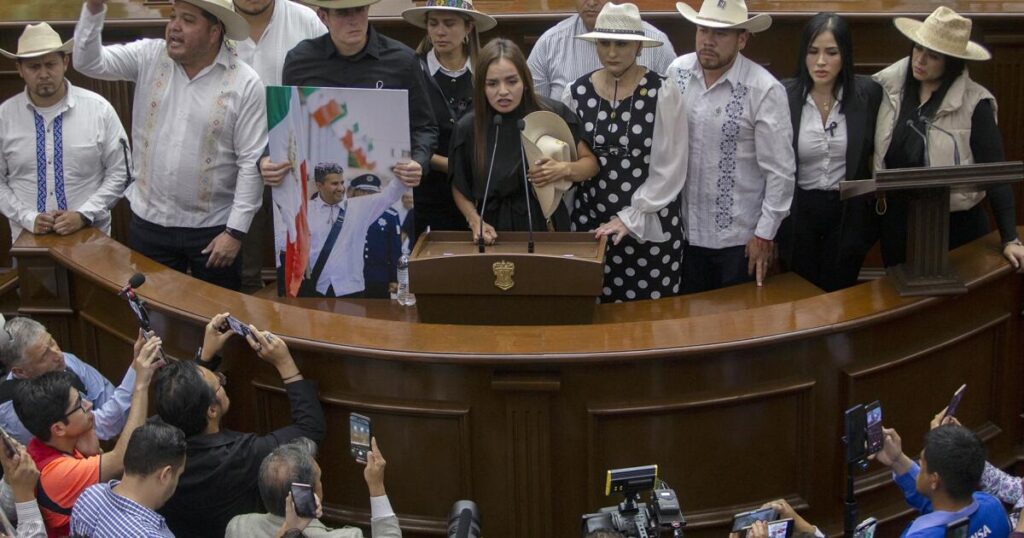
Quiroz was sworn in as mayor while clutching her husband’s white hat.
“I will follow in Carlos Manzo’s footsteps,” she said through tears. “I will leave you with an Uruapan, a Michoacán and a Mexico that he would have wanted.”
She met with Sheinbaum, who deployed to Uruapan the thousands of soldiers Manzo had asked for, and who assigned Quiroz round-the-clock protection.
Officials say Manzo was shot by a 17-year-old with methamphetamine in his system, who was killed by police at the scene. Members of the Jalisco cartel have been charged with orchestrating the attack and several of Manzo’s bodyguards were arrested for possible participation.
Quiroz said she believes Manzo’s death was part of a broader conspiracy. She points to a video recorded shortly before his death in which Manzo said that if he was harmed, police should investigate the former governor, Leonel Godoy Rangel, and his allies. State officials have summoned Godoy for questioning.
The truth is, Manzo had many enemies.
“He was inconvenient for the whole system,” said Bautista. “No one can be ruled out.”
Chants rang out at Manzo’s funeral — “Carlos didn’t die, the government killed him” — and protesters smashed windows in the state capital. Demonstrators wore white hats at a massive march against violence and impunity in Mexico City a few weeks later.
The plaza where Manzo was slain is now filled with monuments — large photographs and posters featuring his quotes and an altar where people leave flowers, candles and handwritten notes. “Welcome to the land of the brave who give their life for their people,” reads a banner.
People make pilgrimages here, like a man who had come on a recent afternoon from the Tierra Caliente, a famously dangerous part of Michoacán.
“A lot of people woke up after this,” said the man, who was afraid to give his name. “I still have hope. It won’t be him, but there will be other people who follow his ideology and form of thinking.”
A baker named Francisco brought his daughter to pay respects. Recently, a teenager entered the bakery and slipped him a piece of paper with a phone number on it. When Francisco called, a man threatened to harm his family unless he paid $400 a month.
“We can’t live like this,” Francisco said.
Quiroz recently began wearing a sombrero. She does not go out on law enforcement missions like her husband did. She has a quieter style, while adhering to his belief that you can’t lead without grassroots support.
Recently, after a long day in a local gym hearing complaints from residents with exorbitant electrical bills and business owners facing red tape, she met with a group of politicians from Colima state. They asked how they could support the movement.
Quiroz told them she plans to run for governor of Michoacán next year. The women, who all wore white hats, pledged their support, then asked if they could take photos with Quiroz.
She knows there are many eager to exploit the hat movement. Quiroz said she is open to expanding the party, but that anybody who joins will have to be heavily vetted.
After the last photo was snapped, Quiroz retired to her office. The one that used to be his.
It is still barely decorated, just a corkboard pinned with photos of the boys and a folding table covered with stacks of reports. Quiroz mostly holds it together, but sometimes, when she is here alone and looks at the hat Manzo was wearing the night of his death, and the anti-ballistic vest that he was not, the tears come.
It was after 8 pm. Time now to go home — her security team watching — to the kids. These days, when somebody asks Carlitos, “Where is your dad?” he responds: “He’s in my heart.”
Quiroz turned off the lights. On her way out, she stopped by a rack and hung up her hat.
The post Her husband was slain for defying cartels. Can she carry on his fight? appeared first on Los Angeles Times.