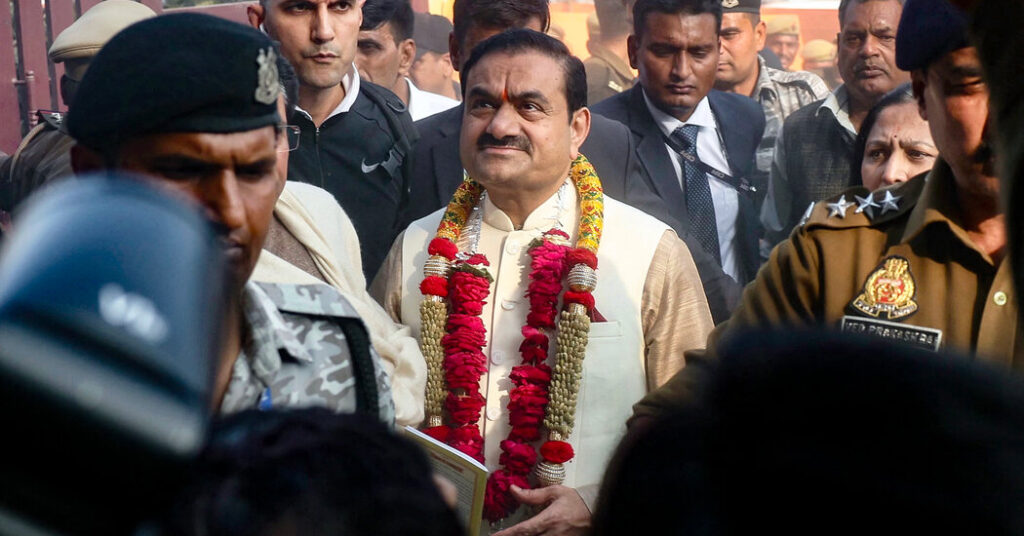
Federal prosecutors in Brooklyn on Monday asked a judge to drop bribery-related charges against the Indian tycoon Gautam Adani, a decision with domestic and geopolitical ramifications that appeared to typify the transactional nature of the Justice Department under President Trump.
In a brief letter, prosecutors said they had decided “not to devote further resources” to the case against Mr. Adani, who had offered to invest $10 billion in the United States while proposing a settlement of both the criminal matter and a parallel civil case brought by the Securities and Exchange Commission, and seven others.
The S.E.C. announced that Mr. Adani and his nephew, Sagar Adani, would pay an $18 million fine on Thursday to resolve its case. Earlier on Monday, the Treasury Department announced that it had reached a $275 million settlement with Adani Enterprises Limited to resolve a separate investigation into whether Mr. Adani violated sanctions against Iran.
The Justice Department did not cite the proposed $10 billion investment as a rationale for dropping the case. Justice Department officials had earlier told Robert J. Giuffra Jr., a lawyer for Mr. Adani who has also acted as Mr. Trump’s personal lawyer, that the proposal would play no role in the resolution of Mr. Adani’s criminal case, The New York Times reported last week.
The letter, which seeks to dismiss the case with prejudice, was signed by R. Trent McCotter, the principal associate deputy attorney general, and Joseph Nocella Jr., the U.S. attorney for the Eastern District of New York. Judge Nicholas G. Garaufis must rule on the motion to formally dismiss the case.
In November 2024, during the final weeks of the Biden administration, federal prosecutors in Brooklyn unsealed an indictment against Mr. Adani, his nephew and six others. The case, along with the S.E.C. case against Mr. Adani announced at the same time, had been in an unusual limbo since then.
The defendants were not living in the United States at the time, and they have not been extradited. None of them have entered a plea. Still, it is atypical for prosecutors to drop charges at such an early stage of a case, particularly for one of the Justice Department’s most ambitious white-collar prosecutions in recent years.
Mr. Adani, 63, is a titan of industry in India whose fortune has grown explosively with India’s rise as a global economic power under Prime Minister Narendra Modi, a close ally. He has a net worth of more than $100 billion, according to Bloomberg’s Billionaire Index. The share price of his flagship conglomerate company, the Adani Group, has risen sharply during Mr. Modi’s 11 years in power.
The conglomerate has businesses in shipping, mining, manufacturing, port operations and more. It was a renewable energy company called Adani Green Energy that attracted scrutiny from U.S. authorities, in what they called a corrupt bid to secure lucrative solar contracts in India. Although the defendants paid bribes in India, prosecutors said, the company solicited investments from people in the United States and was subject to American laws.
Breon Peace, the former U.S. attorney for the Eastern District of New York, said in a statement after Mr. Adani was indicted that the office had been “committed to rooting out corruption in the international marketplace.”
Mr. Adani and his conglomerate have consistently denied the allegations. In recent court filings, Mr. Adani’s lawyers wrote that there was no evidence that the alleged payments harmed American competitors. The case, they further said, was “conclusively beyond the reach of the U.S. securities laws.”
The move to drop the charges against Mr. Adani comes as the Justice Department in Mr. Trump’s second term has shifted away from prosecuting crimes like public corruption and foreign bribery, and toward immigration offenses.
The department has prosecuted some of Mr. Trump’s political enemies and abandoned cases against those perceived to be his allies. Last year, the Justice Department decided to end its prosecution of Eric Adams, then the mayor of New York City, after a dramatic struggle with prosecutors in the case. The charges against Mr. Adams included wire fraud conspiracy and bribery. Federal prosecutors in Manhattan who led the case resigned in protest, including the interim U.S. attorney at the time, Danielle R. Sassoon.
In 2024, in the weeks before Mr. Adani was charged in the Eastern District, he made no secret of his support for Mr. Trump. A day after Mr. Trump’s election victory, Mr. Adani congratulated him in a social media post, calling him an “embodiment of unbreakable tenacity, unshakable grit, relentless determination and the courage to stay true to his beliefs.”
One week later, on Nov. 13, Mr. Adani promised $10 billion in investments in the United States.
Like Mr. Trump, Mr. Modi and his Bharatiya Janata Party have embodied strongman politics, and the two leaders have publicly touted their friendship. Recently, the two leaders have had a more strained relationship. Mr. Trump’s open campaigning for the Nobel Peace Prize last year after claiming he “solved” the military conflict between India and Pakistan infuriated Mr. Modi.
When Mr. Modi visited the White House last year, a reporter asked him during a news conference about whether he and Mr. Trump had discussed the case against Mr. Adani. Speaking through an interpreter, the prime minister called the case “a personal matter” and said that he and Mr. Trump did not talk about such issues.
According to the indictment, Adani Green Energy won a contract with a state-owned company in India to invest $6 billion in solar energy. At the time, the energy company called the plan to build eight gigawatts of solar projects the biggest effort of its kind, and said it would generate a profit of $2 billion over two decades.
But Indian states couldn’t afford to buy the solar power that the company produced, threatening the profit of the investment, according to prosecutors. So Mr. Adani, along with seven co-defendants, paid Indian officials $265 million between 2020 and 2024 to persuade them to purchase the energy, prosecutors said.
These payments included a $228 million bribe to an unnamed official in the state of Andhra Pradesh, who Mr. Adani met with, the indictment said. Mr. Adani’s co-defendants referred to Mr. Adani as “Mr. A,” “Numero uno” and “the big man” while keeping track of the bribes, prosecutors said.
By paying the bribes, the energy company misled American investors, prosecutors said. The company then further deceived investors and made misleading statements about its commitments to anti-corruption and anti-bribery efforts, according to the indictment.
In a meeting with Justice Department officials last month, Mr. Giuffra, Mr. Adani’s lawyer, presented more than 100 slides outlining what he saw as the weakness of the prosecution, The Times reported. The arguments included that prosecutors lacked jurisdiction, since the alleged conduct took place outside the United States, and that there was insufficient evidence that Mr. Adani had paid a bribe.
One slide said that if the charges were dropped, Mr. Adani would be willing to invest $10 billion in the American economy, echoing his pledge from November 2024.
Like Mr. Modi, Mr. Adani hails from the state of Gujarat, and the two have been friends for a quarter century. Mr. Modi has assisted Mr. Adani’s businesses, including by helping him win major contracts. In turn, Mr. Adani’s empire has become a tool of soft power for India since Mr. Modi became prime minister, by fostering its global presence in public works projects. The Adani Group has made large investments in ports, hydroelectric plants and more in places like Israel, Vietnam and Australia.
Those cozy ties have drawn scrutiny. In 2023, Hindenburg Research, a now-defunct investment research firm based in New York, published a report that accused the Adani Group of stock manipulation and accounting fraud. The report shook Indian markets, and Mr. Adani’s wealth plummeted by half in just a week.
The announcement of the prosecution also hurt Mr. Adani’s businesses. Days after he was indicted, several countries and multinational companies threatened to cancel or review contracts with the Adani Group for public works projects. But speculation arose that the case would be dropped by a Trump Justice Department less focused on white collar crime.
Nicole Hong, William K. Rashbaum and Ben Protess contributed reporting.
Santul Nerkar is a Times reporter covering federal courts in Brooklyn.
The post Federal Prosecutors Move to Drop Bribery Case Against Indian Magnate appeared first on New York Times.