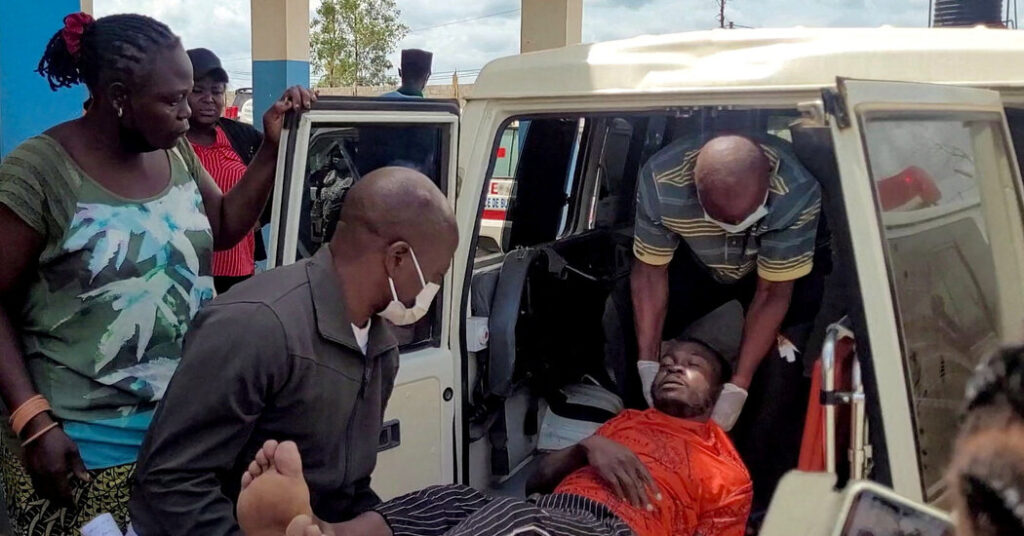
As soon as Ebola was identified in the Democratic Republic of Congo and Uganda late last week, the severity of the outbreak was clear. There were already hundreds of suspected cases and dozens of suspected deaths.
Shortly after the outbreak was announced, the World Health Organization declared it a global health emergency. But by then, the virus had already been circulating for weeks.
Congo has surveillance systems meant to identify outbreaks early so that they can be effectively contained. The country has added several laboratories in recent years and has extensive experience with previous, devastating Ebola outbreaks.
And yet, precious time was lost when officials in Ituri, the province at the heart of the current outbreak, did not raise the alarm when patients began to show symptoms. Samples may not have been sent quickly enough to Kinshasa, the capital, for testing.
“The alert was out very late,” said Dr. Marie-Roseline Belizaire, a doctor and epidemiologist who is leading the World Health Organization’s response to the outbreak. Typically, high numbers of cases are picked up much earlier by health officials or in news reports. This time, it was weeks before health officials knew for certain that they were dealing with an Ebola outbreak.
The consequences of such a long delay could prove catastrophic. There are no vaccines or treatments for Ebola Bundibugyo, the rare species of the virus that is responsible for the current outbreak, and tests that can be used in the field are hard to come by. And in Ituri, contact tracing is likely to be very difficult.
There are large numbers of people who are displaced by conflict and many migrant laborers drawn to its gold mines. The previous outbreak in Ituri, between 2018 and 2020, was the second deadliest Ebola outbreak ever.
A lack of testing capacity was one reason for the delayed response, officials say. Equipment on the ground in Ituri only tests for the most common species of Ebola, known as Zaire, so early results kept coming back negative. When samples were finally sent to Kinshasa, officials there identified Ebola Bundibugyo.
The latest suspected death toll, according to Congo’s health ministry, stands at 105 in Ituri alone — a toll that climbs daily. Hundreds of suspected cases have been reported around the province, as well as one in Goma, another major city more than 200 miles away in eastern Congo, and two in Kampala, the capital of Uganda. Five countries in the region have started screening travelers or tightening border controls, and Rwanda has closed its border with Congo.
The outbreak was declared late, said Dr. Bill Kanyenche, a doctor working mostly in displaced people’s camps for the Congolese nonprofit GRACE, and who is involved in the Ebola response in Bunia.
“It should have been done nearly 30 days before,” he said.
He said that the epicenter of the epidemic, a gold mining town called Mongbwalu, is almost impossible to access now, in the rainy season. Several militias operate there, and because they often clash with each other and with the Congolese Army, he said, most health authorities usually stay in Bunia, 30 miles south.
“This is how it happened that there were deaths with signs of Ebola in the community,” he said, and “the community and even health care personnel weren’t aware of these signs.”
In April, one health worker in Mongbwalu became sick, was taken to Bunia and died there. Later the body was taken back to Mongbwalu, Dr. Kanyenche said. That case was what pushed health workers to collect samples, he said, adding that some of the samples collected have been contaminated.
Samples were collected in the last days of April in Aru, an area about 100 miles northeast of Bunia and close to the Ugandan border, according to Placide Mbala, the head of epidemiology and global health at Congo’s National Institute of Biomedical Research. Those samples tested negative for Ebola in Bunia, and later, tested negative in Kinshasa as well.
More samples, collected between May 3 and 7 in an area south of Bunia, Rwampara, also tested negative in Bunia. But when the Rwampara samples were tested in Kinshasa, they tested positive.
Dr. Mbala’s team used a test designed for Ebola Sudan, another species that has caused eight outbreaks in Uganda and Sudan, according to the W.H.O. They were surprised to find results for the Bundibugyo species, not for Sudan, Dr. Mbala said.
It is not yet known when this outbreak started. Infected people have likely been traveling and attending funerals for at least a month. The W.H.O. said that many deaths have been reported, “potentially associated with unsafe burial practices,” like washing, touching and wrapping the deceased without protective measures.
“This has been out of control for weeks, clearly,” said Atul Gawande, a former senior official at the United States Agency for International Development. “Speed is everything. From when the first case happens is critical.” He said that the Trump administration’s closure of U.S.A.I.D. had already impeded the response to the outbreak.
The director-general of Congo’s National Institute of Biomedical Research, Jean-Jacques Muyembe, told Congolese media that there were delays both in reporting the epidemic and technical delays in the diagnostic system.
“Our surveillance system didn’t work,” he said in an interview with a Congolese news website, adding that members of Parliament and senators in the area who were aware of the deaths went on leave without raising the alarm.
Dr. Muyembe said that the laboratory in Bunia should have sent the samples directly to the institute as soon as the first signs of hemorrhagic fever appeared, according to the interview.
“Something went wrong there. That’s why we found ourselves in this catastrophic situation,” he said in the interview.
The W.H.O. described a “critical four-week detection gap” between the onset of symptoms of the presumed first case and the laboratory confirmation of the outbreak. This suggests health care workers had a “low clinical index of suspicion,” it said in a summary of the situation, adding that they may have confused it with other illnesses.
Four health care workers died within four days at Mongbwalu General Referral Hospital, the W.H.O. said.
Dr. Belizaire, the leader of the W.H.O. response, said that there were problems of mistrust in the authorities, which may also go some way to explain why the surveillance system didn’t pick up the outbreak until many people had already died.
“In the community, maybe they didn’t share the information,” she said. “They didn’t go to health care.”
Jean Kaseya, the head of Africa’s Centers for Disease Control and Prevention, said he was in “panic mode” over the outbreak. “People are dying. I don’t have medicines, I don’t have vaccines,” he told The Associated Press.
Ebola Bundibugyo has a mortality rate of up to 50 percent, Congo’s health minister told journalists on Sunday, urging the sick to seek treatment. There have been only two other outbreaks of it. The first killed 42 people in western Uganda in 2007, and the second, in Congo in 2012, killed 29.
Matthew Mpoke Bigg contributed reporting from Juba, South Sudan and Caleb Kabanda from Goma, Democratic Republic of Congo, and Apoorva Mandavilli from New York.
Ruth Maclean is the West Africa bureau chief for The Times, covering 25 countries including Nigeria, Congo, the countries in the Sahel region as well as Central Africa.
The post Ebola Raged for Weeks in Congo Before Anyone Raised the Alarm appeared first on New York Times.