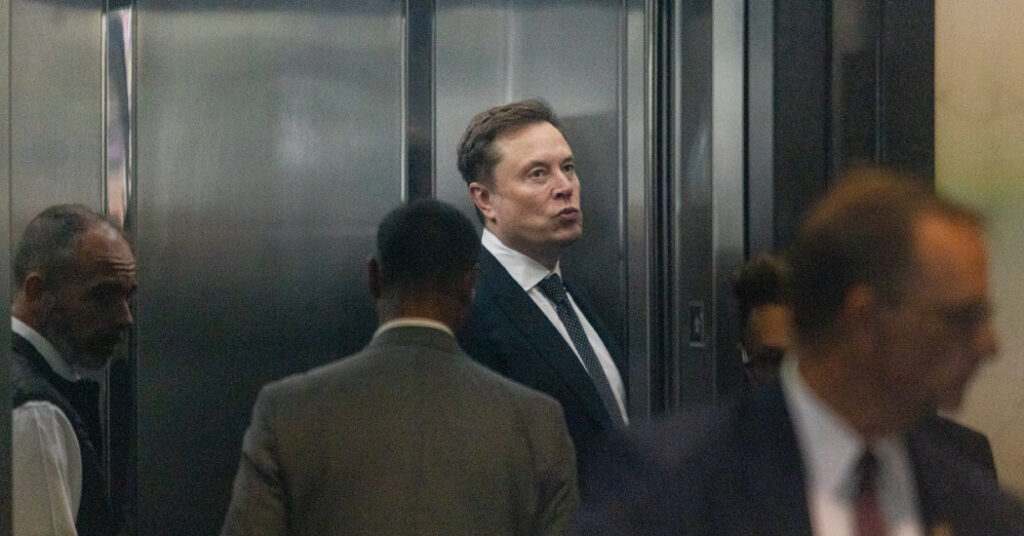
Elon Musk lost his bid to derail OpenAI. Few will feel sorry for him.
Unless you are a corporate chieftain or a venture capitalist, you might want to take a moment, however, to feel sorry for yourself. The juggernaut of artificial intelligence bearing down on the world is probably not your friend.
If you are a clerk, a programmer, an administrator, a writer, an entry-level knowledge worker of any sort, you have already been warned that A.I. might replace you. Even if those worries prove overblown in the short term, the new technology could push down incomes.
The speedy collapse of Mr. Musk’s legal case on Monday will not slow down the juggernaut. If anything, it will speed up. With rising emotions around the country, this could be a long, hot A.I. summer.
A.I. critics dismissed the three-week trial in federal court in Oakland, Calif., as a power struggle between oligarchs that was of little concern to the masses. But it was also a rare glimpse into the seething maw of Silicon Valley as it makes a bid to transform, and possibly take over, the world.
As the A.I. industry likes to remind us, the stakes could not be higher. “The worst-case situation,” Mr. Musk pointed out in his trial testimony, is one where A.I. will “kill us all.”
Mr. Musk was undoubtedly seeking to benefit Elon Musk in his pursuit of OpenAI, the leading A.I. company, and its chief executive, Sam Altman. Mr. Musk, 54, argued that OpenAI was trying to make as much money as possible from the beginning, a violation of its self-proclaimed mission as a charity putting humanity first.
Was A.I. fundamentally a bait and switch? It’s a question that was emphatically worth asking. It would have been nice to have a court ruling that provided a definitive answer.
“The fundamental issue still stands,” said Oren Etzioni, a veteran A.I. researcher who was the founding chief executive of the Allen Institute for A.I., a nonprofit. “Can a nonprofit of any kind become a for-profit willy-nilly?”
The nine men and women of the jury did not consider the merits of Mr. Musk’s argument but decided the statute of limitations meant his lawsuit could not proceed.
“The A.I. trial of the century ends with a whimper,” wrote Gary Marcus, a cognitive scientist who is a prominent critic of A.I. companies. “And so there are some things we will never know.”
Mr. Musk’s challenge to OpenAI ended, at least for the moment, rather differently than the recent court cases against social media. Losses in Los Angeles and New Mexico in the last few months, and the specter of more trials to come later this year, are putting that part of the tech industry on the defensive.
Any reckoning against A.I. will have to come in another form at another time.
Mr. Musk tried his best. If one of his goals was to humiliate Mr. Altman, 41, once a buddy and now a nemesis, he managed to accomplish a bit of that in the court of public opinion. These revelations go to the center of people’s biggest concerns about A.I.: Can it be trusted? And can the people in charge of it be trusted?
No one at OpenAI ended up looking particularly good in the trial. Mr. Musk had accused Mr. Altman of “perfidy” and “deceit” and said OpenAI’s leadership “unjustly enriched” themselves “to the tune of billions of dollars.”
“Our primary fiduciary duty is to humanity,” the OpenAI charter states. But if the company is acting in the people’s best interests, why is everyone who works there getting so rich? Greg Brockman, the president of OpenAI, confirmed his stake was now worth nearly $30 billion. Ilya Sutskever, an OpenAI co-founder who has since left, said he had a $7 billion stake.
(As for Mr. Altman, he has repeatedly maintained he has no direct stake in OpenAI. “I’m doing this because I love it,” he told a Senate subcommittee in 2023. It emerged during the trial, however, that he has stakes worth $2 billion in companies that directly do business with OpenAI. He said he was recused from negotiating the deals.)
And then there is the question of safety — especially important with a technology so potentially dangerous.
“Obviously we’d comply with/aggressively support all regulation,” Mr. Altman told Mr. Musk in 2015 in an email that became an exhibit in the trial. But OpenAI, like nearly every tech company, did not end up a fan of regulation at all.
Ross Gerber, the chief executive of Gerber Kawasaki, a wealth and investment management firm in Santa Monica, Calif., that invested in Mr. Musk’s rocket company, SpaceX, said the lawsuit did not hurt Mr. Altman’s reputation or help Mr. Musk improve his public perception. “The good news is that people hate both of them,” Mr. Gerber said.
“The public is already fearful of A.I.,” the investor added. “I don’t think they dispelled that in any way through this lawsuit.”
Out in the real world, that fear is rising almost by the day.
Many people seem to be uniting behind the idea that they don’t want power-hungry A.I. data centers in their community. Speakers who celebrate A.I. and expect their audiences to do so as well are getting a rude reception. And violence is beginning to flare: Last month, a man traveled to San Francisco to throw a Molotov cocktail at the Mr. Altman’s house. No one was hurt, and he was arrested.
(The New York Times sued OpenAI and Microsoft in 2023 for copyright infringement of news content related to A.I. systems. The two companies have denied those claims.)
A.I. has pretty much a green light from Congress, the Trump administration, the courts and Wall Street. There is a scattering of opposition among state regulators and isolated lawmakers, but so far it hasn’t amounted to much. All of which leaves the increasing anger felt by those clerks, administrators, writers and other citizens with pretty much nowhere to go.
Wall Street expects smooth sailing from here. “OpenAI can shift its strategic focus to capitalizing on the A.I. Revolution taking place front and center given its strong market position in the space,” Dan Ives, an analyst, wrote after the verdict.
OpenAI’s public offering, which may be somewhere in the neighborhood of $1 trillion, is expected as soon as later this year.
Mr. Musk did not get a win on Monday, but he still has his lawyers and his Ahab-like quest to sink the OpenAI whale. He wrote on X, “I will be filing an appeal with the Ninth Circuit, because creating a precedent to loot charities is incredibly destructive to charitable giving in America.”
David Streitfeld writes about technology and the people who make it and how it affects the world around them. He is based in San Francisco.
The post After Elon Musk’s Court Loss Comes the Long Hot A.I. Summer appeared first on New York Times.