Even the most capable autocrats cannot rule alone.
In Russia, Vladimir V. Putin needs his circle of handpicked oligarchs; in Iran, the Revolutionary Guards and its allies in the business world protect the regime’s power; Viktor Orban transformed Hungary into an “elected autocracy” with the help of a few crucial judges, political enforcers and friendly tycoons. But to actually carry out the dirty work of consolidating and maintaining power, such leaders rely on help from a far greater number of lower- and midlevel people: military officers, secret police and bureaucrats.
Yet until recently, researchers paid little attention to how leaders convince and recruit ground-level workers to go along with their demands. The incentives for elites to stay loyal have been studied extensively, but the rank and file have remained something of a black box. In the absence of real data, researchers have tended to assume that they cooperate because of ideological extremism, fear of persecution or some combination of the two.
New research, drawing on an extraordinary data set from Argentina’s Dirty War in the 1970s and ’80s, suggests a very different explanation. It turns out that the kinds of career pressures familiar to employees everywhere — the desire to revive a stalled career or obtain a minor promotion — can be enough to incentivize lower- and midlevel officials to violate professional obligations, fundamental norms and even basic morality. The people who make those decisions, the research suggests, are neither extremists nor victims. They are often just middling workers looking for a way to get ahead.
“Making a Career in Dictatorship,” a new book by two German political scientists, Adam Scharpf and Christian Glassel, reads like what you might get if you crossed Hannah Arendt’s ideas about the “banality of evil” with a business school guide on how to get the most out of low performers.
Their in-depth study of Argentina’s military during that country’s era of coups and forced disappearances found that low performers — whom they refer to as “career-pressured” individuals — filled the ranks of the secret police. That service allowed them to “detour” around the ordinary military hierarchy, the book shows, achieving promotions and career success they could never have managed otherwise.
It turns out that would-be authoritarians don’t need to staff their regimes with ideological true believers, offer extreme enticements or impose draconian punishments in order to make successful power grabs. They just need to figure out how to target their ideal labor pool: the frustrated and mediocre.
Their conclusions have implications for countries around the world grappling with the stability of their democracies — including the United States.
A Data Set of Mediocrity
When he was a young Ph.D. student, Mr. Scharpf was conducting dissertation research in Buenos Aires when a government official dropped a fateful offhand comment during a conversation in a cafe. During the military dictatorship, the official said, the intelligence officers who did the regime’s worst dirty work were “essentially idiots.”
At first, Mr. Scharpf thought the man was just being insulting. He soon realized that the official meant the comment literally — that the military junta’s secret police had been, in his view, incompetent losers.
When he returned to his university in Germany, he mentioned the discussion to his colleague, Mr. Glassel. Both men saw a glimmer of social-science possibility. They decided to learn more. Argentina, it turned out, had published information on all of its military officers’ graduation ranks, promotions and retirements going back to the late 1800s, which meant that it was possible to identify and track the low performers. And because secret police work during the Dirty War was conducted primarily by army intelligence Battalion 601, the researchers could trace exactly which officers joined the unit, how long they stayed and what happened to their careers.
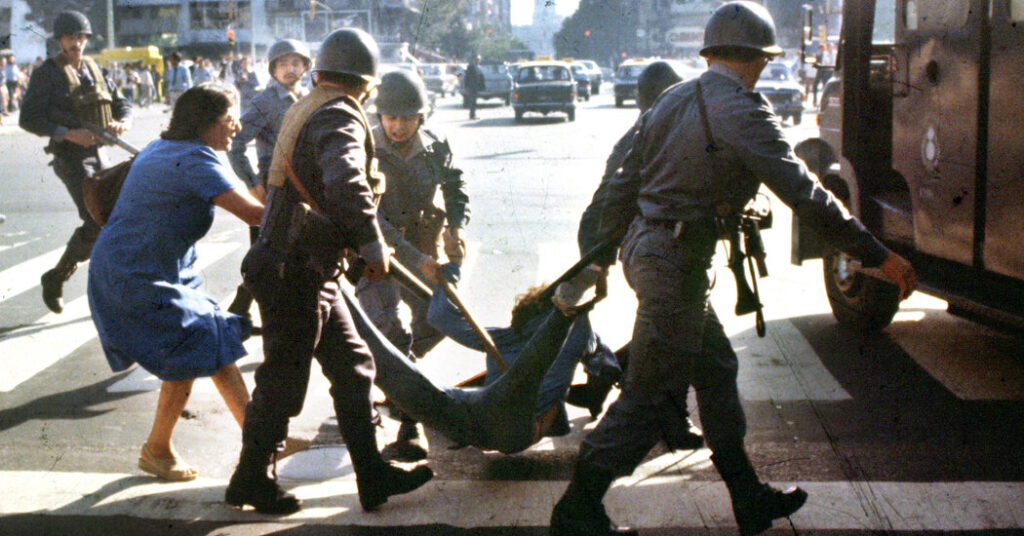
The data showed that the official’s offhand comment had been right. For the most part, the Argentine military operated under a meritocratic “up or out” system. Officers who underperformed early would fall behind their peers, and eventually be forced into retirement. But Battalion 601 offered a detour around that meritocracy: Low performers could transfer into the secret police, spend a few years earning promotions there and then return to the regular army, often leapfrogging over peers who had stayed with the regular forces. Men who took the detour ended up with longer careers, higher salaries and better pensions than similar individuals who stayed in the mainstream military units.
The worse an officer’s academic record had been at the military academy, the more likely he was to join Battalion 601. And once inside, the lowest performers were assigned to the most brutal units, carrying out the day-to-day tasks of torture and murder, work that was so morally repugnant that it carried a serious risk of both social stigma and psychological trauma. But that meant that the career rewards for doing it were the most valuable. A stint as a monster could rehabilitate the most disastrous underperformer.
How Regimes Rely on ‘Loyal Losers’
Ordinarily, of course, it is very difficult to get complete information on who a regime’s “dirty workers” are or what motivated them to take those jobs. So there aren’t really comprehensive data sets to compare with Mr. Glassel and Mr. Scharpf’s research on Argentina.
However, available information suggests that other countries may have followed a similar pattern. For example, Mr. Glassel and Mr. Scharpf found that superiors in the Nazi bureaucracy skillfully exploited career pressures to recruit commanders for the Einsatzgruppen, the mobile killing squads that carried out the “Holocaust by bullets” in Eastern Europe. Many of the recruits had backgrounds that placed them at a disadvantage, such as records blemished by disciplinary proceedings, unclear “racial purity” or lack of military and policing experience. Zealous service in the killing squads helped them improve their careers.
In the Soviet Union, the NKVD, the secret police who killed hundreds of thousands of people during the so-called Great Terror of 1937, “deliberately recruited individuals with poor formal skills and knowledge,” Mr. Glassel and Mr. Scharpf write, often with no more than a primary school education. Senior commanders nurtured their subordinates’ fear of failure by instigating competition between different offices to see who could arrest more people.
In the modern era, autocratic leaders often win power via elections, and then dismantle checks and balances to concentrate power in their own hands. That process tends to be far less violent than the acts carried out by the Argentine military junta or Stalin’s NKVD, but over time it sharply curtails political competition and freedom of expression.
Although each country has its own idiosyncrasies, that process tends to follow a pattern, said Erica Frantz, a political scientist at Michigan State University who studies democratic backsliding. Initially, elected would-be autocrats often appoint “loyal losers” to important positions to rubber-stamp their power grabs, Ms. Frantz said. “The leader knows that people are going to be more likely to be loyal if they don’t have many other career options, so when I say losers, I kind of mean it literally,” she said.
Take Hungary under Mr. Orban. He was first elected in 2010. By 2022, the European Parliament passed a resolution stating that Hungary had ceased to be a democracy and had become an “electoral autocracy.”
To make that happen he relied on a few handpicked loyalists at the top, plus a small percentage of ambitious strivers at the midlevel who saw politics as the route to success, experts say. “There were certain offices that did the dirty work,” said Kim Lane Scheppele, a Princeton University professor who has studied Hungary’s democratic breakdown. She pointed to the National Judicial Office, which selected judges and controlled their promotions, as particularly crucial. It was led by an Orban loyalist.
At the lower levels of the court system, a small percentage of ambitious individuals carried out the government’s agenda. “Five or 10 percent of the judges, the careerists, just do the ‘dirty job’ to get along with their career,” said Attila Vincze, a judicial studies researcher at Masaryk University in the Czech Republic who has studied how Mr. Orban co-opted courts.
Venezuela began a similar trajectory after Hugo Chávez was elected in 1999, but ultimately he and his successor, Nicolás Maduro, used more violent means to preserve their power. To crush protests and other public opposition, the government relied on the National Guard, a branch of the military tasked with preserving internal security, and armed gangs of civilians known as “colectivos.”
The National Guard is considered “the lowest rung of the armed forces” in terms of prestige, said Alejandro Velasco, a Latin America historian at New York University. “If you couldn’t get a job and you couldn’t get in the army, you would join the National Guard.” The colectivos grew out of informal neighborhood watch groups, but as their ties to the government grew, many members were given jobs in the security details of government ministries.
Eventually, such leaders become too unpopular for mere manipulation to keep them in power, and they lose elections. Which leaves them with a choice: leave office, as Mr. Orban did this month after losing an April election, or turn to more violent repression to hang on to power.
Leaders who take the latter path, as Mr. Maduro did in Venezuela in 2024 after his efforts to tilt the presidential election in his favor failed, need to have loyal units of the security forces available to do the dirty work of a violent crackdown. Mr. Maduro relied heavily on the National Guard and the colectivos. According to Human Rights Watch, government forces killed dozens of opposition supporters and detained thousands more after the stolen election.
The American Case
For Americans, this is not just an academic question. Many experts worry that democratic decay appears to be progressing especially quickly during President Trump’s second term.
Ms. Frantz sees parallels between Mr. Trump’s presidency and some of the elected authoritarian leaders she has studied elsewhere. Although Mr. Trump did not create the Republican Party, he has reshaped it over the last decade into an institution centered around himself. And a number of his cabinet members and political appointees, particularly in his second term, appear to fit the paradigm of loyalists whose résumés would be unlikely to land them roles in any other administration.
So the Trump administration’s apparent attempts to secure political control over the armed services, as well as the F.B.I. and ICE, stand out as worrying even when compared with other cases, Ms. Frantz said. Elected leaders “tinkering with” the security services “tends to be something that we see once a system has already transitioned to authoritarianism,” she said, rather than when democracy is in decline.
Mr. Glassel and Mr. Scharpf are concerned that President Trump’s planned expansion of ICE, in particular, could make it an ideal venue for “detouring” by ambitious underperformers who could be deployed for anti-democratic purposes. The worry is especially profound given the storming of the Capitol at the end of Mr. Trump’s first term, albeit by a less organized band of loyalists.
The playbook for a leader to create a loyal security service, they said, is to set up or repurpose an institution that can become a “second ladder” for career promotions, resource it generously and ensure that the barriers to getting hired there are low, signaling that it offers career opportunities to those who cannot find them elsewhere. (Cutting other government jobs or squeezing budgets can create a larger pool of potential recruits.) The leadership then signals impunity for people on that second ladder, to assure them that they won’t face consequences for wrongdoing.
The administration seems to tick those boxes, even if Mr. Trump’s intentions are obscure. (The president has spoken openly of a third term in violation of the Constitution and disparaged the need for an election.) ICE remains an anti-immigration force, but it is set to be radically expanded, with a budget that would dwarf other federal law-enforcement agencies if the current funding bill passes. The Trump administration has drastically cut employment in other federal agencies, leaving thousands of people unemployed or fearful that they soon might be. And top officials in the administration, including Vice President JD Vance and Stephen Miller, Mr. Trump’s deputy chief of staff, explicitly assured ICE officers of “immunity” after immigration officers killed a protester in Minneapolis in January.
At the same time, it has become easier than ever to become an ICE agent. Ryan Schwank, a former training academy instructor, testified to Congress in February that new cadets “are graduating from the academy despite widespread concerns among training staff that even in the final days of training, the cadets cannot demonstrate a solid grasp of the tactics or the law required to perform their jobs.” ICE recruits must now complete only nine practical examinations to graduate from the training academy, compared with 25 exams that were listed in a training syllabus dated July 2021. It’s a good career opportunity for someone looking to get ahead.
Amanda Taub writes the Interpreter, an explanatory column and newsletter about world events. She is based in London.
The post Actually, Democracy Dies in H.R. appeared first on New York Times.