In 2024, Tucker Carlson revealed that he had been physically attacked in his bed by a demon — “or by something unseen.” The entity left four claw marks on each of his sides and on his left shoulder, he said. He was bleeding when he woke. Catholic and Orthodox clergy weighed in publicly, with an Orthodox priest lamenting that Mr. Carlson’s Episcopalian faith left him ill-equipped to respond to such an attack.
More recently, Gregg Phillips, the head of FEMA’s Office of Response and Recovery, made news for claiming that he had once been teleported, by forces beyond his control, to a Waffle House 50 miles away in Rome, Ga. The Times sent a reporter to track down the workers and regulars at all three of Rome’s Waffle House locations, but nobody remembered Mr. Phillips.
In a less esoteric vein, this past Easter, Catholic priests in dioceses across the country welcomed the largest classes of converts they had seen in 15 or more years. Eastern Orthodox parishes are also reporting a surge in growth, particularly among young men.
“In the whole history of the Orthodox Church in America,” one Antiochian Orthodox priest told The Times, “this has never been seen.”
The backdrop of all this is the peculiar atmosphere of contemporary public life — claustrophobic, faintly hallucinatory, where what we know as real feels like sand shifting under our feet. The first lady, Melania Trump, walks a humanoid robot down a White House red carpet and later tells the audience to imagine a future humanoid educator named “Plato.” A former intelligence official testifies under oath that the United States has been secretly retrieving and reverse-engineering crashed U.F.O.s for decades, and that nonhuman “biologics” have been recovered.
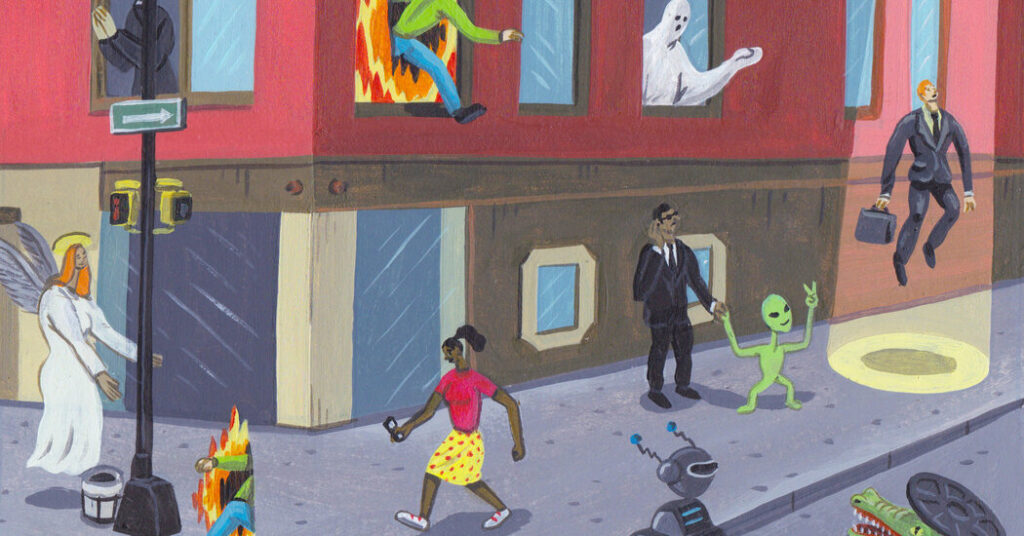
Demonic vexation, teleportation, increased interest in religious practice — those phenomena are all signs that life feels, to many, increasingly charged with unseen forces. You might say it has been re-enchanted. There’s a widespread feeling that the material explanation is no longer sufficient; that something uncanny, maybe even numinous, is diffused into the texture of ordinary American life.
Pew found in 2024 that 30 percent of Americans consult astrology, tarot cards or fortune tellers at least once a year. New age practices are even more popular among some demographics, like younger women and L.G.B.T.Q. adults. During my first pregnancy I received a reiki, or energy healing, treatment for my unborn son. It’s now offered at major hospitals across the country.
What is going on? Why is the world re-enchanting itself now?
In 1917, the sociologist Max Weber argued that a long process of rationalization, culminating in modernity, was eliminating “mysterious incalculable forces” from the world. Science would explain; technology would master; and magic would disappear. For a brief stretch of modern history, he seemed right: The enduring human instinct to believe in the otherworldly declined as empiricism, common evidentiary standards and, for the shortest period of all, mass media produced a rough consensus about what was real. Now we seem to be sliding back.
Three changes in both the kind of information we receive and the way we receive it may help explain what’s going on.
The first is that, in the era of digital technology and the endless scroll, the mind is being asked to do more than it comfortably can. The brain is a pattern-matching machine. Most of the time, it’s like a piece of software running in the background, synthesizing information without your noticing. You walk into a room and instantly read the mood; you glance at a friend’s face and know something is wrong before they tell you. Today, there’s just too much information — and we’re noticing patterns that don’t exist.
This mental overload is how you get from “that’s an odd coincidence” to “nothing is a coincidence.” It’s the same type of thinking that produces QAnon and other conspiracy theories. It’s what happens when a stranger on TikTok tells a million viewers this video was “meant” to find them, and many of them, despite being vaguely aware of how recommendation algorithms work, take it as a sign that supernatural forces are at work.
The second change has to do with proof and evidence. Doctored photographs predate A.I. and even the digital camera. But fabricating proof used to take work.
A.I. has removed that friction — any claim can now be furnished with evidence on demand, evidence increasingly indistinguishable from the real thing. And since so much evidence can now be fabricated, any piece of evidence can be dismissed. When nothing is verifiable, then everything is permitted.
Finally, there’s institutional decay. The paranoid explanation keeps turning out to be partly right. To give just one high-profile example, Purdue Pharma, the maker of OxyContin, spent decades downplaying how addictive its product was, even as it fueled an overdose epidemic that has killed hundreds of thousands of Americans.
When events like that one happen often enough, people lose confidence in institutional authority. There goes “the science,” or “the church,” or “the official story.” Demonology, astrology or conspiracy theories about satanic pedophile cabals ruling the world fill the gap.
The result of all of those conditions is that life has begun to feel governed by forces beyond our understanding, by knowledge that is unverifiable and by authority that is distant and suspect. It is, in a word, beginning to feel medieval.
I do not believe that re-enchantment, in itself, is the main problem. After all, re-enchantment doesn’t mean “irrational,” or “untrue,” or “conspiracy,” though it can lead there. Rather, it’s the re-emergence of one of the oldest and most durable features of human experience, the sense that the world is bigger than what human knowledge can, at a particular moment, measure. It’s not a coincidence that many of our most famous scientists were obsessed with ideas that we’d now find crazy. Thomas Edison, for example, claimed to be working on a device that would try to receive the voices of the dead.
But enchantment mutates when it’s untethered from a foundation, from a community that acts as a check on the most wild and destructive instincts.
In a Rolling Stone article about A.I.-induced spiritual crises, the writer Miles Klee spoke to an unnamed source whose partner had messaged extensively with ChatGPT. Eventually, the partner came believe he was God. He had an ecstatic experience with a product that has a stake in keeping him engaged; his story might have ended differently inside a spiritual community, where someone could have told him to slow down.
The world we’re moving into will look more like the one before the modern era than like the one we grew up in. It will be saturated with the supernatural. Everyone will believe in something. The question is in what.
Katya Ungerman writes under the pen name Katherine Dee. She’s the tech correspondent for The Spectator and a columnist for Tablet. She blogs at default.blog.
The Times is committed to publishing a diversity of letters to the editor. We’d like to hear what you think about this or any of our articles. Here are some tips. And here’s our email: [email protected].
Follow the New York Times Opinion section on Facebook, Instagram, TikTok, Bluesky, WhatsApp and Threads.
The post We Are Sliding Back Into the Middle Ages appeared first on New York Times.