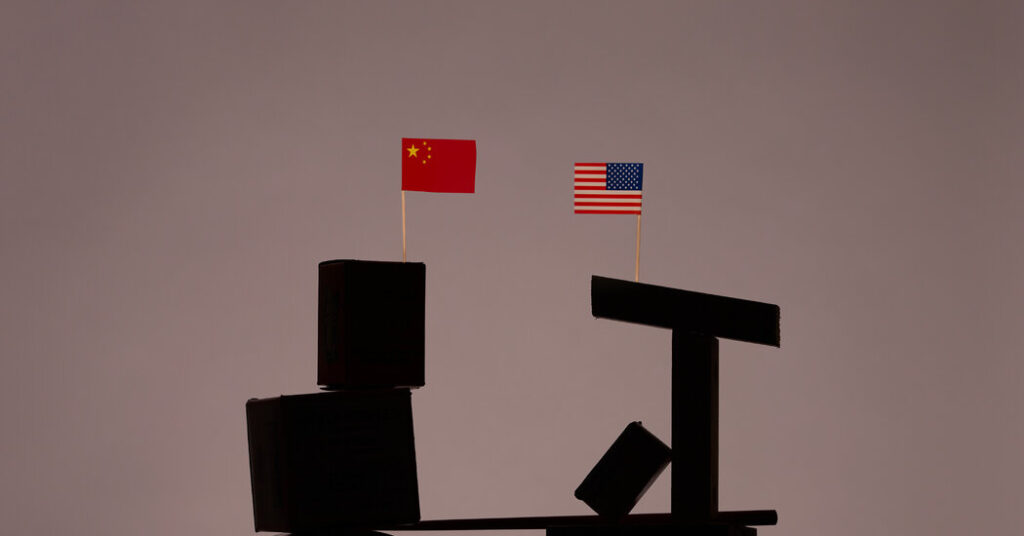
With some family gatherings, the best you can hope for is that no one gets drunk and starts a fistfight. Expectations when President Trump and China’s leader, Xi Jinping, met on Thursday and Friday were similarly low — and they were met.
Mr. Trump had some warm words about the duo’s “fantastic future” and how the Chinese would buy American goods, but the meeting ended without clear progress toward resolving the two sides’ trade disagreements. The result was like a host saying brightly, “It’s so nice when you all get along,” as his relatives sullenly slink away.
Since family feuds and trade discussions are almost always disappointing, one should ask: Could we have done better?
We think so. In our dream scenario, Mr. Trump would accept that his government could help to redress global economic imbalances by borrowing less. For its part, the Chinese government would strip away the incentives it provides that lead its companies to overproduce, while encouraging its citizens to spend and import more. The United States and China would agree that mutual dependence makes them both safer — and then exchange hugs.
For this to happen, however, Mr. Trump and Mr. Xi would need personality transplants. So more realistically, any future deal must reckon with three facts: First, the Chinese government is no more willing to transform its subsidy-soaked economic model than the U.S. government is keen to make veganism the national diet; second, both the U.S. and China have considerable leverage in any negotiation; and third, the bilateral U.S.-China trade relationship involves the rest of the world, too.
Trust between the two sides is going to remain low. A recent report commissioned by the U.S. Chamber of Commerce described how China was doubling down on entrenching its dominant position in global supply chains. After years of frustration on the part of U.S. negotiators, there’s no point in promising a level playing field through shared rules of engagement, only for Chinese bureaucrats to tilt it again behind closed doors. And if you think Mr. Trump is a man of his word, then I have a cryptocurrency to sell you.
If it’s not possible to agree to shared rules, then negotiating over outcomes is the ugly but more pragmatic alternative. In some areas, that could mean purchase agreements to help overcome trade barriers; in others, it might mean exchanges of license approvals: The Chinese could let some rare earths out, while the U.S. government could agree to send over some high-end chips. It would be clunky, inefficient and extremely unlikely to lower a trade deficit, but it might be better than a tit-for-tat of escalating export controls and tariff wars.
The fact that the United States and China are each looking to weaponize their economic dominance means that any deal should really be time-limited. It’s no longer controversial to say that while having so much manufacturing concentrated in one place might be efficient, it is also dangerous. An announcement of a longer-term trade deal might send businesses the signal that everything is fine in the relationship and that those manufacturing clusters are risk-free.
To be fair, the United States and China didn’t pretend that they had done a lasting deal when their leaders met last week. Doing better could mean formally giving up on any idea of a grand, permanent détente in the near future, and establishing a goal of resetting expectations at least once a year.
If neither side is about to lower its fists, any trade agreement should try to help both nations manage their race to become less dependent on each other — and avoid it blowing up. Imagine an Organization for Watching Liabilities, which would identify cases in which supply is too highly concentrated in one nation. Like an international competition regulator, this new institution would hunt for instances of concentrated market power. If and when such instances were identified — say, China’s command of rare earths — the other nation would be within its rights to act to reduce that dominant position without retaliation, including by restricting imports.
However it is done, the two sides must find a way of preventing trade disputes from spiraling out of control. The U.S. trade representative, Jamieson Greer, has proposed a “Board of Trade” to manage trade relations with China by reducing tariffs on certain “nonsensitive” goods. Such a board could help, if it provided a way of communicating U.S. intentions more diplomatically than via Mr. Trump’s social media posts. Mr. Greer has said that he plans to put out a call for public comment on which products should be deemed nonsensitive and tradable relatively freely.
The Trump administration doesn’t seem to like big family gatherings, preferring to sort out its grievances one-on-one. In an interview with Bloomberg on Friday, Mr. Greer suggested that the Chinese had accepted that there would be tariffs as part of a truce, though he was noncommittal about how high they would be. If the objective is to loosen trade ties with China, such barriers could have some effect: Last year, relatively high tariff rates meant that China’s exports to the United States fell by nearly 30 percent compared with the year before. The rest of the world’s nations faced new trade barriers too, but not as high, and their exports to the United States rose by 9 percent.
But if the goal is to discourage either nation from becoming dangerously dependent on the other, then focusing so heavily on exchanges between China and the United States risks pushing the problem further back along supply chains, as they are routed through other countries. The United States could try to act on its own to block products containing critical Chinese components arriving from elsewhere. But if Uncle Steve throws a plate at the family gathering as an act of self-preservation, Aunt Brenda might just throw a bowl right back. The Chinese recently warned they would do as much, when they published an order threatening to retaliate if nations took action to penalize their suppliers.
Mr. Trump presumably wanted more to announce from his trip to China. The fact that he didn’t get it reflects China’s perceptions of its own strength. It could be that surviving a particularly fraught family gathering means gritting your teeth and soldiering through. But at least trying to talk it out seems more constructive than stewing alone — and certainly more constructive than fighting.
Soumaya Keynes is an economics columnist at The Financial Times. Chad P. Bown is a senior fellow at the Peterson Institute for International Economics. They are the authors of the forthcoming book “How to Win a Trade War: An Optimistic Guide to an Anxious Global Economy.”
The Times is committed to publishing a diversity of letters to the editor. We’d like to hear what you think about this or any of our articles. Here are some tips. And here’s our email: [email protected].
Follow the New York Times Opinion section on Facebook, Instagram, TikTok, Bluesky, WhatsApp and Threads.
The post Trump and Xi Would Need Personality Transplants to Get This Deal Done appeared first on New York Times.