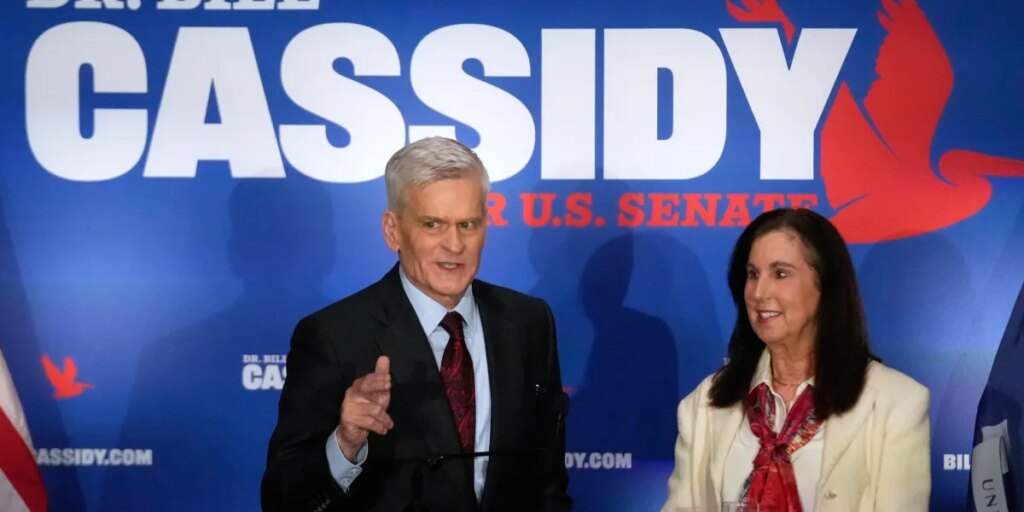
Sen. Bill Cassidy was decisively defeated in Saturday’s Republican primary in Louisiana, unable to convince voters that he deserved another term five years after voting to convict President Donald Trump during an impeachment trial over the Jan. 6 attack on the U.S. Capitol.
He finished behind U.S. Rep. Julia Letlow, who capitalized on the power of Trump’s endorsement as the president continues purging his party of people he views as disloyal, and John Fleming, the state treasurer. Letlow and Fleming will compete in a runoff on June 27.
The result was the latest example of Trump’s unrivaled power over the Republican Party as he approaches the twilight of his second term with persistent inflation, sagging approval ratings and dissatisfaction over the war with Iran. Unlike some other senators who declined to run again after crossing Trump, Cassidy pushed hard for reelection and spent nearly double the combined amount of his opponents.
But none of that was enough for Cassidy to qualify for a runoff, let alone win a third term.
“Our country is not about one individual,” he told supporters after his loss. “It is about the welfare of all Americans, and it is about the Constitution.”
Letlow, on the other hand, swiftly embraced Trump’s central role when she spoke at her victory party.
“I want to say thank you to a very special man who you all know, the best president this country has ever had, President Donald Trump,” she said while flanked by her two young children.
Asked about Cassidy’s vote at the impeachment trial, Letlow called it “a sign that he had turned his back on the Louisiana voters.”
Trump cheered the victory on social media, saying “that’s what you get by voting to Impeach an innocent man.”
Trump has been purging his party
Trump unloaded on Cassidy the morning of the election, calling him “a disloyal disaster” and “a terrible guy.” Later that night, the senator made a thinly veiled reference to the attacks.
“Insults only bother me if they come from somebody of character and integrity, and I find that people of character and integrity don’t spend their time attacking people on the internet,” Cassidy said.
The Louisiana primary comes in the middle of a month of campaigns by Trump to exact retribution on politicians who have crossed him. On May 5 he helped dislodge five of seven Indiana state senators who rejected his redistricting plan.
Next Tuesday, U.S. Rep. Thomas Massie of Kentucky will face a Trump-backed challenger, Ed Gallrein, in another Republican primary. Massie angered Trump by opposing his signature tax legislation over concerns about the national debt, pushing for the release of the Jeffrey Epstein files and opposing his decision to go to war with Iran.
After Cassidy’s defeat, Trump wrote on social media that “Tom Massie, a major Sleazebag, is even worse.” He encouraged voters to “get this LOSER out of politics in Tuesday’s Election.”
It’s a striking amount of intraparty turmoil as Republicans face the possibility of losing control of Congress in November’s midterm elections.
The runoff between Letlow and Fleming, a former U.S. House member and Trump administration official, will likely determine Louisiana’s next senator because of the state’s Republican leanings.
On the Democratic side, Jamie Davis advanced to a runoff, but the second spot remained too close to call between Nicholas Albares and Gary Crockett.
Election changes stir concern
The election was scrambled by a recent U.S. Supreme Court decisiongutting a part of the Voting Rights Act that affects how congressional maps are drawn. Although the Senate primary went forward, Louisiana leaders decided to delay House primaries until a future date to allow them to redo district lines ahead of time, a shift that raised the possibility of confusion for voters on Saturday.
Cassidy also complained that a new primary system enacted last year confused voters by requiring them to ask for a partisan ballot instead of the all-party primary previously in place. He said some called his office to say they had been unable to vote for him.
“The process that was set up was destined to be confusing,” Cassidy told reporters Friday.
Dadrius Lanus, executive director of the state Democratic Party, said his team fielded hundreds of calls from voters who said the changes undermined their ability to vote as they planned.
“A lot of the information should have gotten to voters well in advance,” Lanus said. “It’s literally been a whirlwind of confusion.”
Incumbent senator tried to hang on
Cassidy waged an aggressive campaign to convince voters he should not be counted out.
His campaign was expected to have spent roughly $9.6 million on advertising through May 16, according to the ad-tracking firm AdImpact. And Louisiana Freedom Fund, a super PAC supporting him, was on track to spend $12.3 million.
By comparison Letlow’s campaign, which launched Jan. 20, spent roughly $3.9 million, while a super PAC backing her, the Accountability Project, spent about $6 million.
Fleming’s campaign spent about $1.5 million.
Cassidy and Louisiana Freedom Fund ran ads attacking Letlow for supporting diversity, equity and inclusion initiatives, which Trump has tried to eliminate.
Letlow, a college administrator before her election to the House, said she supported DEI while interviewing for the position of president of University of Louisiana-Monroe in 2020.
Targeted by Trump
Cassidy’s vote in favor of convicting the president after his 2021 impeachment has shadowed him since.
John Martin, a 68-year-old retired engineer in south Louisiana, said he would vote for Letlow because he was still upset by Cassidy’s decision. He waved a campaign flyer showing her standing alongside the president.
“I know a lot more about Cassidy than I do about her,” Martin said. “But if she’s endorsed by Trump, I’m going to believe that.”
Cassidy steered clear of Trump’s ire last year, supporting Robert F. Kennedy Jr. to lead the Department of Health and Human Services despite his public reservations about the nominee’s anti-vaccine views.
But as chair of the Senate health committee, Cassidy has been more publicly critical of Kennedy, including over funding cuts for vaccine development.
Trump also blamed Cassidy for the failed nomination of his second choice for surgeon general, Casey Means, who raised doubts about vaccinating newborns for hepatitis B, a practice Cassidy supports. Trump withdrew the Means nomination and criticized the senator.
Letlow waited for Trump’s backing
Letlow considered running for Senate last year but only entered the race after Trump announced his endorsement in January.
By that time Fleming, who was elected treasurer in 2023, had already jumped in and pitched himself as a Trump devotee. But Landry was looking for a better-known challenger, and he suggested Letlow to the president.
Letlow had an unconventional and tragic entry into politics.
In 2020, while she was a college administrator, her husband Luke was elected to the U.S. House but died of COVID-19 before he could be sworn in. Letlow ran for and won the seat in a March 2021 special election and was reelected in 2022 and 2024.
The post Sen. Bill Cassidy, who voted to convict Trump in Jan. 6 impeachment, loses primary as president retains grip on GOP — ‘that’s what you get’ appeared first on Fortune.