
New York City is dealing with elevated crime and disorder, failing and emptying schools, taxpayer flight and a fiscally crunched City Hall.
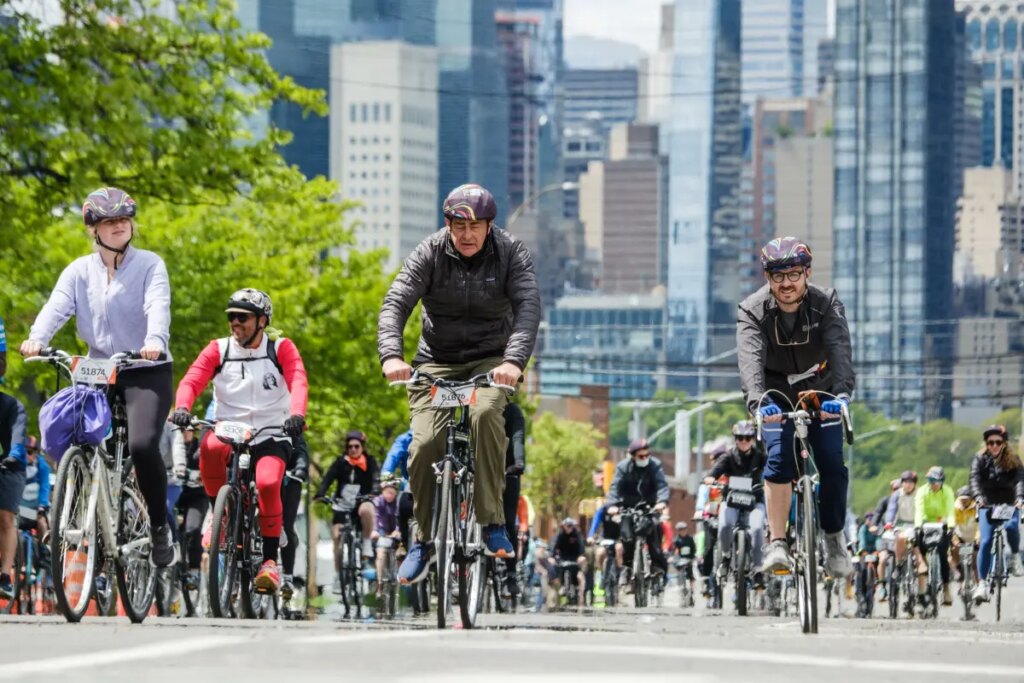
But our ruling class is targeting the “real” emergency: not enough bike lanes.
Cycling activists and their friends at the Department of Transportation have stepped up their crusade against the existential threat of the four-wheeled vehicle, imposing street-redesign plans on neighborhoods, whether residents want them or not.
Let’s be clear. New Yorkers like bikes. Four wheels good, two wheels better.
Bike lanes can be great assets, so long as they’re not at the expense of pedestrians or drivers.
Cyclists and pedestrians travel well together in places like the Hudson River Greenway right by the faster drivers on the West Side Highway.
Reducing any of the lanes of the greenway or highway would upset a careful balance.
But that balance is exactly what’s missing across much of the city.
DOT’s “bike kings” have turned street design into an ideological exercise, where the goal is not better mobility — but fewer cars, period.
Park Avenue. Canal Street. 72nd Street. Astoria’s 31st Avenue. One by one, major arteries as well as side streets are set to be narrowed, rerouted or stripped of lanes under the cyclist creed.
The bike kings go to communities with glossy presentations stuffed with buzzwords — “traffic-calming redesign,” “rebalancing public space,” “reimagined corridors.”
Translation: Your car, delivery truck or Access-A-Ride van — no longer welcome.
Too often, “reimagining” a street simply means strangling it.
And if residents object? Dismiss them as backward, selfish or (worse) suburban-minded.
On the Upper West Side, hundreds of residents protested a proposed bike lane on 72nd Street, citing worse congestion, lost parking, delivery chaos and reduced access for seniors and the disabled.
In Astoria, firefighters pointed out that barriers and narrowed lanes could slow emergency response as firetrucks have more trouble maneuvering and accessing curbs, hydrants and buildings.
In both cases, the response was essentially the same: Proceed anyway.
The policy appears no longer about trade-offs, but about doctrine.
That anti-car doctrine ignores how New York actually functions.
Most people still get around by foot, subway, bus or car. Businesses rely on trucks and vans. Families depend on pickups and drop-offs. Seniors depend on taxis, Access-A-Ride and ambulettes.
In Chinatown, for example, Canal Street is not a lifestyle corridor — it’s a vital commercial artery connecting Manhattan to Queens, Brooklyn and New Jersey.
Reduced lanes and access would destroy its fragile economy.
Yet the area remains under study for lane reductions and redesigns that prioritize bikes over basic circulation and for further pedestrianization.
Ask residents what they want, and it’s removing illegal vendors — not welcoming more with expanded sidewalks.
Local residents and business owners in nearby Bowery, Park Row and Chatham Square faced DOT presentations again last week for “new” plans; the community rejected it, just as it did in 2008.
Yet proposals keep coming once every several years, as in Flushing and Queens Chinatowns too.
For older New Yorkers, this isn’t abstract. Many live in what’s known as Naturally Occurring Retirement Communities, such as Chinatown, Penn South and Fresh Meadows, where daily life depends on curb access.
A 29-year-old urban planner may see curb space and parking lanes as “underutilized space.” An 82-year-old with a walker needing a car for a doctor’s visit sees it as independence.
That senior can’t “reclaim” the street on a fixed-gear bike.
Add to that high-speed e-bikes and scooters — often unregistered and difficult to track after accidents.
Meanwhile, businesses — already hit by inflation, e-commerce and congestion pricing — must take more hits: fewer loading zones, more traffic backups and a never-ending stream of parking tickets.
All this for a heavily weather-dependent mode of transportation that, despite years of expansion, still represents a small share of total trips.
None of this is an argument against bike lanes. It’s an argument against absolutism.
Streets exist first to move people and goods efficiently and safely. That means balancing competing needs, not just reducing cars.
Instead, City Hall increasingly treats the removal of vehicle space as a good in itself.
And the people pushing hardest for these changes are often the least affected by them — professionals who can work from home, avoid peak travel or simply absorb the inconvenience.
Ironically, DOT is one of the top three agencies responsible for misused city-issued parking placards. They want you to take the bus while they park wherever they want.
New York doesn’t need streets designed to conform to the cyclist ideology. It needs streets that make possible greater circulation, commerce and access.
Residents should say no to senseless bike-lane expansion.
Because a city that can’t move and accommodate the people who actually live and work in it isn’t “reimagined.”
It’s just stuck.
Wai Wah Chin is the founding president of the Chinese American Citizens Alliance Greater New York and an adjunct fellow of the Manhattan Institute.
The post Gotham’s tyrannical ‘bike kings’ are taking over the city appeared first on New York Post.