Last week, I wrote about Russia’s war in Ukraine and the drone technology helping Ukrainians hold their own, at least for now. Today, I want to introduce you to the man in charge of that strategy.
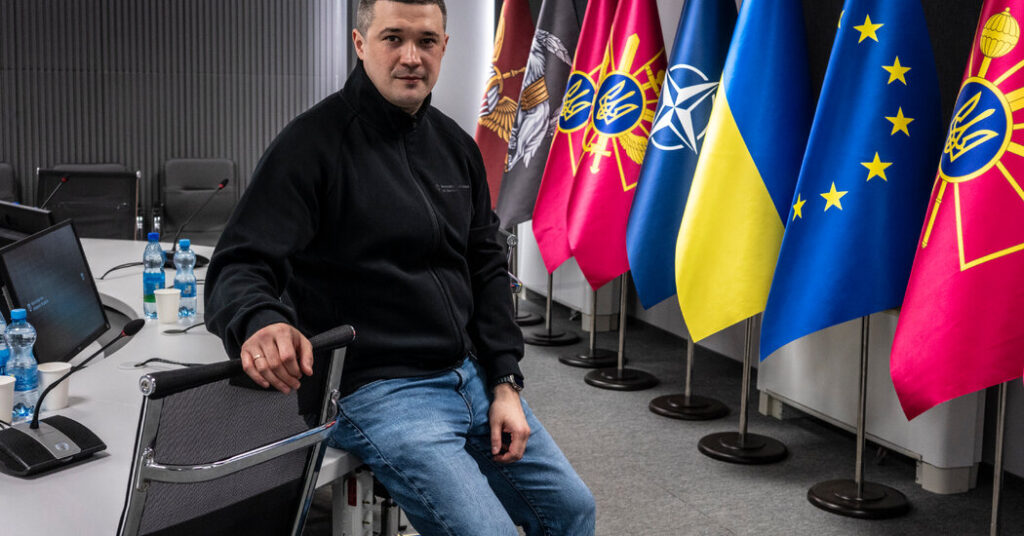
Mykhailo Fedorov is Ukraine’s defense minister. He’s 35 years old. He used to work in tech. If the sci-fi dream (or nightmare?) of autonomous killer robots eventually comes to fruition, it may be in part because of him.
I’ll hand it over to my colleague Andrew Kramer, who leads the Times bureau in Kyiv, to tell you all about the man forging the future of warfare.
The man bringing Silicon Valley to Ukraine
By Andrew Kramer
Who is Mykhailo Fedorov? He’s the man President Volodymyr Zelensky put in charge of the Ministry of Defense four months ago, to help pursue a strategy that boils down to killing so many Russian soldiers that Moscow can’t recruit enough to keep fighting. (The goal is to raise the Russian casualty rate from 35,000 killed and wounded a month to more than 50,000.)
To get there, Fedorov is pushing for the introduction of autonomous drones, which could decide on their own to use lethal force.
One good quote: “Autonomous weapons are the new nuclear weapons. Countries that possess them will be protected.”
Who likes the sound of this? Defense-adjacent tech companies.
Fedorov, whose background is in digital advertising, has become Ukraine’s point person for Silicon Valley, touting the war as a testing ground for defense technologies. He’s working with Alex Karp, the chief executive of the defense-focused data analysis company Palantir, to integrate A.I. into Ukraine’s military. Fedorov has also met with Eric Schmidt, a former chief executive of Google who founded a venture fund, D3, focused on weapons development in Ukraine.
Fedorov is also leading an effort to monetize or trade Ukrainian military data, including a library of more than five million annotated videos of the battlefield filmed by surveillance and strike drones. These include footage showing how humans behave as killer drones close in, such as by running or hiding. Last month, Ukraine opened up the data sets to companies from allied nations: If they share their A.I. models with Ukraine, they can have access to Ukraine’s data.
Who’s not so sure? Some members of Ukraine’s military and human rights groups.
Fedorov has never served in the military, unlike many Ukrainian men of his generation, and there have been tensions between his office of young sweatshirt-wearing data analysts and members of the armed forces.
Last month a Ukrainian unit attempted a risky assault with a column of armored vehicles, and several soldiers were killed and wounded. An adviser to Fedorov sharply criticized the tactics in a social media post: “We often laugh at the enemy when he sends his troops in columns. Treating our people like this is a crime.” The unit responded that if the adviser knew how best to attack Russian positions, he should enlist in the military himself.
Human rights groups are also not fans of the use of A.I. in lethal weapons in Ukraine, warning that delegating life-and-death decisions to machines crosses a moral red line and risks unlawful civilian casualties. But Fedorov argues that “the risks are not as high as you think.”
Read Andrew’s full profile of Fedorov.
MORE TOP NEWS
An Ebola outbreak in Africa
The World Health Organization declared a “public health emergency of international concern” over an Ebola outbreak in the Democratic Republic of Congo and Uganda.
The outbreak was first identified in Congo’s Ituri province, where 246 suspected cases and 80 deaths were attributed to the virus. There is no approved vaccine and no therapeutics for this strain of Ebola, which is known as the Bundibugyo species. The W.H.O. has also confirmed cases in Kinshasa and Kampala, the capital cities of each country.
The outbreak’s spread to those cities could pose an added challenge for public health workers because infectious diseases can spread more rapidly in dense urban settings.
Qatar’s door to the world is slammed shut
The Iran war and the closure of the Strait of Hormuz have paralyzed the vital gas exports that have transformed Qatar from a pearl-diving backwater into one of the world’s wealthiest nations.
Qatar derives more than 60 percent of its revenue from gas and gas-related exports. Virtually no gas has left Qatar’s shore for more than two months. The nation is also cut off from the sea routes through which it imports everything from vehicles to produce. Fears of regional instability have hurt tourism and eroded business sentiment.
OTHER NEWS
-
Vladimir Putin will travel to China tomorrow for talks with its leader, Xi Jinping, just days after President Trump’s visit there.
-
At least four people were killed by Ukrainian drone strikes across Russia, including in Moscow, in the biggest attack by Ukraine this year.
-
Israel secretly operated at least two military outposts in the Iraqi desert for months during the war with Iran.
-
An Israeli airstrike killed the leader of Hamas’s military wing in Gaza.
-
A commander of an Iranian-backed militia has been charged with planning at least 20 attacks against U.S. and Israeli interests in Europe and Canada.
-
Trump said that U.S. and Nigerian forces had killed a top-ranking ISIS leader in an operation in Africa.
-
Félicien Kabuga, who was accused of being a mastermind of Rwanda’s genocide, died. He was 91 or 93, based on various accounts.
WHAT ELSE IS HAPPENING
-
Bulgaria won the Eurovision Song Contest after it triumphed at the last second over Israel.
-
The Swiss watchmaker Swatch had to close stores in dozens of cities after crowds lined up to try to snag a Royal Pop pocket watch.
TOP OF THE WORLD
The most clicked link in the newsletter on Friday was a recipe for chocolate-mayonnaise cake.
SPORTS
Golf: The final round of the 2026 PGA Championship is underway. Follow our live updates.
Formula 1: Strippers in Montreal have called for a strike during this month’s Canadian Grand Prix in protest of working rights and conditions.
Football: Xabi Alonso will become Chelsea’s new manager.
ARTWORKS OF THE DAY
The things that made Frida Frida
To appreciate Frida Kahlo in all her complexity, it helps to think of her not just as a painter but as a performance artist, carefully curating the image she presented to the world. We’ve put together a visual dictionary of the things — like plaster corsets and Tehuana skirts, men’s wear and spider monkeys — that helped make Kahlo what one costume designer called “a living work of art.”
MORNING READ
President Recep Tayyip Erdogan of Turkey has called birth control a “betrayal” and his country’s falling birthrate a “disaster.” His government is trying to increase the birthrate with monthly stipends, interest-free loans and extended parental leave. But they’re not working.
Turks today are more likely than ever to have university degrees and want to start careers before having children, one sociologist said. And many parents we interviewed said the incentives were just too small to make a difference. Read about Turkey’s baby slump.
AROUND THE WORLD
Meet a master of wildlife dioramas
Tim Bovard is the last full-time taxidermist at any museum in the U.S. Since 1984, he has worked at the Natural History Museum of Los Angeles County, where he creates dioramas and maintains animal mounts that have been in the collection for more than a century.
It takes an encyclopedic knowledge of the natural world to do the job well. Bovard knows, for example, how a raptor would sit, preen and hunt, as well as the right kind of tree for the bird. Check out his craftsmanship.
RECOMMENDATIONS
Watch: Jude Law plays a chilling Vladimir Putin in “The Wizard of the Kremlin.”
Travel: These five railway journeys around the world are great for stargazing.
Decide: Want to find shoes that match your personality? Take this quiz.
Move: The key to starting a fitness habit isn’t more discipline but more flexibility: an “all-or-something” mind-set.
RECIPE
Pastina is a simple Italian dish made from tiny pasta stars, chicken broth, egg yolks and Parmesan. Is it soup? Is it pasta? Who cares! It’s comforting and tastes like a hug.
WHERE IS THIS?
Where is this street?
TIME TO PLAY
Here are today’s Spelling Bee, Mini Crossword, Wordle and Sudoku. Find all our games here.
That’s it for today. See you tomorrow! — Katrin
Andrew E. Kramer was our guest writer today.
We welcome your feedback. Send us your suggestions at [email protected].
Katrin Bennhold is the host of The World, the flagship global newsletter of The New York Times.
The post He’s Forging the Future of War appeared first on New York Times.