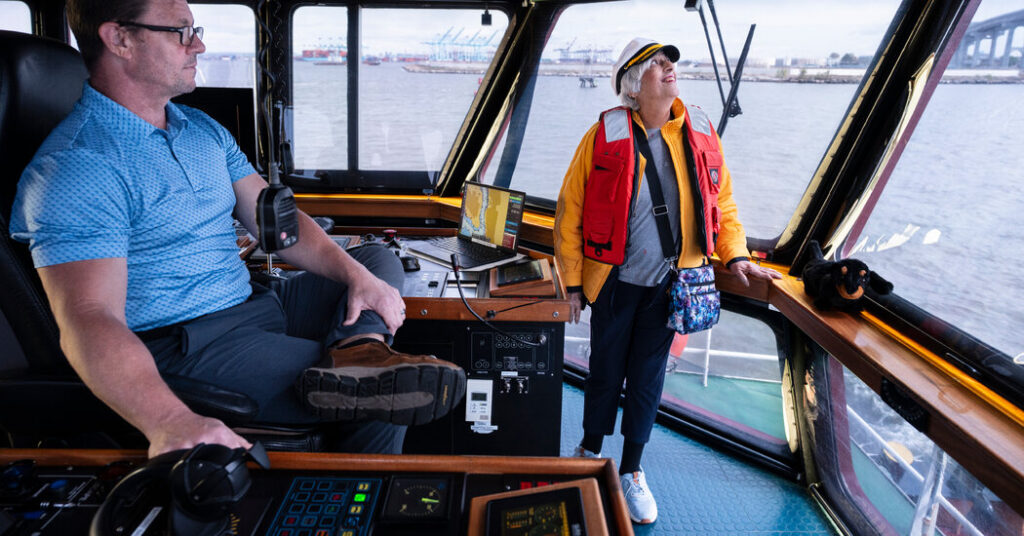
After more than four decades of watching tugboats from the window of her New York City apartment, Phyllis Silver put on a captain’s hat and climbed aboard one for the ride of her life.
Mrs. Silver, at 80, untied the thick ropes holding the tugboat, the Capt. Brian A. McAllister, to the dock in Staten Island. Then she settled into the captain’s chair as the red tugboat cruised by the Statue of Liberty and chased a hulking cargo ship from Sri Lanka.
“I give the orders so I don’t have to do anything,” Mrs. Silver told the much younger crew. “As long as we understand our positions, we’ll get along.”
Mrs. Silver’s dream of riding on a tugboat came true last month through the “Golden Dreams” program at RiverSpring Living, a senior community in the Bronx that asks its 600 residents what they’ve always wanted to do, or wish they could do again.
A retired psychiatrist with Parkinson’s disease soared at an indoor skydiving center. An 86-year-old woman with a prosthetic leg glided to Nat King Cole at a private dance lesson. Another woman, who is 73, wistfully remembered her parents going to the opera and was treated to “La Bohème” at the Metropolitan Opera.
At a stage of life when many slow down, lose partners and friends, and struggle with health and financial problems, some older Americans are checking off their bucket lists with the help of programs that aim to bring joy and inspire them to keep going.
“It means a lot more because many of us give up,” Mrs. Silver said. “I haven’t, but many of us give up and just say, ‘OK, this is what I’m doing.’”
‘I Don’t Need Anything’
The Golden Dreams program was started in May 2025 by Wendy Steinberg, the chief communications officer at RiverSpring Living, and five of her co-workers.
At first, many residents responded with, “I’m good, I’ve lived a great life, I don’t need anything,” Ms. Steinberg recalled.
So the Golden Dreams team had to dig deeper. They talked to residents individually to learn more about their lives. They found that many had been so busy raising families and pursuing careers that there were things they missed out on, never had the opportunity to do or would like to do again.
“It opened up possibilities that they had not thought about in decades,” Ms. Steinberg said. “They may have thought that chapter was closed, but it’s not.”
Some requests fell short of a dream. A woman asked for two hamburgers and a soda. She got her wish after a dietitian signed off.
One man wanted to travel to the Falkland Islands because he had never been. That was not in their budget. Another man, who is 91, hoped to publish a book that he had been writing in Spanish about his life. They are still calling publishers.
The Golden Dreams team has logged every request on a spreadsheet. There are 30 now, of which 11 have been granted.
Research has shown that such bucket-list experiences can improve mental and physical health and reduce social isolation. A 2025 study at the University of Texas at Arlington found that fulfilling a wish for patients near the end of life was particularly meaningful and strengthened family bonds.
Ellen J. Langer, a psychology professor at Harvard University, said that new and exciting experiences can “wake up” people who have tuned out the world. Her 2023 book, “The Mindful Body,” is based on decades of research showing that people who are actively engaged in the present are healthier and happier. “If you make the moment matter, then you have a life that matters,” she said.
Dr. Langer, 79, said that memorable experiences — and not just those on bucket lists — can change the mind-set of older people who think all their good days are behind them and get them thinking about what to do next. Just the anticipation of an experience can matter as much as the experience itself. “When you have a purpose and a forward orientation, those tend to be the strongest predictors of longevity,” she said.
Similar programs have bestowed thousands of wishes across the country. Twilight Wish Foundation has granted more than 7,200 wishes to lower-income seniors. Wish of a Lifetime, a nonprofit affiliated with AARP, has fulfilled more than 3,000 wishes since 2008. And Senior Wishes, a program for lower-income residents in western New York, is planting a vegetable garden at a senior apartment complex for its 500th wish since 2014.
Ready to Fly
Carol Weingrod, 67, the retired psychiatrist, knew right away she wanted to go skydiving. She struggles to walk because she has Parkinson’s disease and worries about falling. But at an indoor skydiving center, she put on a flight suit, helmet and goggles and flew fearlessly in a vertical wind tunnel. “I’m free,” Ms. Weingrod declared, before going again even higher.
When Ms. Weingrod repeated that she was free back at RiverSpring, some residents thought she had been cured of Parkinson’s. Her caregivers noticed a change. They said she joined more activities, opened up about her life and was more eager to socialize.
Mordechi Greenspun, 94, who grew up in Brooklyn, wanted to revisit a synagogue that his grandfather helped build in the 1800s near a farming community in Vineland, N.J. As a teenager, Mr. Greenspun worked in the fields there with his cousins during the summers.
But after Mr. Greenspun stopped driving in 2018, he could no longer get there on his own. So the Golden Dreams team tracked down community leaders and members of the synagogue and arranged a special tour ahead of a celebratory lunch. Mr. Greenspun’s son, Jonathan, drove him.
“It was a simpler life, and I miss it,” the older Mr. Greenspun said recently. “I would go back tomorrow if I could.”
Weeks before each dream is granted, the Golden Dreams team mobilizes. They wear gold-colored clothing and accessories and surprise the lucky recipient with gold balloons and a card saying “Dream Fulfilled!” They make all the arrangements and often accompany the residents to their dreams.
La Tasha Castillo, 37, a resident engagement coordinator, went with the woman who wanted to see the opera after her friend could not go. They had orchestra seats, and the woman held her hand and cried. “Being there with her, experiencing it, there was nothing better for me,” Ms. Castillo said.
Captain Phyllis Has Some Questions
Local businesses have donated tickets and experiences to the program. RiverSpring has covered the rest, about $1,000 so far. Mrs. Silver’s tugboat ride was arranged by McAllister Towing, which does not usually allow passengers and charges about $2,000 an hour for its tugboats.
Mrs. Silver, a former schoolteacher, and her late husband, Stan, moved to New York in 1980 from Michigan. Their apartment on the Upper West Side had a view of the Hudson River and Mrs. Silver kept binoculars by the window. Tugboats were her favorite.
“They have a wonderful history,” she said. “So many things have been replaced, and I’m glad to see that they’re still around.”
On an April morning, Mrs. Silver and the Golden Dreams team, in matching gold jackets, arrived at the McAllister shipyard. Mrs. Silver’s friend had given her the captain’s hat along with earrings shaped like anchors. “I didn’t even have to go to Chanel for this look,” she said.
“You’re Captain Phyllis?” said Buck McAllister, the company’s president.
Soon, Mrs. Silver was on board the tugboat, firing off questions at Mr. McAllister and the crew about their operations. “This is a whole different perspective seeing things from the water,” she said.
Two hours later, Mrs. Silver’s tugboat adventure came to an end. She wrote down the names of the crew members in her journal and took photos with them. She hugged Ms. Steinberg. “This has really been special, beyond special,” Mrs. Silver said.
Then Mrs. Silver wore her captain’s hat back home and did not take it off until she went to bed.
Winnie Hu is a Times reporter covering the people and neighborhoods of New York City.
The post What’s on an Octogenarian’s Bucket List? A Tugboat Ride. appeared first on New York Times.