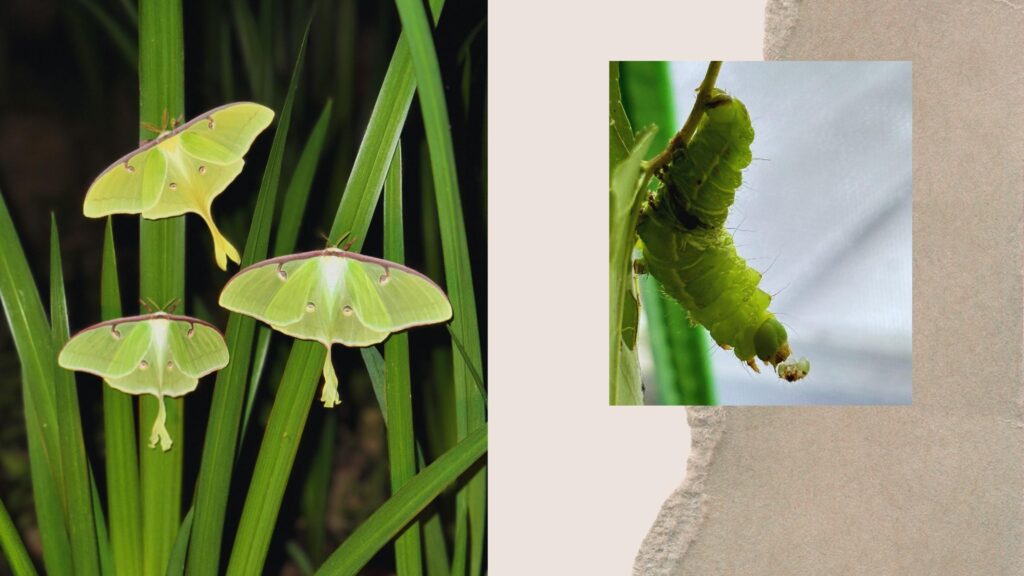
On April 25, 2024, I was walking in the Ouachita National Forest, with my wife and other Master Naturalists, studying mosses and searching for elusive lady slipper orchids in bloom, when we noticed a luna moth on the tip of a dried-up flower stem, dangerously close to a mountain bike trail. She was so still, I thought she was dead.
Luna moths are rare to see, especially during the day, because they are nocturnal creatures who navigate by the light of the moon. We gathered around in a moment of shared awe, then carried on.
On the way back to the car, I doubled back. The luna moth hadn’t moved. As I looked closer, I saw a cluster of eggs underneath her. I broke the dried stem at the base and brought the unmoving mama and her eggs into the car, into a small box.
My wife found my close entomological studies endearing. It’s for science, I always said.
By that afternoon, I had read everything I could find about the species. I placed the luna moth in a small butterfly enclosure in our greenhouse. She flapped her tattered wings only once, and moved closer to her eggs. The next morning, I found her on the floor of the enclosure, life cycle complete.
I didn’t realize then that in saving this moth, I would also be saving a part of myself.
Adult luna moths only live about four to seven days, such grand impermanence. The twisted tails on their hindwings scramble the echolocation capabilities of their biggest predator, bats. They do not have digestive systems or working mouths. They do not eat. All the fuel they have as an adult is from what they eat as caterpillars.
Luna moths belong to the family Saturniidae, in the giant silkworm group. The scientific name Actias luna, derived from the Roman goddess, refers to the moth’s moon-like eyespots.
Luna moths are not pollinators. They have no beneficial mutualism with another species. Their only purpose is to reproduce. And, perhaps, beauty.
I kept the broken-off stem and cluster of eggs in a tupperware on the windowsill above the kitchen sink. It takes about 10 days for luna moth eggs to hatch, and I watched like a devoted monk, washing every dirty dish slowly so as to keep my gentle vigil.
When a luna moth caterpillar hatches, it is smaller than a grain of rice. On May 5, I saw the tiniest green movement. And another. With a fine-haired paintbrush, I moved 44 newborn caterpillars into a mason jar with a mesh lid, stocked with a few fresh sweet gum leaves.
Each day, I woke early, gathering leaves and taxiing them to clean jars. I leaned into this slow, meticulous work. Luna caterpillars molt into five instars, shedding their skin four times. Every four to 10 days, usually at night, the babies would slow and silk-anchor their bodies to a leaf so they could crawl out of their former selves, evacuating the exoskeletons that no longer fit them, sometimes eating them after.
As the days and weeks passed, they outgrew the mason jars and the small monarch enclosure we had. We purchased a new three-foot-tall mesh butterfly habitat and tucked it into the corner of our greenhouse outside, so they could start to feel the weather of the natural world.
The large enclosure had a door that zipped all the way open. Most mornings, you’d find me on a footstool peering inside their world, tallying softly. The stockpile of leaves I gathered each morning was completely stripped overnight by nocturnal munching. They grew and grew.
After almost a month of this meditation, the caterpillars were as thick as my forefinger.
In their fifth and final instar, their bright green bodies turned into a pinkish rust color, and they began the wandering phase. Out in the wild, this would be when they’d stop eating, wander off their host tree, and drop to the forest floor to spin their cocoons. With me, in the bird-protected enclosure, they wandered to the floor that I littered with fresh leaves, and spun themselves in an intricately tough cocoon of silk, like forest sleeping bags. I found 44 cocoons stuck all over the enclosure walls and ceiling, some still connected to stems and branches, making hammocks that would sway in the breeze.
Inside, a luna moth transforms a final time into a dark brown wriggling pupa. Signaled by warm outside temperatures, adult winged luna moths will emerge from their cocoons within three to four weeks.
On Juneteenth, by sunrise, five moths had emerged, wings open and drying in the morning sunlight. I was not prepared for this metamorphosis. I cried. They were beautiful, ethereal, majestic.
Tearing out from their cocoons, they climb out awkwardly and crawl up to the highest point they can reach to hang and pump fluid (hemolymph) from their abdomens into their wings. Over three to four hours, their wings open as they dry. Eleven emerged that day. I couldn’t look away.
Starting on the summer solstice and for many nights following, I opened the enclosure fluttering with pale green wings, and carefully reached inside to release each one out into the wild moonlight. Frogs would sing their trills from the pond and summer fireflies would light up the woods.
The luna moths would sit on my hand, clasping their legs around my fingers. Their wings would tremble, and they’d lift off, flying toward the moon.
Invariably, before each night’s release, a few lunas would get a little romantic. There would be dozens of eggs stuck to the inside of the enclosure. Midwifing these creatures lasted much longer than anticipated.
In the end, I raised five generations of luna moth caterpillars, releasing over 200 charismatic ambassadors of beauty into our forest. Their capacity for more glimmers of life, each female ripe with eggs, exponential.
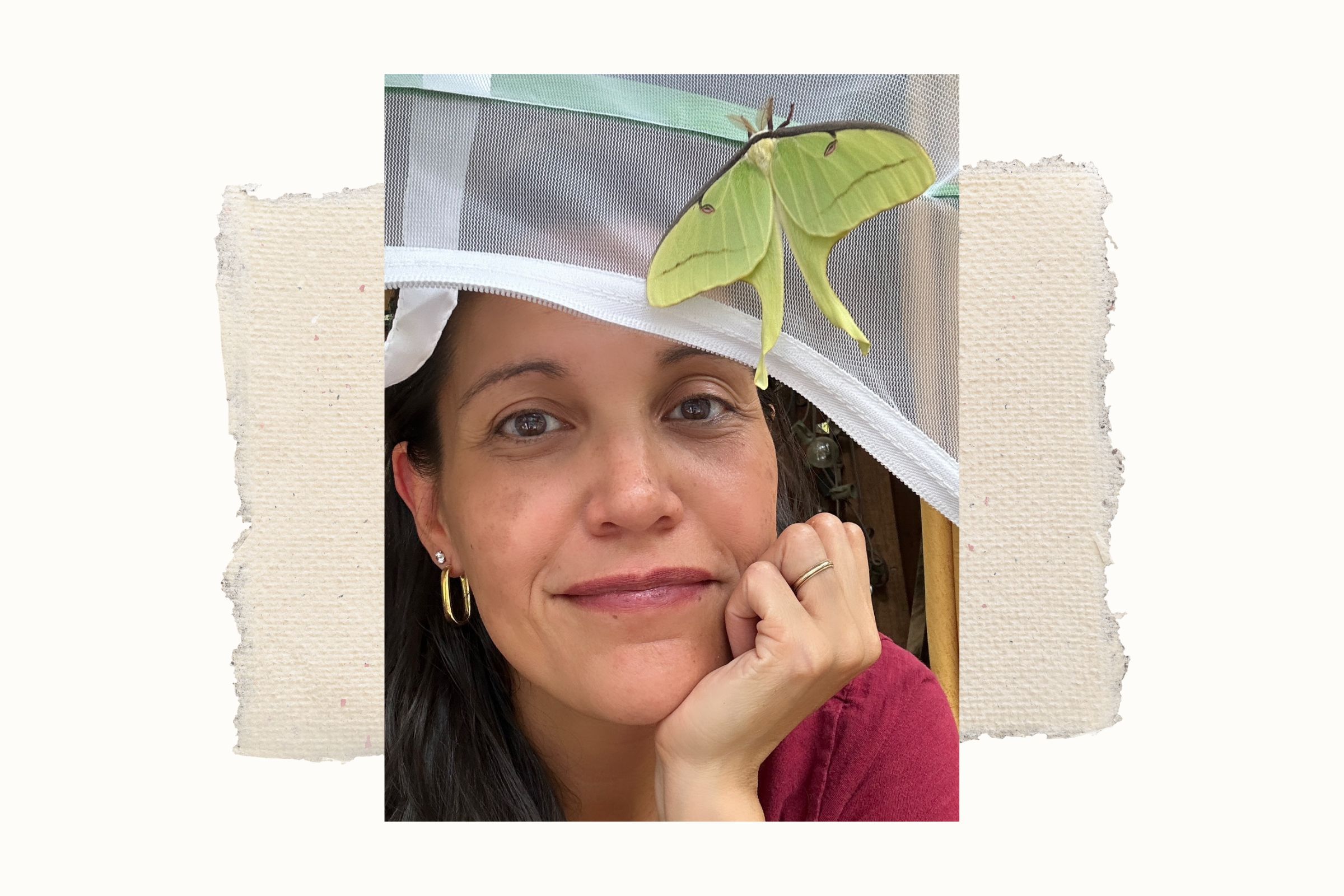
For 16 months, I was dedicated to their green lives, their protection, their metamorphosis. As the luna moths transformed, I did, too. Something about the sustained close attention nourished an ache inside me, a place where my inner child finally had a prolonged practice in wonder, not just survival.
I could sit for hours at the open enclosure door and listen as caterpillars chewed into the green chlorophyll-thick cells of sweet gum’s star-shaped leaves. I felt my own cells reshaping. Indigenous ethnobotanist Robin Wall Kimmerer writes in Braiding Sweetgrass that “paying attention is a form of reciprocity with the living world, receiving the gifts with open eyes and open heart.”
I softened in this slowness, in communion with another species. Observing them led me to see myself and better understand my own story. I had been in a cycle of survival mode, dissociation, and hyper-vigilance since I was a child.
I don’t have memories of my childhood in Bangkok and my life before my parents divorced and we came to America. My first memory is at age seven, looking up at my father, in Houston, his hand on my shoulder as I hugged his pant leg goodbye, and him saying, Take care of your mother and sister for me. He left. I was the man of the house now.
My mother will always be a hero to me. She was in survival mode, too, and had trauma of her own—a small but mighty Filipina single mom who was raised on a Calibungan rice farm, suddenly alone in America raising two young girls. She worked three jobs, and we were latchkey kids home alone after school until late. There was always a roof over our heads and food on the table: the physiological level of Maslow’s hierarchy. She came to every marching band contest, volleyball game, and swim meet, always cheering in the crowd.
And yet, there just wasn’t much room for emotions, for talking about feelings, for being held in safety. It’s cultural, perhaps. She worked so hard so we could have a better life. She did her very best, and still does.
I didn’t want to worry her, so I kept everything inside. The depression. The suicidal thoughts in fifth grade. The man who pushed himself inside me when I was 13. The guilt. The shame. The fact that I liked girls. I learned how to wear many masks, used sarcasm to make the pain funny, gained a lot of weight, and disappeared slowly.
College made it worse. Wannabe soldiers jolted me awake every morning in a cacophony of yelling. I was the only female drummer in a university military band. Hazing was tradition. My junior year, I was expelled from the corps for violating the Don’t Ask, Don’t Tell policy by fraternizing with a female cadet. I thought she loved me. After I was ousted, the generals made me march around the quad in full winter dress uniform to make an example of me in front of 2,000 cadets.
My early twenties were a blur of numbing out on anything that could take away the pain. I shut myself off from feeling, no light behind my eyes.
My nervous system built escape hatches and emotional barriers to protect me from enduring more harm. I built an inner world in which to hide, but I didn’t let anyone inside. Sometimes not even myself. I only lit up when I was in the classroom, where I began teaching high school English.
At 28, I fell in love with a remarkable woman. We moved to Hot Springs, Ark. We made a life together. A beautiful life. I paved my own path as a poet, published books, made a name for myself. My life finally started looking up, and I didn’t look back.
I thought I had buried all that pain deep enough, and that I could move on, but as they say in therapy circles, the body keeps the score.
Finding the language of complex post-traumatic stress disorder gave me the intellectual capacity to begin the journey to healing, but the healing in my body came on the wings of a luna moth and her cluster of eggs.
.jpg)
In the stillness of those mornings with my caterpillars, I anchored into nervous system regulation. My mind went quiet, my breath deepened, and something started to open inside me. The tension in my neck and shoulders loosened. My heart settled. As I listened to them munching through leaves and tearing through silk, I finally heard the voice of little Kai.
The daily ritual of care showed me the nurturing I needed to give my own emotional growth and metamorphosis.
Among the luna moths, I was infused with delight and imagination, curiosity and joy. The caterpillars brought my inner child out of the most hidden corners of my psyche and welcomed her to peer into that mesh enclosure, backdropped by sunrise. Bathed in that golden light, sometimes I would feel little Kai. I’d close my eyes, pull her small body close to me, and bring her into the safety of my mothering arms. Together.
My therapist guided me through cognitive behavioral therapy, internal family systems, brainspotting, and bilateral sound stimulation that awakens hemispheres of the brain to create new neural pathways. Each time a luna moth shivered their wings, gearing up for flight from the launch pad of my fingertips, painful memories shook off and fell from my shoulders, telling me to keep flying through the dark to my whole illuminated self.
In protecting that one luna moth and raising five generations of her lifeline, I re-mothered parts of myself that longed for that same softness. In search of integration and healing, they taught me to follow my own inner knowing and timing, to trust the wisdom of my own imaginal cells.
Metamorphosis is a mysterious act, an unbecoming and becoming something else entirely.
If you or someone you know may be experiencing a mental-health crisis or contemplating suicide, call or text 988. In emergencies, call 911, or seek care from a local hospital or mental health provider.
The post The Luna Moth that Saved Me appeared first on TIME.