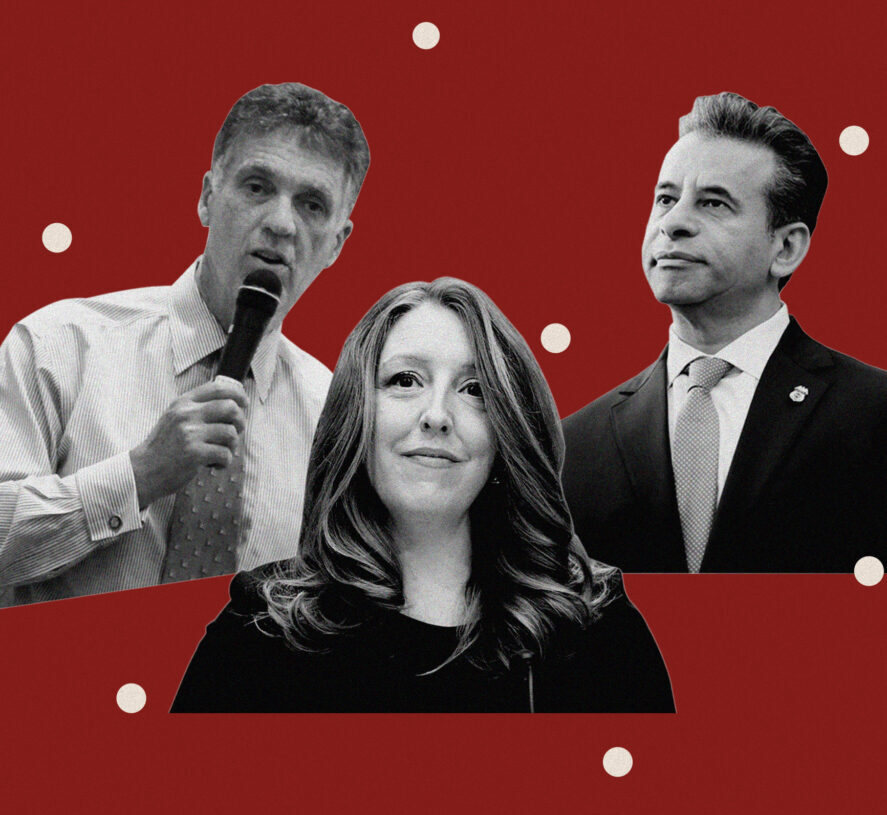
FDA Commissioner Marty Makary: Resigned.
Surgeon general nominee Casey Means: Withdrawn.
CDC director nominee Dave Weldon: Didn’t make it to a congressional hearing.
All three were allies of Health Secretary Robert F. Kennedy Jr. All three — and others who have been pushed out — were heralded as vanguards of Kennedy’s effort to remake the nation’s health agencies with those who questioned or outright opposed the medical establishment.
But more than a year into Kennedy’s tenure, Trump officials have increasingly swapped out Kennedy’s handpicked deputies for people with more traditional experience, seeking to tamp down the health agencies’ controversies ahead of this year’s midterm elections.
The leadership overhaul has left some Make America Healthy Again allies worried that Kennedy’s influence, as well as the broader movement’s Republican alliance, is being diminished, according to three people familiar with the matter, who spoke on the condition of anonymity to talk candidly. Some say they are worried there is increasing attention within the administration to satisfy corporate interests.
Influential MAHA leaders are warning Republicans that if they don’t do more to appease the MAHA moms that make up their movement, they could lose critical votes in November.
“The GOP has historically had trouble with women. And dropping from the sky like manna from heaven — gluten-free, GMO-free manna from heaven — you have this coalition of voters who are willing to vote red as women,” said Alex Clark, a prominent conservative wellness influencer and podcaster aligned with the MAHA movement. “We should be doing everything we can to keep them happy.”
The concerns reflect the internal battle for influence in the White House and among federal health officials — and the tensions of a movement at odds with a political party historically friendly to corporate America. President Donald Trump’s picks for the top leaders of the nation’s nearly $2 trillion health department affects every American. The sprawling entities are charged with approving safe medications, administering health insurance to millions of people, responding to infectious-disease outbreaks and regulating the food supply.
In an interview this month, Trump praised Kennedy, saying: “He’s doing a good job. I think Bobby … people love him.”
White House officials dismissed questions about a rupture with the MAHA movement. In a statement, White House spokesperson Kush Desai said MAHA remains a “top priority.”
“Much work remains on the MAHA agenda, and the Administration remains laser-focused on delivering more wins, more reform, and more progress for the movement to Make America Healthy Again,” he said.
Administration officials also said top Trump leaders, such as White House Chief of Staff Susie Wiles, remain committed to MAHA and have argued that installing more effective deputies will deliver more wins for the movement.
The White House “is very happy with RFK Jr.,” said an official who spoke on the condition of anonymity to describe internal meetings. “When you reduce the unnecessary noise, it gives everyone more space to accomplish MAHA’s goals.”
Emily Hilliard, a spokesperson for the Department of Health and Human Services, said in a statement that HHS and the White House are “fully aligned” and “rejecting the failed status quo that has failed too many Americans.”
“There is no shortage of highly qualified candidates eager to serve at HHS,” she said.
Roughly 4 in 10 Americans say they identify with MAHA, according to recent polling from KFF, a health policy research and news organization. The movement, which emerged from the 2024 political alliance between Kennedy and Trump, draws most of its support from the GOP and the Make America Great Again movement, according to the KFF survey.
Surveys have found that many MAHA-linked ideas, such as better regulation of artificial dyes and pesticides, are broadly popular.
But the White House has also taken note of polls indicating that vaccine skepticism, espoused by Kennedy and some MAHA supporters, is broadly opposed, including by Republicans.
“Vaccine skepticism is bad politics,” read one polling memo by conservative polling firm Fabrizio Ward that was presented to congressional leaders and shared with Trump officials in recent months.
Some MAHA advocates said change isn’t simple and they approve of the job Kennedy is doing.
“It’s a complicated task that they’re taking on and with complications you have to navigate appropriately,” said Michael Boes, the chief MAHA officer for Steak ‘n Shake, who was a senior adviser to the assistant secretary for health until last month. “I consider myself a fan of the president and also a MAHA warrior, and I haven’t been disappointed.”
Turnover and turmoil
The resignation of Makary created the latest major vacancy at the health agencies, where senior positions at the Centers for Disease Control and Prevention, the Food and Drug Administration and other key roles don’t have permanent leaders. Jim O’Neill, the Trump administration’s deputy health secretary, was pushed out in February, with the White House and Kennedy tapping Chris Klomp, a longtime health care entrepreneur, to assume some of his responsibilities in a newly created role as Kennedy’s “chief counselor.”
In 2024, Kennedy advisers recommended Makary helm the FDA, which oversees products that account for 20 cents of every dollar spent by consumers. The Johns Hopkins University School of Medicine surgeon had risen to prominence as a Fox News contributor who criticized the coronavirus response and challenged the medical establishment.
Makary resigned this week amid FDA turmoil, and the agency’s leadership was overhauled Friday. Kennedy had grown frustrated with Makary’s leadership and supported replacing him, according to two people familiar with the matter, who spoke on the condition of anonymity to describe personnel matters. Makary’s allies have characterized his departure as a matter of principle, saying he left over the authorization of fruit-flavored vapes.
Kennedy has said the health department will move swiftly to identify a new FDA commissioner, a search that Klomp is helping lead. Officials are seeking to prioritize candidates who have proven leadership experience, particularly within large organizations, and can command the respect of FDA officials and Americans, according to a person familiar with the search process. They also hope to find a leader who can continue the FDA changes begun under Makary, such as expediting some drug approvals. An announcement is not expected until June at the earliest, the person said.
Hilliard said the search for key leaders, including at the FDA, will focus “on experienced leaders who will strengthen agency operations, advance meaningful reforms, restore public trust, and deliver results for the American people.”
David Mansdoerfer, who served as a senior health official in the first Trump administration, said the selection of Kyle Diamantas to serve as acting FDA commissioner was a “good pick for MAHA.”
“You could argue that the dietary issues have been the most successful part of MAHA’s influence at HHS, and Kyle was a core player in those successes,” Mansdoerfer said.
In recent weeks, Trump has selected more establishment picks to serve in other top health department roles, infuriating some MAHA activists. Although Kennedy signed off on those picks, the searches were largely shaped by Klomp, who narrowed the field of choices and presented recommendations to Kennedy and the White House, according to two people.
Trump dropped MAHA favorite Casey Means, whose nomination for surgeon general had stalled in the Senate, in favor of Nicole Saphier. A radiologist and former Fox News contributor, Saphier had questioned whether Means had the right credentials for the role and had previously criticized actions that HHS has taken under Kennedy’s watch.
When the CDC revised its website to contradict the long-settled scientific conclusions that vaccines do not cause autism, Saphier said on a November episode of her podcast that the website sounded like “someone without a science background wrote it.” (Kennedy told the New York Times that he personally asked for the change.) After a federal judge halted Kennedy’s vaccine overhaul, Saphier wrote on X that “the system needed reform, but not chaos.” She has since limited visibility of her posts.
Saphier did not respond to a request for comment. Hilliard did not directly respond to questions about Saphier’s previous critiques, but pointed to a social media post of Kennedy’s in which he called her a “long-time warrior for the MAHA movement” and said he looked “forward to partnering with her.”
Trump also nominated Erica Schwartz, a deputy U.S. surgeon general during his first term, as his third choice to lead the CDC after Susan Monarez said she was ousted after refusing to commit to vaccine changes. Schwartz has a history of supporting vaccines. The post has largely remained open through Trump’s second term amid tensions over vaccines. Weldon, whom Kennedy initially chose to lead the agency, had questioned vaccine safety and was withdrawn in March 2025 because GOP senators indicated he would not be confirmed.
The latest test of MAHA’s power
MAHA advocates are seeking to demonstrate their strength this weekend, urging supporters to back Rep. Julia Letlow against Sen. Bill Cassidy in Saturday’s Louisiana Republican Senate primary. Cassidy is the chairman of the Senate Health, Education, Labor and Pensions Committee who ultimately voted to confirm Kennedy but has since questioned his actions on vaccines. MAHA advocates also blame him for thwarting Means’s nomination.
Tony Lyons, a close ally of Kennedy’s who leads MAHA political advocacy groups, told The Washington Post in February that he had seen “unprecedented excitement from donors.”
Campaign finance reports reviewed by The Post show that his MAHA PAC has spent more than $580,000 against Cassidy as of the most recently available filings — short of the million dollars Lyons had pledged.
Lyons has said he plans to raise $100 million to support Republican candidates in the midterms — and elect those viewed as MAHA friendly.
As of March, MAHA PAC has raised about $1.7 million, according to 2025-2026 campaign finance reports. The organization had more than $7.7 million in cash on hand going into 2025, much of which it gave to MAHA Action, another advocacy group run by Lyons.
It’s difficult to discern exactly how much money MAHA-affiliated groups have raised. For instance: Lyons’s MAHA Center, a nonprofit organization, spent $8.5 million on a Super Bowl ad, but its current cash flow status has a lag time in public reporting, much like MAHA Action.
Lyons did not respond to multiple requests for comment.
Earlier this year, the Trump administration released an executive order to boost the manufacturing of a commonly used weedkiller, drawing the ire of many in the movement. Still, MAHA has notched some wins.
At a regenerative-farming event in Texas Hill Country in early May, Kennedy nodded to a recent MAHA victory: Advocates had successfully stripped a provision they argued would shield pesticide manufacturers from lawsuits from a bill moving on Capitol Hill.
Kennedy said at the event, according to a video reviewed by The Post: “There’ll be a battle within the administration, but there’s a lot of people [for which] I think that reversal on the farm bill was a wake-up call for Washington, D.C.”
The post Ouster of RFK Jr.’s allies tests MAHA-Trump alliance appeared first on Washington Post.