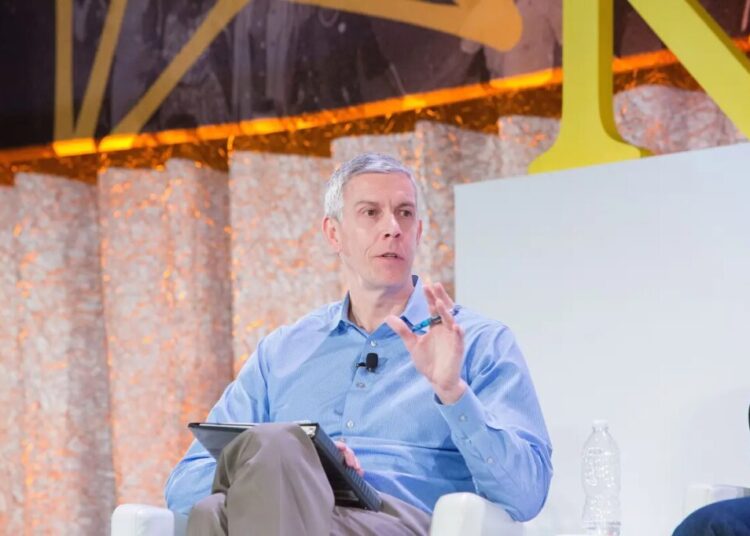
Last month, Carlos Eduardo Espina, a progressive influencer, revealed a surprising endorsement to his 14.5 million followers on TikTok: He would support Tom Steyer, the billionaire running for California governor as a Democrat.
“I really believe Tom Steyer is different,” Mr. Espina said in a speech that he posted on social media. “He could be traveling around the world or doing whatever he wants, but he wants to serve the people of this state.”
Unmentioned in Mr. Espina’s post: Mr. Steyer’s campaign was paying him $100,000 to help win the election.
A few days earlier, Mr. Espina, who lives in Texas, had noted in a video that the campaign hired him to consult on issues related to Latinos, which are the primary focus of Mr. Espina’s social media posts. But none of his several dozen subsequent posts on TikTok, Instagram or Threads promoting Mr. Steyer noted the financial arrangement.
The $100,000 fee, buried in campaign finance records, is described as a payment for “strategic advice and campaign surrogacy.” The money went to a limited liability company in Texas that Mr. Espina also used to receive a travel reimbursement from the Democratic Congressional Campaign Committee in 2024.
Mr. Espina’s arrangement provides a rare glimpse into the world of pay-for-play social media, where content creators and marketing firms are increasingly compensated to promote candidates or points of view and where there are few requirements for disclosure. The paid advocacy exists outside the realm of traditional lobbying and campaigning, reaching younger, more online audiences unlikely to be swayed by television advertisements or glossy mailers.
Democratic and Republican groups have spent millions on this type of communication over each of the past few campaign cycles, according to consultants and campaign officials from both parties. Yet little is known about many of the payments. The Federal Election Commission, the agency that monitors political spending, says its rules governing disclosure for traditional political advertising do not apply to social media. And the Federal Trade Commission, which regulates deceptive business practices, requires influencers to disclose payments for promoting commercial products and services but, it says, does not regulate political advertisements.
As a result, paid influence has become a magnet for campaigns and groups that want to push political priorities without disclosing where their money is going or revealing that some of their supporters are being paid.
“You can’t see where the money is coming from, and you can’t see where it’s going,” said Brendan Fischer of the Campaign Legal Center, a nonprofit watchdog group. In October, his organization petitioned the F.E.C. to require disclaimers on paid political content created by influencers; the agency has not taken action on that request.
In 2024, California enacted a law that requires influencers who are compensated for political messaging to include a disclaimer noting they were paid and sets penalties for campaigns for violations. Texas also adopted disclosure requirements that year.
On Wednesday, two social media influencers who support another candidate for governor, Xavier Becerra, filed a complaint with the California Fair Political Practices Commission, which enforces the state’s campaign finance laws. They accused the Steyer campaign of paying “perhaps dozens of third party influencers to publish content supporting” the candidate without proper disclaimers.
In a statement, Kevin Liao, a spokesman for the Steyer campaign, called the accusations “baseless.”
“The campaign believes in compensating people for their time and work product and has paid creators to generate content,” Mr. Liao said, adding that it properly notified influencers of their disclosure requirements and that the onus was on them.
After the complaint was filed, the campaign added language to a job listing offering influencers $1,000 per month to create pro-Steyer content. “Creators will have obligations to include disclaimers in media they produce under this offer,” the new language states.
On Wednesday evening, Mr. Espina appeared with Mr. Steyer at a campaign event in a Los Angeles suburb. As the crowd ate free tacos and churros, Mr. Espina acknowledged in an interview that the campaign had paid him but said he did not think he needed to put a disclaimer on any of his posts because he wasn’t being paid to post. Instead, he said, he was hired as a consultant with expertise on Latino issues.
“People see me as a content creator, and they think all I do is content,” said Mr. Espina, wearing a royal blue Steyer campaign shirt and taking selfies with throngs of enthusiastic fans. “What I do is more of the advising side of things.”
In the past year, journalists have uncovered numerous payments to influencers to shape public opinion or lobby government officials, including efforts to protect sugary sodas from regulation, block proposed state and federal A.I. legislation, promote Israeli interests to American audiences and, last month, undermine a congressional candidate before a primary.
Some of the payments to influencers, and in particular to marketing firms that specialize in political social media, are disclosed in public records. One of those firms, Creator Grid, has received almost $875,000 from the Republican National Committee and the National Republican Congressional Committee since late 2023, including a payment of $35,840 in February. On its website, Creator Grid says it “connects Republican candidates with the internet’s most powerful conservative influencers.”
But other political social media agencies scarcely appear in F.E.C. records. In part, that is because much of the money to the creators originates from nonprofit advocacy organizations that are not required to report their spending, rather than from campaigns or political action committees.
Occasionally, influencers disclose payments on their own. Last summer, Dominick McGee, a right-wing influencer known as Dom Lucre, criticized former President Barack Obama on X for opposing the sweeping bill to extend tax cuts and slash social safety net programs that Congress voted on last year. Beginning with the phrase “BREAKING” and published just hours before the House voted on President Trump’s bill, the post was viewed 1.3 million times.
In January, Mr. McGee launched a website that revealed he had been paid for the post, one of 11 he spotlighted as “successful ad examples.” He also included a price list stating that he charges $15,000 for posts beginning with the word “BREAKING” or “DEVELOPING.” The site does not disclose who paid him for the post about the bill.
Mr. McGee did not respond to a request for comment. He has lately started tagging some of his posts with a label that reads “Paid Partnership,” a feature that X recently introduced to increase transparency.
In March, Jessica Reed Kraus, an influencer with a large and passionate following, included a version of that same phrase — “#PaidPartnership” — when she amplified a post on X by Senator Tim Sheehy, a Montana Republican.
The lawmaker had critiqued a New York Times journalist who reached out to him with questions before publishing an article about billionaires donating to political campaigns, including to Mr. Sheehy’s. Ms. Kraus’s post was one of dozens from popular pro-Trump accounts that criticized the reporter and The Times, but hers was the only to include the disclaimer.
Within hours, Ms. Kraus deleted the post.
In an interview, she said she had received a text message urging her to take it down. She said that her post had been part of an organized campaign offering influencers money in exchange for amplifications of the senator’s original post, and that she had been trying to be transparent by noting she had been compensated.
“I didn’t do anything wrong here,” said Ms. Kraus, who declined to say who had paid her for the post. In a subsequent conversation, she said she could not remember who had originally approached her, who had texted asking her to take the post down or how much she had been paid. “Anything I am getting paid for, I don’t want people to think I wasn’t.”
A spokesman for Mr. Sheehy said neither the senator nor his campaign had paid for the posts.
Ms. Kraus, who is known for commentary on wellness and celebrities as well as her support for Health Secretary Robert F. Kennedy Jr., has 1.2 million followers on Instagram, 441,000 subscribers on Substack and more than 66,000 followers on X. She said she often worked with social media marketing firms and received multiple offers to make paid content every week.
“You get talking points you can seamlessly weave into your own content,” Ms. Kraus said.
Mr. Espina, in a video posted in mid-April, said Mr. Steyer’s campaign had contacted him a week earlier and offered him the opportunity to work with the campaign to be “a bridge between our community and the candidate.”
Many of Mr. Espina’s followers, though, have questioned his motives. Why, they wondered in hundreds of comments responding to his posts supporting Mr. Steyer, would Mr. Espina be taking such a strong and sudden interest in a California race he had scarcely mentioned previously? And why wasn’t he supporting Mr. Becerra, a Democrat in the race who, unlike Mr. Steyer, is Latino?
“I have my reasons for believing that Steyer would be a better option,” Mr. Espina said in another video. But he added that “as Democrats, we shouldn’t be focused on attacking each other” and instead should be unified in ensuring Republicans didn’t win.
“Carlos,” one commenter responded. “Don’t gaslight us.”
Ken Bensinger covers media and politics for The Times.
The post Political Money Is Flowing to Influencers. But From Whom? appeared first on New York Times.