Music videos from pop stars don’t usually inspire serious theater pieces, but nothing about “Is God Is” by Aleshea Harris has been business as usual.
Premiering in 2018 at SoHo Rep, the drama follows the twin sisters Racine and Anaia, and the mission their mother (known as “God” among other names) has entrusted them with: to murder their father, who years earlier set her on fire, burning and badly scarring their daughters in the process. The Obie-winning play was celebrated for its bold characters, pulsating dialogue and reinvention of form.
“Step aside, Quentin Tarantino and Martin McDonagh, and all you other macho purveyors of mutilation and mayhem with a smile. A snarly new master of high-octane carnage has risen into view,” Ben Brantley wrote in his review of the play.
Surprisingly, the drama was partly inspired by Rihanna’s 2015 banger “Bitch Better Have My Money.”
“What struck me about Rihanna’s video was that she was playing out with such aggression and, totally unapologetically, this narrative of redemption,” Harris told me when we recently sat down for an interview at Calvert’s, a restaurant in the Park Lane Hotel. “I love revenge narratives, but I also haven’t seen many Black women in them.”
Now fearlessly filling that void comes the movie version of “Is God Is” (in theaters now) adapted by Harris, who is making her directorial debut.
Unlike her characters, Harris has a calming presence and exudes a discerning warmth. At the restaurant, we ran into Vivica A. Fox, whom Harris cleverly cast as the mother in “Is God Is” and who also played an assassin in Tarantino’s “Kill Bill: Vol. 1.” The affection between the two women was palpable, with Fox describing Harris’s generous personality and clear vision on set.
Onstage, Harris cultivated an aesthetic that drew on the “Kill Bill” films, but even more from the experimental language of three playwrights: Suzan-Lori Parks, the first director of CalArts’ Writing for Performance master’s program, from which Harris graduated in 2014; Robert O’Hara, the author of the unruly dramatic comedy “Insurrection: Holding History”; and Sarah Kane, who helped popularize the confrontational In-yer-face theater movement in Britain in the 1990s.
Their influence led Harris to make an unusual choice: She played with typography. The cast and creative team saw this in the script’s spacing and font size, while audiences experienced it when the actors channeled characters’ anger or absurdity out loud.
Such inventiveness, however, did not automatically imply a path to the big screen. “Though I obviously drew from the genre, I wasn’t thinking about it as a movie,” Harris said. “And I certainly didn’t think about myself directing it.”
The producer Scott Rudin and A24 signed on to a film adaptation in 2018 with Janicza Bravo, known for the satirical, surrealistic 2020 crime caper “Zola,” originally interested in directing. But Harris began reimagining the script as distinct from the play and wanted to do a full rewrite.
It was then that the actress Tessa Thompson and her producing partner, Kishori Rajan, took on the film. The project went to Orion, which is owned by Amazon, with Bravo offering to mentor Harris and eventually signing on as a producer.
In the early stages, Harris shared drafts only with Bravo. “She was so instrumental in encouraging me to keep the weirdness of it,” Harris said. “Because she’s a bit of a weirdo too.”
Eventually, Bravo and the playwright Jeremy O. Harris (no relation), who was running a writer’s room for a television adaptation of the Brit Bennett novel “The Vanishing Half” that included Aleshea Harris, both encouraged her to direct it herself.
“It felt natural and inevitable because I am a very particular playwright,” she said. “I already have strong ideas and impulses about not just writing the thing, but helping people to understand.” In rehearsals, she added, she can “definitely get on directors’ nerves sometimes because of that impulse.” Emphasizing, “I was really thinking about what I could do with the film that I couldn’t do with the play.”
To make the story more cinematic, Harris took a deep dive into revenge movies, like the Japanese thriller “Lady Snowblood” and the spaghetti western “Once Upon a Time in the West.” She also steeped herself in films with a Greek-tragedy bent, like “O Brother, Where Art Thou?,” or ones that had visual qualities to which she aspired, such as “Daughters of the Dust” and “Moonlight.”
“Preparing to direct was daunting,” she said. “But it was also such a delight to feel like I had greater power over the vision of how the story would be executed.” She recalled that the poet Douglas Kearney, her grad school mentor, once told her she was “directing in self-defense.” What that meant, she explained, was that “I was trying to avoid the pain, physically, of bearing witness to my work in a way that doesn’t feel right, or like somebody’s lying on me and it’s wrong.”
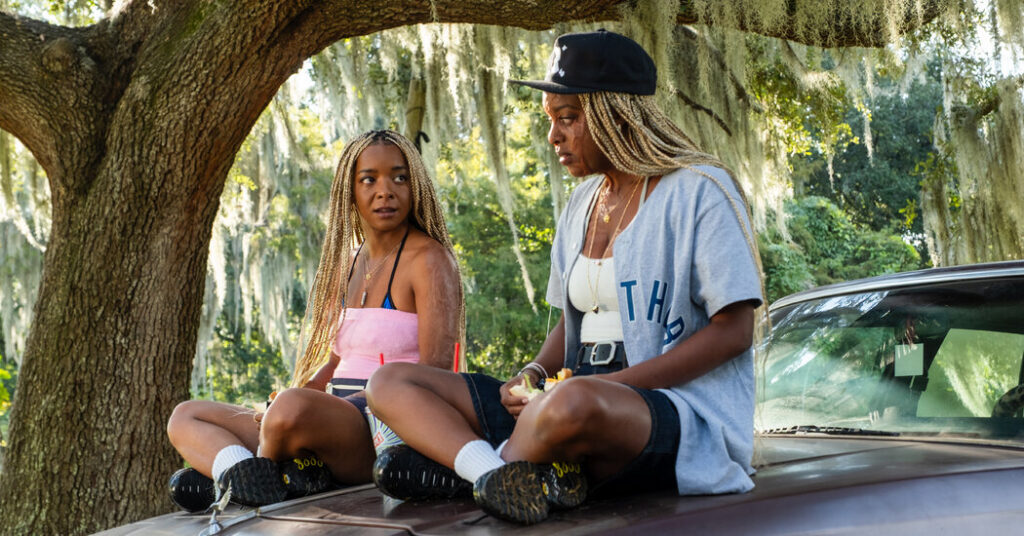
Such a posture is fitting for a movie in which its twin protagonists, Racine the Rough One (Kara Young) and Anaia the Quiet One (Mallori Johnson), have to continually fight off violent attacks from men on a journey that takes them from the Deep South to California, culminating in an encounter with their father (Sterling K. Brown).
Adapting the play’s experimental typography, several scenes feature the twins’ dialogue as text onscreen.
For Young, a two-time Tony winner (“Purlie Victorious” and “Purpose”), the character of Racine is “a Black girl’s dream.” With the sisters, she said, “there is collective rage or joy in these characters who are the culmination, not just the essence of our humanity.” Racine, specifically, “feels like a collective of a million women” whose voices have never been heard.
Given the intensity of the plot, the production took measures to safeguard the actors, like keeping a therapist on standby. But it was the trust that Harris cultivated on the set that made the biggest difference. “I remember there were moments where it got tough,” Johnson said, but “Aleshea had us. She protected us. She would pull us aside and say, ‘We’re about to do this.’ We’d hold hands. We were in it together.”
For Brown, known for well-meaning characters like Randall in the long-running NBC series “This Is Us,” playing the “sociopathic” father was exciting because it went against type. Before taking the role, Brown spoke to his cousin, a drama professor at DePaul University, “People may see me in a different way,” he told her. “And she said, ‘Somebody has to drive the bus in the Rosa Parks story.’ And I was like, ‘You know what? I will drive that bus, man. I will drive that bus to kingdom come.’ Because the story needs to be put out there.”
Brown said that the cast “felt incredibly protective of Aleshea because we knew that she was taking a big swing, and this is a movie that could elicit polar opposite responses.” He added that “we don’t have as much room to fail. The number of opportunities that we get is not the same as that of our counterparts. And so we were like, ‘How do we kill it?’”
Tessa Thompson signed on as a producer, she says, because Harris’s writing “felt so precise, muscular and singular.” Thompson was also struck by Harris’s approach to the characters themselves. “I feel so often that Black women just don’t get to be subjects and are more likely to be the objects in a narrative,” Thompson said. The twins “are squarely, dead-ass in the center of the frame,” she added, when often “as Black women we are not afforded the patience of having a narrative that really explores our interiority.”
These characteristics, alongside the genre-bending mix of noir, comedy, spaghetti western, Greek drama and revenge fantasy, also attracted Alana Mayo, the president of Orion Pictures. “We’ve had this incredible run of working with filmmakers who were either making their first narrative feature film or making their first narrative feature film inside of a studio system,” Mayo said, referring to a slate that has included “American Fiction” and “Nickel Boys.”
“When you have material to work with that is so great and a filmmaker like Aleshea who could speak so clearly about translating that to the screen, it felt like an easy yes to me.”
Salamishah Tillet is a contributing critic at large for The Times and a professor at Rutgers University. She won the Pulitzer Prize for criticism in 2022, for columns examining race and Black perspectives as the arts and entertainment world responded to the Black Lives Matter moment with new works.
The post How Rihanna and Revenge Plots Inspired a Playwright to Turn Director appeared first on New York Times.