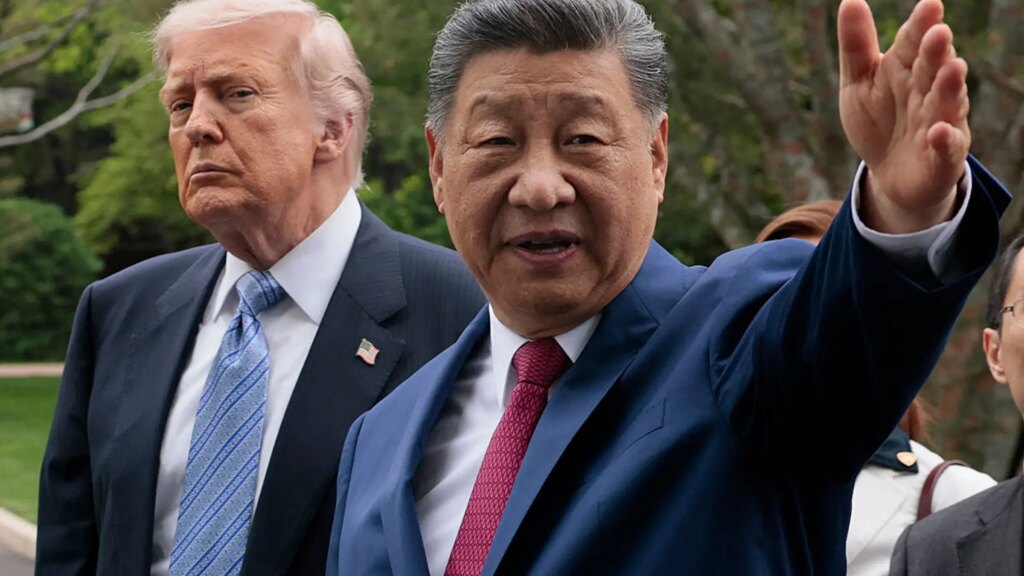
“The world has come to another crossroads,” Chinese President Xi Jinping told U.S. President Donald Trump on Thursday, as the two leaders began their summit in Beijing. Then Xi asked: “Can China and the U.S. overcome the so-called ‘Thucydides Trap’ and create a new paradigm of major-country relations?”
Xi was referring to the ancient Athenian historian and military commander Thucydides, who wrote The History of the Peloponnesian War, recounting the nearly three-decade conflict between the former Greek poleis (city-states) of Athens and Sparta. In his account, he wrote: “The growth of the power of Athens, and the alarm which this inspired in Lacedaemon [Sparta], made war inevitable.”
While debate on the accuracy of translations continues, the core message stuck: this “inevitability” of conflict when a rising power threatens an existing one was later popularized by American political scientist Graham Allison in the early 2010s as “Thucydides Trap.” But in the modern context, China is Athens, challenging the U.S. as today’s Sparta.
Writing for the Financial Times in 2012, Allison said that “the defining question about global order in the decades ahead will be: can China and the U.S. escape Thucydides’s trap?”
Allison expanded on the “trap” idea further in his 2017 book Destined for War: Can America and China Escape Thucydides’s Trap?, which argued that the two countries were “on a collision course for war—unless both parties take difficult and painful actions to avert it.” Allison enumerated 16 historical cases of rising and established geopolitical powers facing the “trap,” 12 of which ended in war.
Xi’s invocation of Thucydides’ Trap comes at a time when tensions between the rival superpowers could boil over on any of a number of issues, from trade to AI to Taiwan.
‘Not inevitable’
It’s not the first time Xi has brought up the trap. Since the modern use of the term arose, the Chinese President has used it to describe navigating relations with the U.S. on a number of occasions.
In 2013, Xi reportedly told international leaders: “We need to work together to avoid the Thucydides Trap, which is a destructive tension between emerging powers and existing powers, or between two existing powers.”
Two years later, in a 2015 speech in Seattle before former Secretary of State Henry Kissinger and other dignitaries, Xi said that China’s foreign policy prioritizes “mutual understanding” with the U.S. and that Beijing wanted to see “more understanding and trust, less estrangement and suspicion.” In that speech, Xi stressed lowering paranoia and bias and even pushed back against Thucydides’ Trap, saying that there was “no such thing” as an inevitability of conflict but that “should major countries time and again make the mistakes of strategic miscalculation, they might create such traps for themselves.”
In his 2023 meeting with then Senate Majority Leader Chuck Schumer in China, Xi again, according to Chinese state media, underlined how Thucydides’ Trap was “not inevitable” and that “the world is big enough to fully accommodate China and the United States’ respective development and common prosperity.”
In a meeting with President Joe Biden in 2024 in Lima, Peru, Xi repeated that Thucydides’ Trap was “not a historical inevitability,” before warning that “a new Cold War should not be fought and cannot be won.” (Allison, the political scientist, has referred to the Cold War between the U.S. and the Soviet Union as one of the 16 cases of the “trap” that didn’t result in war.)
Echoed by Chinese diplomats
Chinese diplomats have since echoed Xi in using the phrase to describe U.S.-China relations.
In 2017, former Ambassador to the U.S. Cui Tiankai said that Thucydides’ Trap was among the main questions that needed to be answered for the future of U.S.-China ties. “What kind of relationship [should we] build together, in the interests of both countries, as well as of the world?” Cui asked. “Is the ‘Thucydides Trap’ so insurmountable that China and the U.S. are destined for war? Can China and the U.S. blaze a new trail in international relations in which countries, especially the major ones, engage in win-win partnership instead of zero-sum rivalry?”
In 2021, Cui’s successor Qin Gang also rejected Thucydides’ Trap and assertions of a new Cold War between the U.S. and China, saying both countries must “jointly explore a way of peaceful coexistence.”
And the latest Chinese envoy to the U.S., Xie Feng, said in 2024 that Chinese culture has shown ways to navigate around the trap. “China is not Athens, nor is it Sparta,” Xie asserted. Xie also appeared to suggest that going to war would be neither characteristic of nor favorable for China.
The view from America
It’s not just China referencing the Athenian historian and maxim. During Trump’s first presidential term, national security adviser H.R. McMaster was a known Thucydides buff. He wrote for the New York Times in 2013: “War is human. People fight today for the same fundamental reasons the Greek historian Thucydides identified nearly 2,500 years ago: fear, honor and interest.”
Politico also reported that in 2017 Allison briefed Trump’s National Security Council on Greek history and that then-Defense Secretary James Mattis was “fluent” in Thucydides’ work. In a February 2018 interview with GQ, Steve Bannon, Trump’s former campaign and White House strategist who is also a reported Thucydides aficionado, was asked if he was worried about starting a conflict with China “that the U.S. would lose.” In response, Bannon told the magazine, “I don’t think it has to happen. First off, the whole concept of the rising power and the declining power presupposes that the larger power that’s declining continues to decline.” He argued that Trump’s “America First” paradigm actually “revitalizes the United States of America and puts China on notice.”
The post Xi Warns Trump of ‘Thucydides’ Trap.’ What to Know About China’s Favorite Greek Reference for U.S. Relations appeared first on TIME.