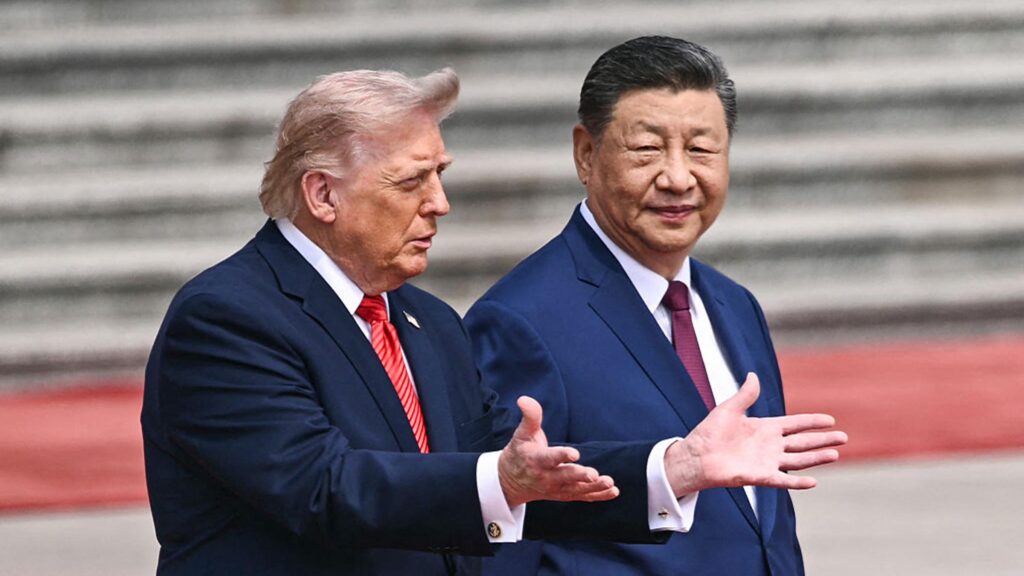
President Donald Trump returns from China today alongside a who’s who in his cabinet and some of the most recognizable faces in American business like Elon Musk and Jensen Huang. While details were thin on any actual dealmaking to emerge from the two-day trip, Trump left with an air of positivity and hinted at more to come.
The visit raised a central tension for American businesses, investors, and policymakers that isn’t going away anytime soon: how to manage China’s growing prowess and relevance in sectors like the auto industry. Thanks to government investment, China’s auto industry produces more cars than any other country. And, increasingly, those cars are higher value electric vehicles that have uptake across the rest of the world. Leaders across government and the private sector know this is a problem, but they have yet to grapple fully with the potential collision course ahead as Chinese EVs—and indeed cleantech more broadly—increasingly put pressure on American companies.
As Trump floated the idea of China ramping up investment in the U.S. ahead of the summit, industry executives balked, including and especially executives from the auto sector, alongside legislators and other influential officials. On April 29, a bipartisan group of members of congress, for example, pushed a measure to codify restrictions on imports of internet-connected vehicles from countries that pose a national security risk, targeting China. Opponents of Chinese cars have also suggested that the administration could extend and raise the existing 100% tariffs on Chinese cars or introduce a full ban.
Even if Chinese investment could be a boon for the U.S. economy, China trade hawks argue, the companies that would set up shop and the technologies they would bring would likely harm American incumbents and undercut labor standards. Furthermore, they say with good evidence, all of that state support represents an unfair practice that runs afoul of international trade rules and would distort the American market.
Read more: The World Needs China’s Climate Technology. That’s the Dilemma
There is truth to these claims. But what is the long-term solution? When products are cheaper or better, trade barriers have historically become increasingly costly and difficult to sustain. Consumers complain. Entrepreneurs look for workarounds. Politicians flirt with buckling. Indeed, in January, Trump, who often follows political winds, suggested that he might be ok with Chinese car companies entering the U.S. market if they build local manufacturing.
Powerful well-organized coalitions are one way to hold back foreign competition. And, to that end, policymakers, executives, and think tank experts speak from a shared script today, citing the aforementioned concerns. So far they’ve been successful with China as one rare area of bipartisan agreement.
But there’s a deep disconnect between that elite consensus view on EVs and the concerns of the broader American public. Polling from the University of Chicago last year showed that Americans would prefer to buy an electric vehicle made in the U.S. But, the bigger the price difference, the more their patriotism erodes. At a $5,000 difference, more respondents say they would prefer a Chinese EV over a more expensive American car. The persistent inflation likely to result from the fallout of the Iran war, including from high fuel prices, is likely to exacerbate this challenge.
And then there’s the rest of the world’s increasing willingness to import EVs. Chinese EVs are now a common sight in Europe, Asia, and Latin America. In January, Canadian Prime Minister Mark Carney traveled to China and cut tariffs on EV imports. And Chinese automaker BYD, the world’s largest EV producer, has seen overseas sales surge more than 70% in the wake of the war in Iran.
Alarm bells should be going off in corporate America and in Washington. A solution that relies on consistent political alignment overcoming a confluence of citizen and market power is a faulty one. In the long term, something has to give.
To get this story in your inbox, sign up to TIME’s Future Proof newsletter here.
The post The U.S. Still Doesn’t Have an Answer to China’s EV Dominance appeared first on TIME.