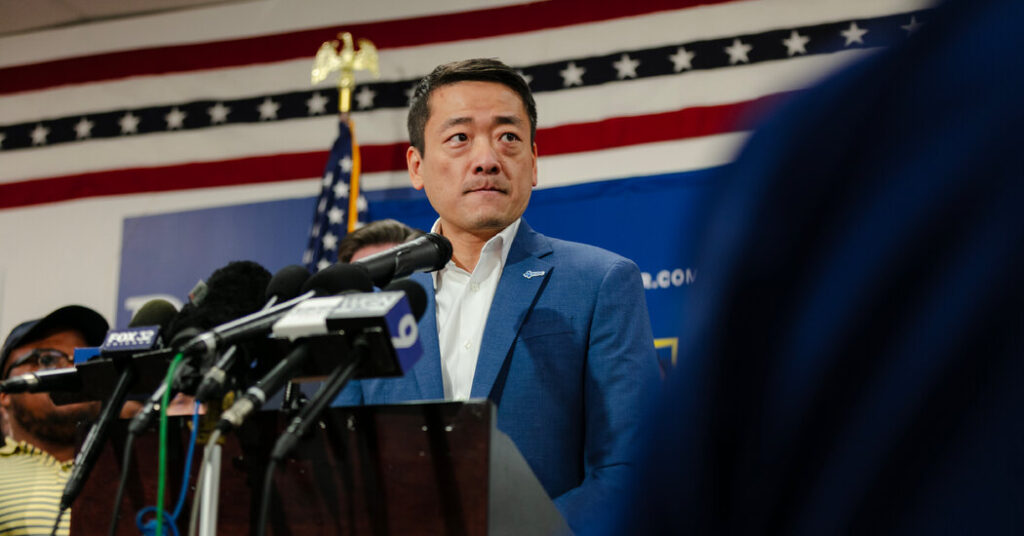
The Texas Supreme Court on Friday rejected an attempt by Gov. Greg Abbott to remove Democratic lawmakers from office, ending a high-stakes legal battle that began when the lawmakers fled the state to delay a Republican redistricting drive last year.
Chief Justice James D. Blacklock wrote in his decision that the court did not need to intervene in a political disagreement between two branches of the state government — a dispute that raised “fundamental questions about the allocation of power” — because, as a practical matter, it was already resolved.
“In the end, a quorum was restored in two weeks’ time, without judicial intervention, by the interplay of political and practical forces,” wrote Justice Blacklock, an appointee of Mr. Abbott and his former general counsel.
The court, whose nine members are all Republicans, declined to rule on whether breaking quorum was an acceptable form of political protest, or one that could result in removal from office in the future, under different circumstances.
The Texas Democrats’ departure in early August to Chicago attracted national attention to Republican redistricting efforts last year that President Trump had pushed. The political map drawing in Texas turned out to be the opening salvo in a nationwide war over partisan control of the House, one that Democrats later joined through redistricting efforts in California and other states.
The decision by Democrats to deliberately break quorum, denying the State House its necessary numbers to conduct business, enraged Republican leaders in Austin, the Texas capital. They levied fines against the absent Democrats and issued warrants seeking their return to the Capitol.
Mr. Abbott, along with Attorney General Ken Paxton, went further and sought to expel several of the Democrats who left, including the top Democratic leader in the State House, Gene Wu.
The governor and Mr. Paxton accused the members of forfeiting their offices by refusing to show up when the Legislature was called into session, and asked the court to formally remove them from office.
The state’s highest court found that doing so was not necessary because the ordinary mechanisms for compelling representatives to return to the Capitol — which are outlined in the Texas Constitution and included the use of fines and warrants — had succeeded after the lawmakers returned in mid-August.
The court did not close the door on revisiting the issue if lawmakers refused to return and the tactics that succeeded last year “unexpectedly prove inadequate in a future case.”
Texas Democrats celebrated the decision.
“When Greg Abbott threatened to arrest and expel us for denying him a quorum, we told him he should ‘come and take it,’” Mr. Wu said in a statement after the decision. “After all his bluster, he couldn’t come and take a damn thing.”
But even in apparent defeat, Mr. Abbott, too, claimed a kind of victory. His top spokesman, Andrew Mahaleris, argued that it was the governor’s legal action that had brought the Democrats back last year — and he said the governor would do it again if necessary.
“The Texas Supreme Court has warned them against pulling a similar stunt in the future,” Mr. Mahaleris said in a statement. “If Democrats abandon their offices again, the governor will bring them right back to the Texas Supreme Court.”
J. David Goodman is the Texas bureau chief for The Times, based in Houston.
The post Texas Supreme Court Rejects Abbott Effort to Remove Democrats From Office appeared first on New York Times.